Friday Severe Weather Outbreak Across the Tennessee and Ohio Valleys?

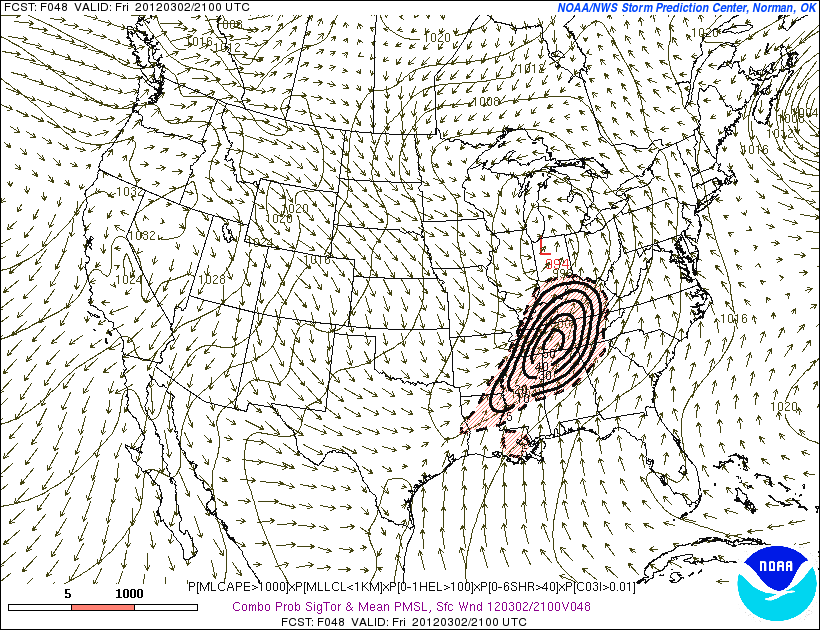
The Storm Prediction Center has outlined much of the Tennessee and Ohio Valleys in a slight risk of severe thunderstorms for Friday and Friday night. This is unusually early in the season to see a severe risk in this area, especially the Ohio Valley, so what gives?

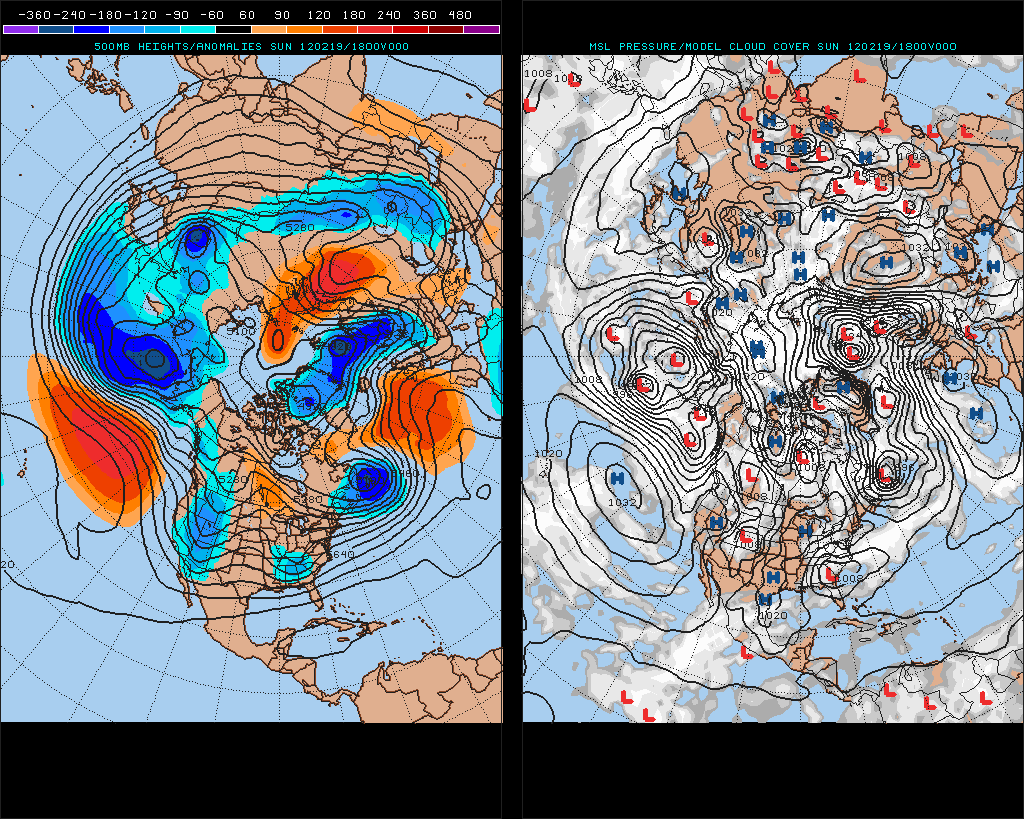
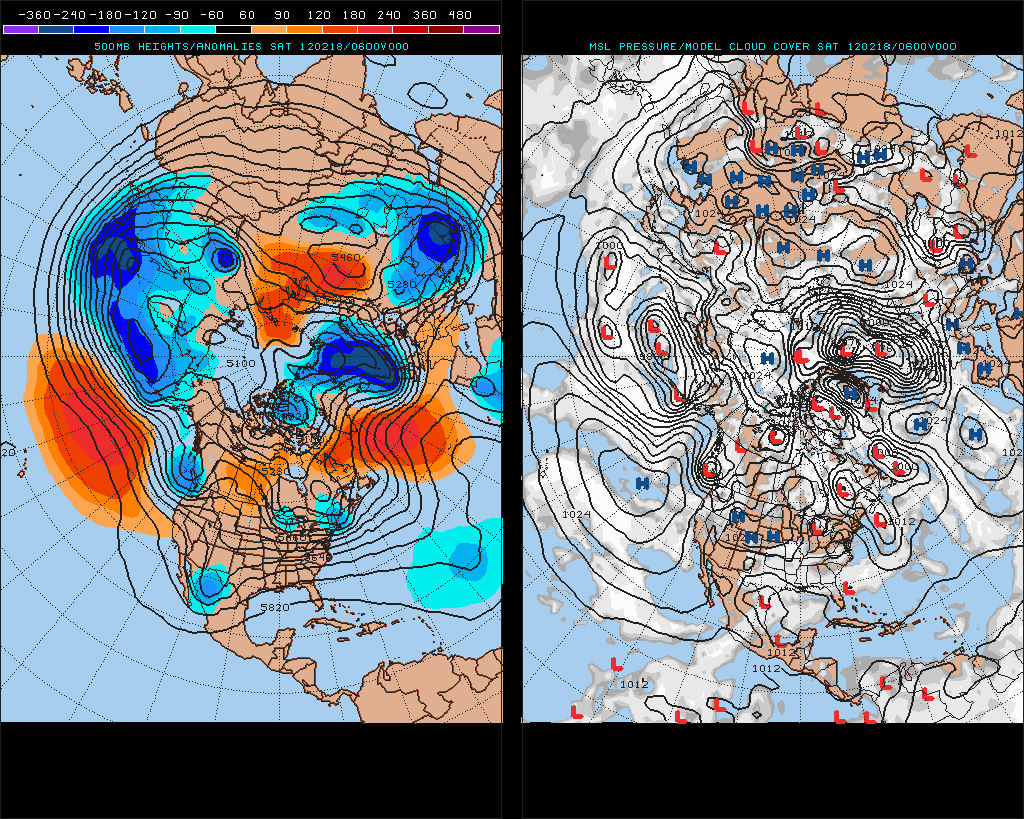
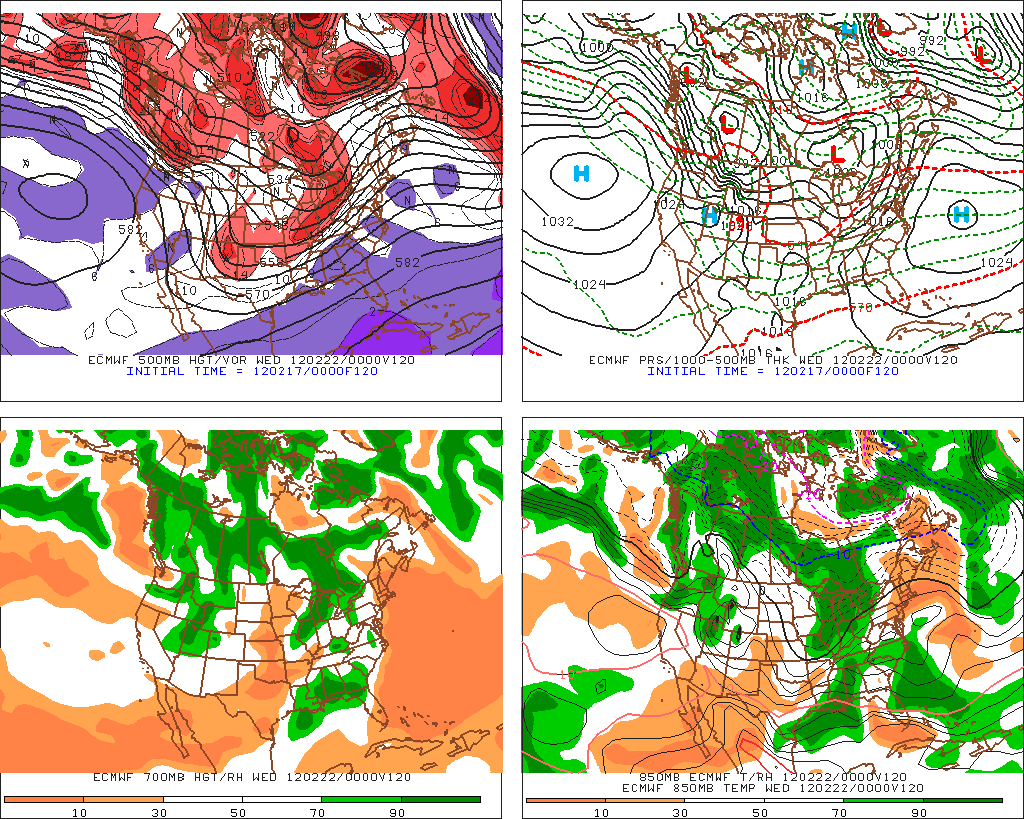
The pattern features a highly positive NAO with well below normal heights over Greenland and a negative PNA, with below normal heights on the west coast of the US. This pattern favors storms cutting north through the Plains into the Great Lakes with a southeast ridge in place, making it easier for moisture to surge northward from the Gulf of Mexico.

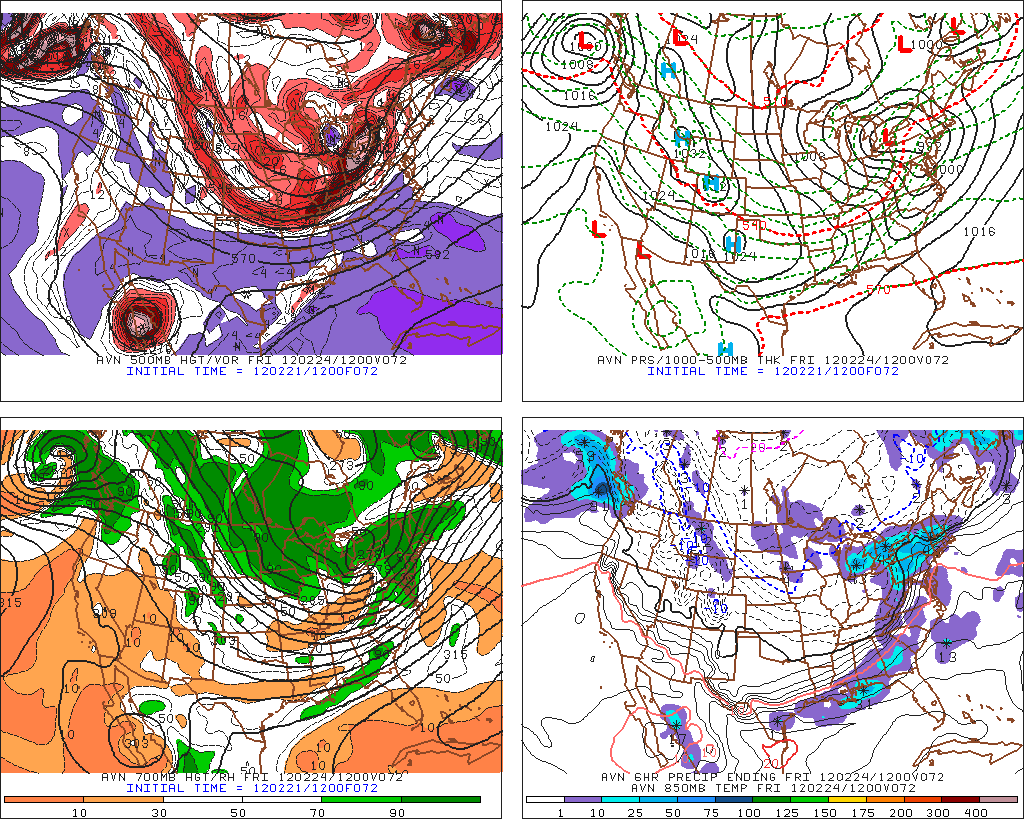
On Friday, that is exactly what happens, as an upper level trough swings east out of the Rockies. Moisture will surge north into the Tennessee and Ohio Valleys, and a low pressure that develops over the Plains and tracks into the Great Lakes Friday-Saturday will promote a strong low level flow across the warm sector over the TN/OH Valleys.

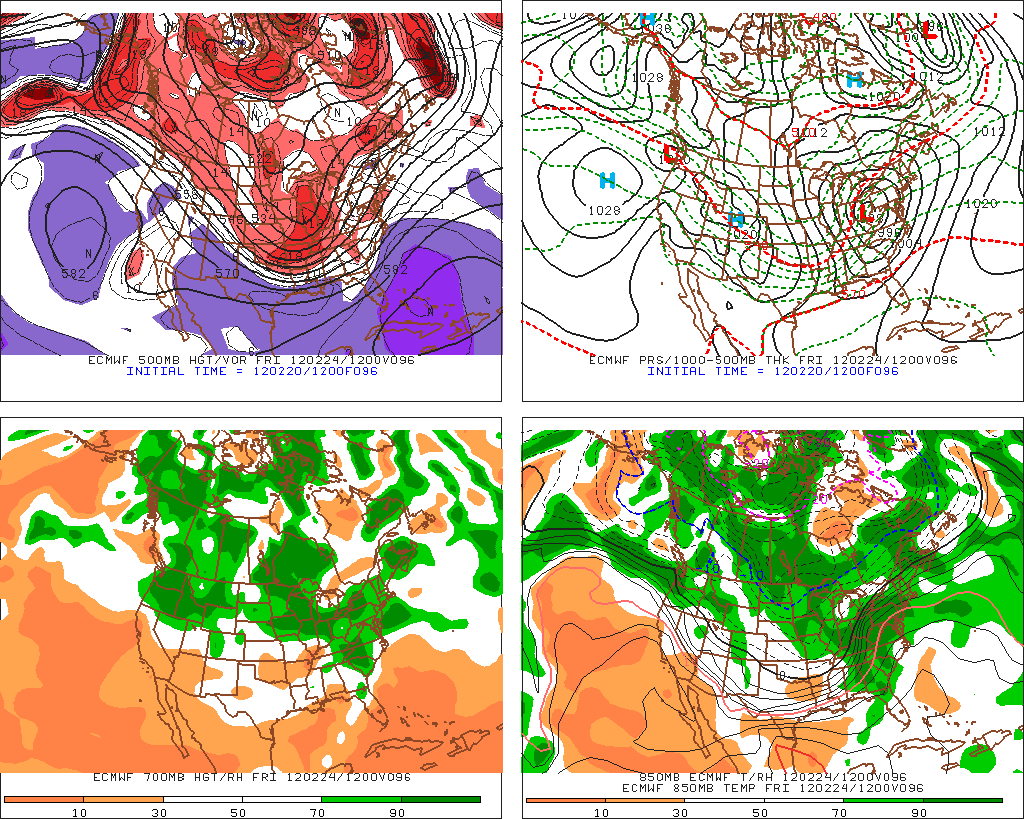
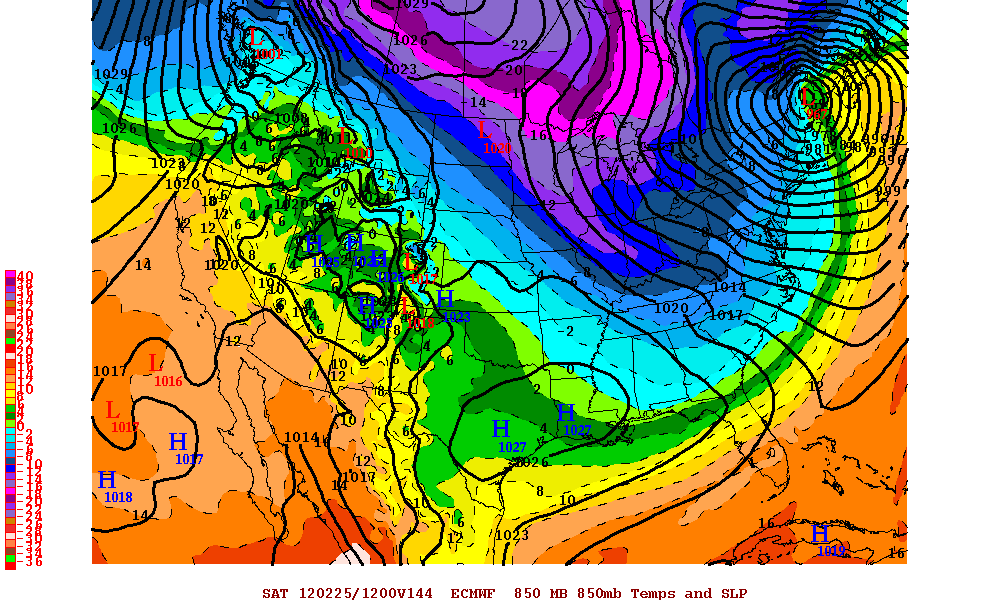
Wednesday’s 12z Euro was a bit more subdued, with a weaker wave of low pressure tracking into the lower Great Lakes, with instability limited north of the Ohio River. However, the model would support severe weather over the lower OH and TN Valleys.

Wednesday’s 12z run of the GFS was a bit farther southeast than the Euro, and more strung out with the surface low, resulting in a less significant (but still present) severe threat:

The NAM model has consistently been a bit stronger and farther NW with the surface low track, resulting in a more significant severe threat that extends into northern IN, northern OH and perhaps far southern MI. Tonight’s 0z run of the model brought a 988mb surface low through Chicago Friday evening and showed the warm front and instability into extreme lower MI:

The NAM shows a very dynamic situation, with winds at 18,000 feet above the surface of 100kts roaring across the upper Ohio Valley over an unstable airmass:

This kind of jet streak moving over an unstable airmass would result in an extensive and significant severe weather outbreak over a wide area, mainly east of the Mississippi, on Friday.

The most recent SREF’s agree, showing a large area of expected favorable conditions for tornadoes Friday afternoon into the evening:

So, we will need to watch how strong the low pressure is and where it tracks on Friday, as that will determine who sees severe and how extensive any outbreak is. I would expect a  moderate risk for severe thunderstorms to be issued by the Storm Prediction Center in subsequent outlooks from western/central TN north into much of KY into southern IN and OH, with damaging winds, large hail and several tornadoes being likely on Friday.

Thoughts and prayers go out to those killed in Wednesday’s storms and the three children murdered in Chardon, OH on Monday, and their families.

Posted in Storm Speculation | Leave a comment

Storm Forecast: February 23-25 Plains, Great Lakes, southern Ontario, Quebec, and Northeastern US Snow Event

A potent shortwave can be seen diving into the northwestern US this evening. This shortwave will carve out a trough over the central US and will be the catalyst of a moderate snow event from portions of the central US points eastward starting Thursday.
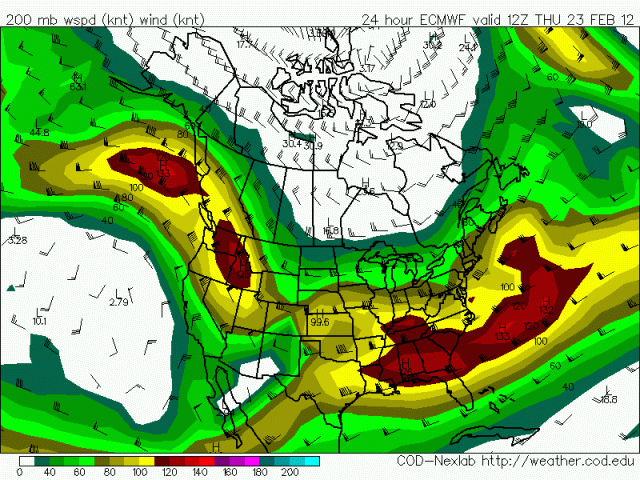
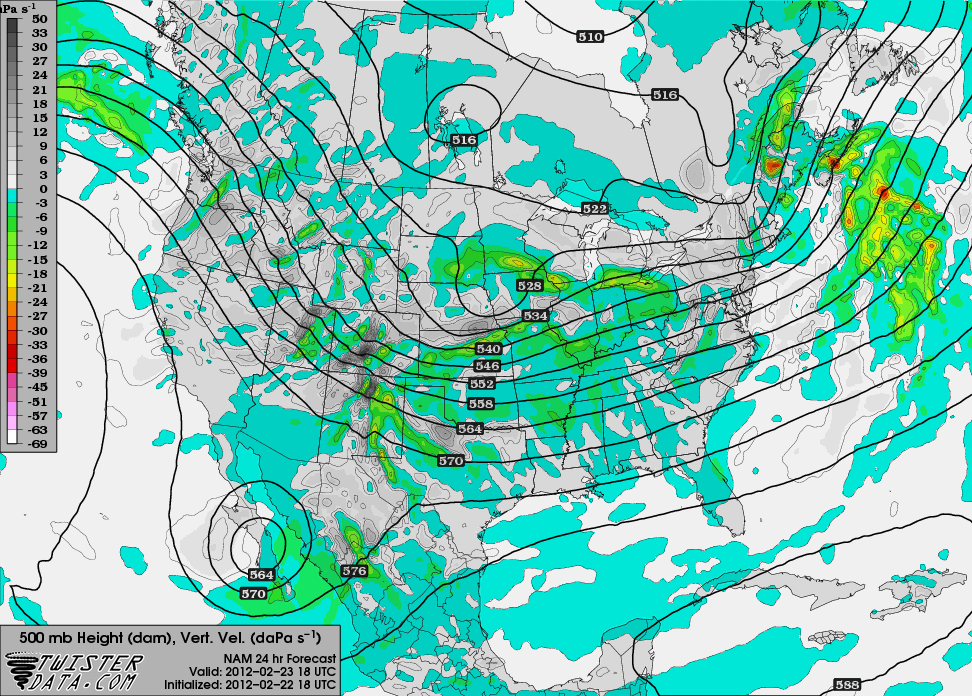
As the jet streak with the aforementioned shortwave rounds the base of the developing trough over the Plains Thursday morning, upper level divergence caused by the jet streak should encourage surface low pressure development over the central Plains along a relatively strong baroclinic zone. Initially snow will be caused by the mid level shortwave creating notable height falls and lift along with mid level frontogenesis Thursday as it dives into the Plains…note the potent mid level shortwave and associated lift as shown on the 18z NAM, valid Thursday afternoon:
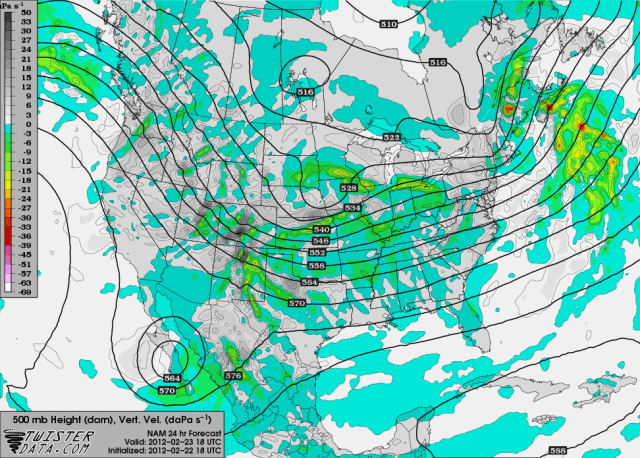
The Euro, UKMET and Canadian (CMC) models are all a bit slower and farther south than the NAM solution (shown above) and the GFS solution…however, it should be noted that the 18z run of the NAM (shown above) is a bit slower and farther south with the mid level energy than the previous run, which is a trend towards the non-American model camp.

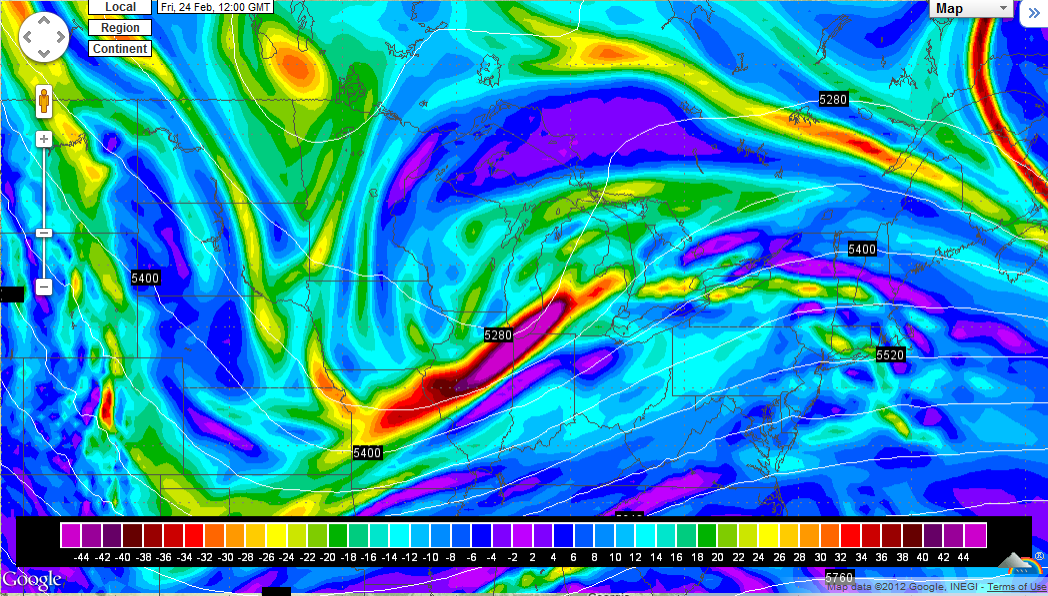
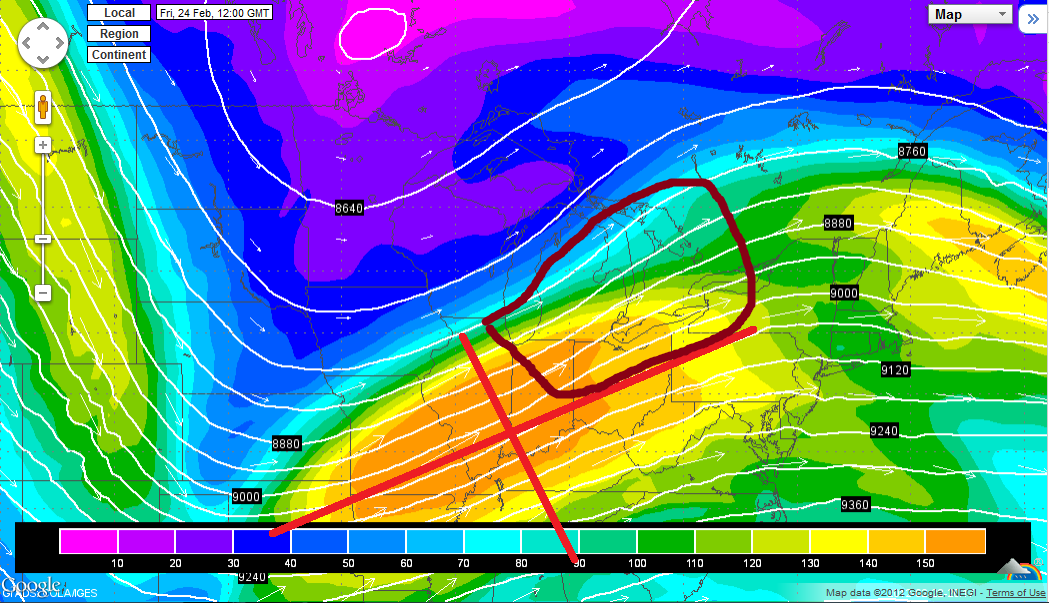
Eventually, the jet streak associated with the shortwave diving into the Plains will partially phase with the subtropical jet stream…and although the cut off energy that has been previously discussed will remain out of the picture and over Mexico through the duration of this event, the phasing of the northern branch jet streak with the subtropical jet stream will create a 150kt speed max in the upper level jet stream, and the large scale lift in the left-exit portion of this powerful jet streak will allow the storm to deepen.

The main difference in the model camps (GFS/NAM/SREF vs. ECM/CMC/UKMET) lies in exactly how fast/far south the northern shortwave tracks and when the streams partially phase…

-The GFS and NAM are a bit faster with the northern branch energy initially, leading to an earlier phase and a storm that hooks a bit harder to the north by Friday morning. This also results in the storm tracking east a bit faster than the foreign models show.

-The Euro, CMC, and UKMET are a bit slower with the northern branch energy and do not amplify it as fast, resulting in the partial phase occurring a bit further east, resulting in the storm strengthening a bit farther east, resulting in a more southerly track overall.
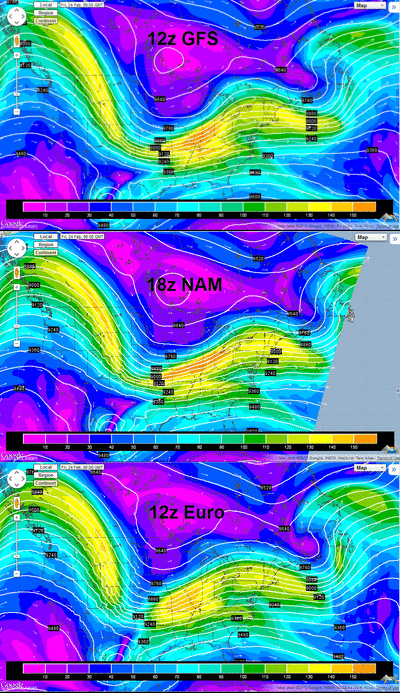
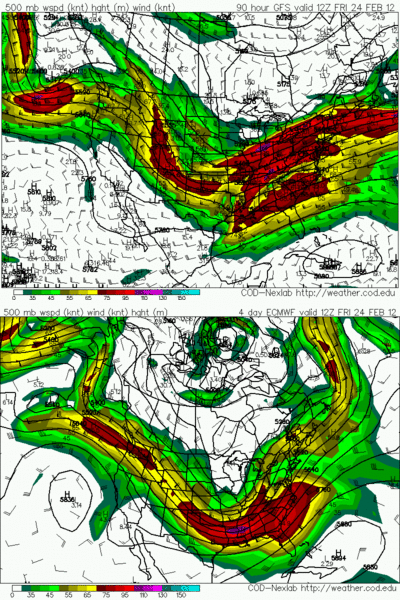
The differences in the speed/amplitude of the northern branch shortwave and phasing can be seen well in the above comparison of the 12z Euro/GFS and 18z NAM’s depiction of 300mb wind speeds valid 6z Friday…The GFS is the farthest east and along with the NAM is fairly well phased by this point, with the NAM a bit slower with the shortwave but still fairly amped up, while the Euro is the slowest with the shortwave and is just starting to phase the northern branch and southern branch, resulting in a storm that tracks farther south and a bit slower than what the American models currently show.
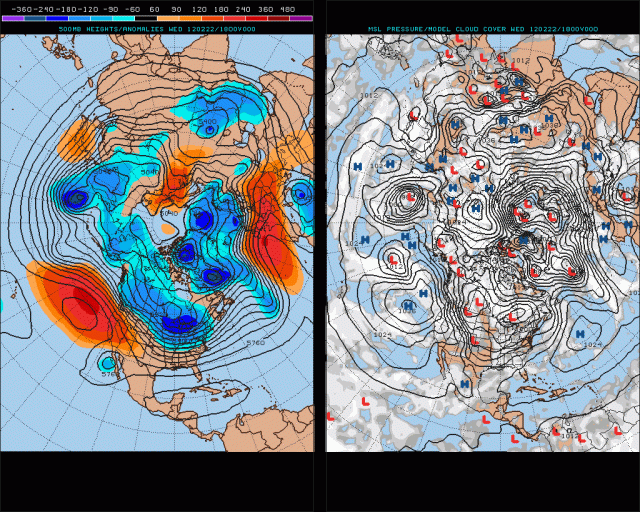
Given the current lack of any blocking on our side of the hemisphere, I believe the less amplified (and thus further south) storm track is more likely…in addition, current observations indicate that today’s GFS/NAM runs are a bit too fast with the low pressure.

For this forecast I will assume a track close to the Euro/UKMET will verify.

As for how much snow will fall and where…as mentioned above, strong mid level lift associated with the northern shortwave diving into the Plains through Thursday will result in a swath of snowfall. The intense lift associated with this feature will likely result in a narrow swath of 6”+ high ratio snowfall from the Dakotas south into Iowa.

The precip shied will begin to expand Thursday night as partial phasing with the subtropical jet stream will occur and as large scale lift and mid level frontogenesis increase to the north of the surface low track…

Note how by 6am (CST) Friday, the Euro shows a small area of very intense positive vorticity and height falls over the Great Lakes region. This will result in positive vorticity advection which will combine with decent height falls and large scale lift in the left-exit portion of an upper level jet streak to produce heavy precipitation rates in a relatively narrow corridor to the north of the mid level low track.

To illustrate the upper level divergence created by the jet streak associated with the storm, note the Euro model valid for Friday morning with the quadrants of the upper level jet streak drawn on…also, note how the height lines spread out in the left-exit portion of the jet streak, representing upper level divergence which encourages large scale lift under that portion of the jet streak.

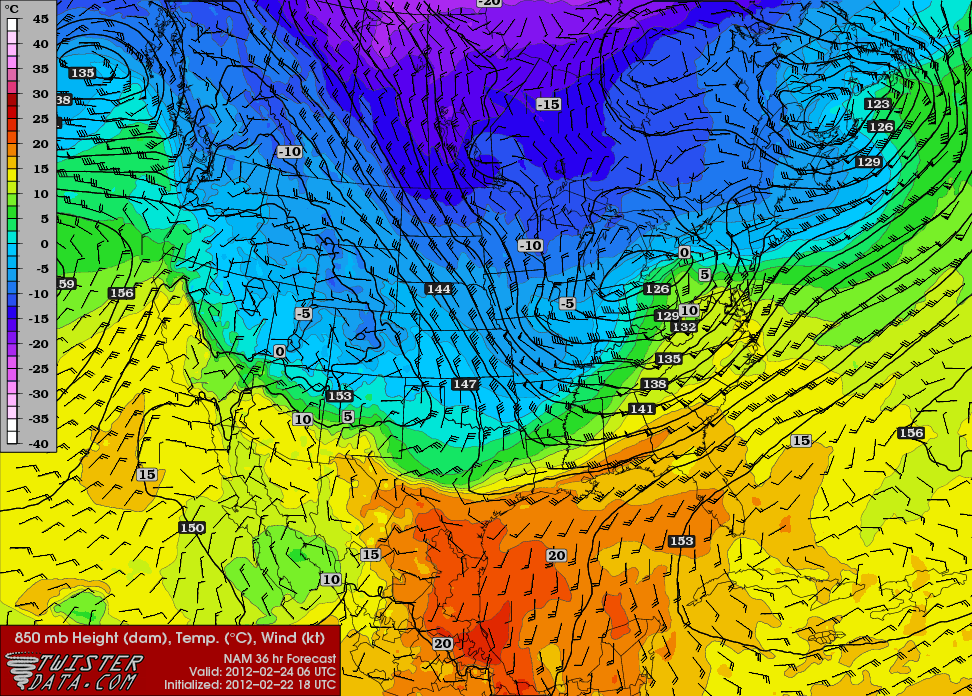
To illustrate a point, also note the 18z NAM’s depiction of converging mid level winds and temp gradient just north of the mid level low:

This all indicates a likelihood for mesoscale banding and heavy snow rates just north of the mid level low track…but given the progressive pattern and speed of the system, this snow will last 12-18 hours to the north of the mid level low, likely limiting amounts somewhat.

In addition to banded deformation snows to the northwest of the mid level low, overrunning precip will increase dramatically Thursday night as the low pressure system intensifies and the low to mid level jets increase, creating decent low to mid level lift to the east of the strengthening low pressure…note the strong H85 jet shown developing by the 12z Euro Friday morning to the east of the mid level low:
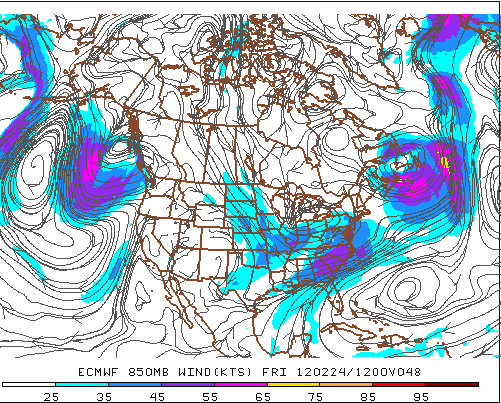
This will result in light to moderate snows breaking out over Upstate NY, southern Ontario and eventually east into northern New England east of the mid level low. This may add a couple to a few inches of snow where the overrunning precip falls as snow.

For precip type, I believe boundary layer temperatures will be overcome, especially along and north of the mid level low track as dynamic cooling becomes dominant after dark due to the expected moderate to heavy precip rates north of the mid level low track…note how the ECM shows temperatures nearing or plunging below freezing at the surface by Friday morning just north of the surface low track:
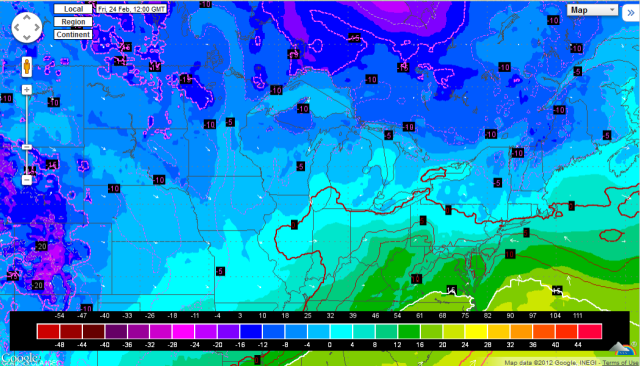
The boundary layer may be more of an issue during over western IL/IA when the heaviest precip will fall during the day Thursday. Elsewhere, I believe where mid level temps are cold enough for snow, surface temps will relatively quickly cool enough for snow to reach the ground and accumulate.

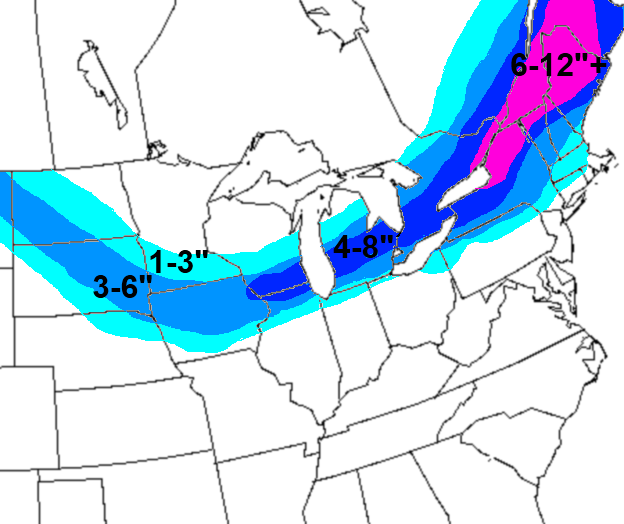
For accumulations east of the Plains, given the 12 hour +/- duration of snow over IA/northern IL/WI, with a burst of moderate to heavy snow likely, will go with a 3-6” of snow where I believe precip will fall as all snow. Farther east, dynamics will improve, duration will improve somewhat especially as overrunning precip becomes more widespread ahead of the storm, and a good portion of the snow will fall as night…therefore, will slightly broaden the swath of heavier snow and increase max amounts to 8”. The bullseye will likely be over the eastern lakes east into southern Ontario and Quebec, where locally 10” will be possible.

Despite the intense dynamics and likely heavy rates in banding, the wet nature of the snow and relatively short duration will keep amounts from getting out of control.

An additional few inches of snow will likely fall in the favored NW flow Great Lake Snow Belts with a marginally cool but moist airmass and cyclonic flow behind the storm. I will not really try to show this in the forecast for the synoptic snows, shown below.

My first and likely final call:
Posted in Storm Forecasts | Tagged , , , , | Leave a comment

Is the Upper Midwest the Place to Be?

For snow-lovers to begin the next work-week, it just may be.

In previous blog posts, I discussed the trough that will eject from the west to end the month of February and the potential ramifications over the central and eastern US, which include a swath of accumulating snows and potentially severe weather.

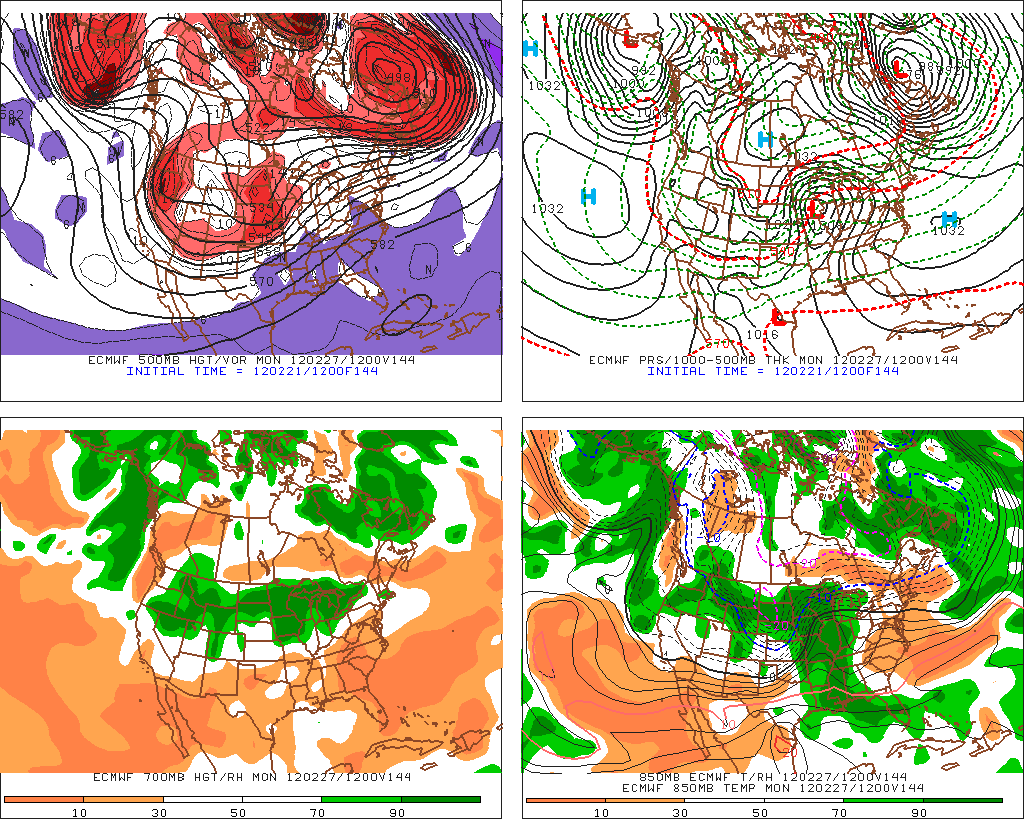
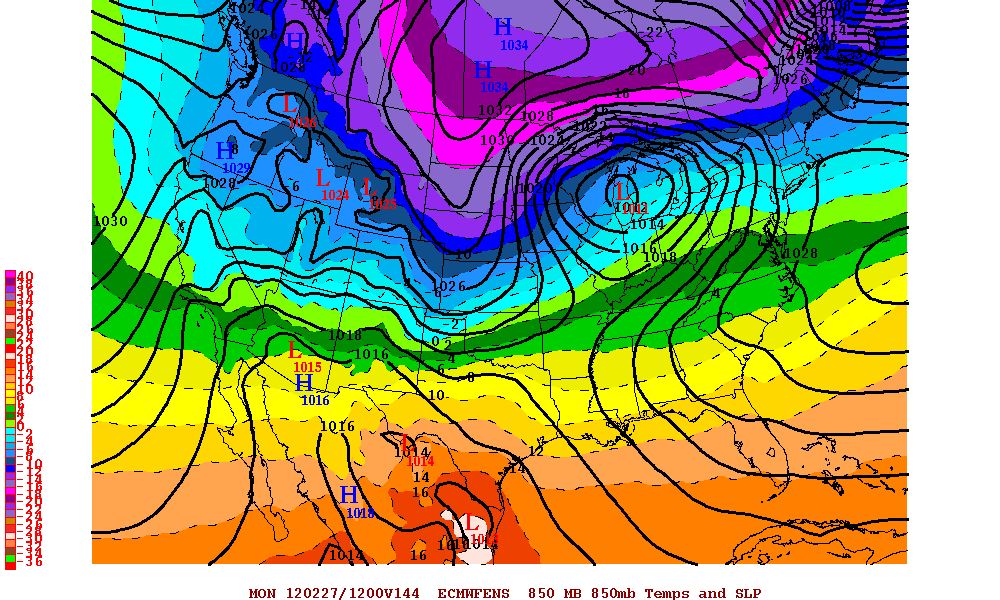
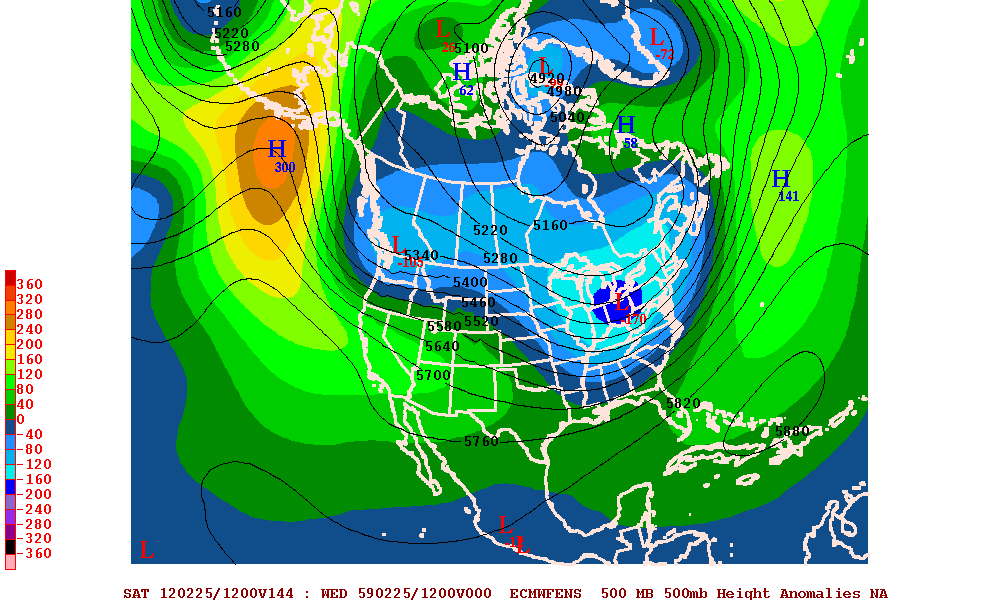
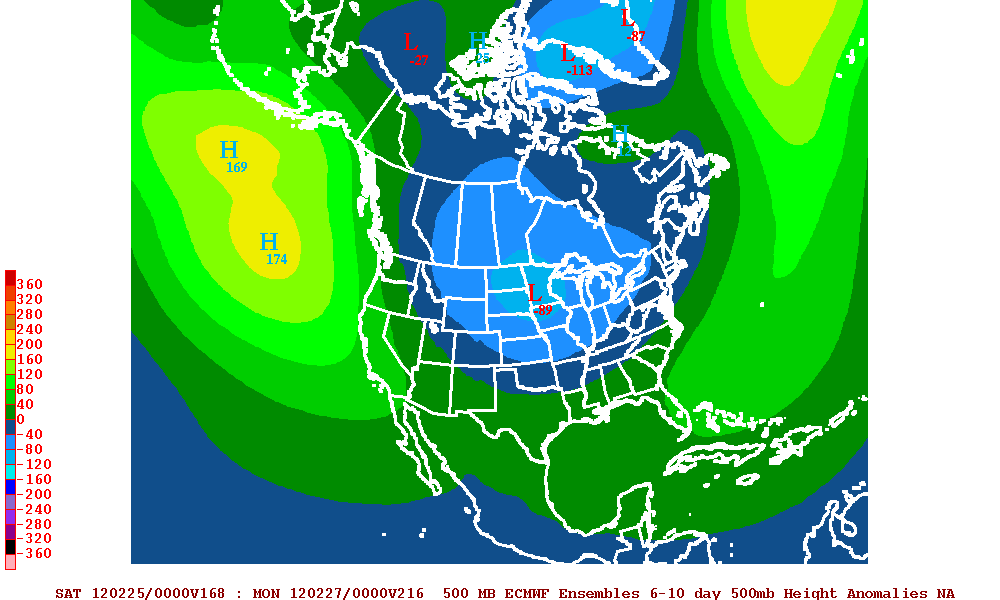
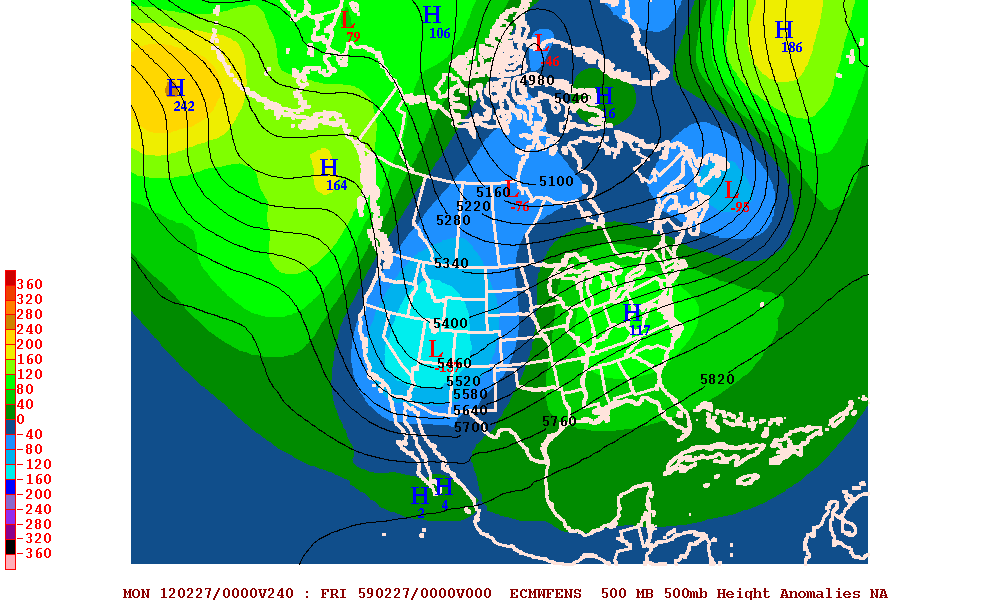
The above capture of the 12z European model (ECMWF) ensemble means shows what the landscape will look like following the weekend storm over the northeast US that has been discussed in previous posts. The weekend storm, by most accounts, will deepen significantly over southeastern Canada and temporarily raise heights over the Davis Strait, allowing for a transient psuedo -NAO and 50/50 low to form Sunday before the fast nature of the pattern forces the NAO to return to a positive state and heights to rise over the eastern US.

At the same time, ridging will thumb its way into southern Alaska and help carve out a trough over the Rockies. This trough will eject east into the central and eventually northeastern US starting Sunday, but it now appears the trough will eject east in pieces, resulting in more than one low pressure riding through the northern tier of the central US/southern Canada as opposed to one large storm cutting through the upper Midwest.

The first piece of energy will eject Sunday and reach Ontario by Monday evening. As one would expect, there are some variable model solutions with this ejecting energy…

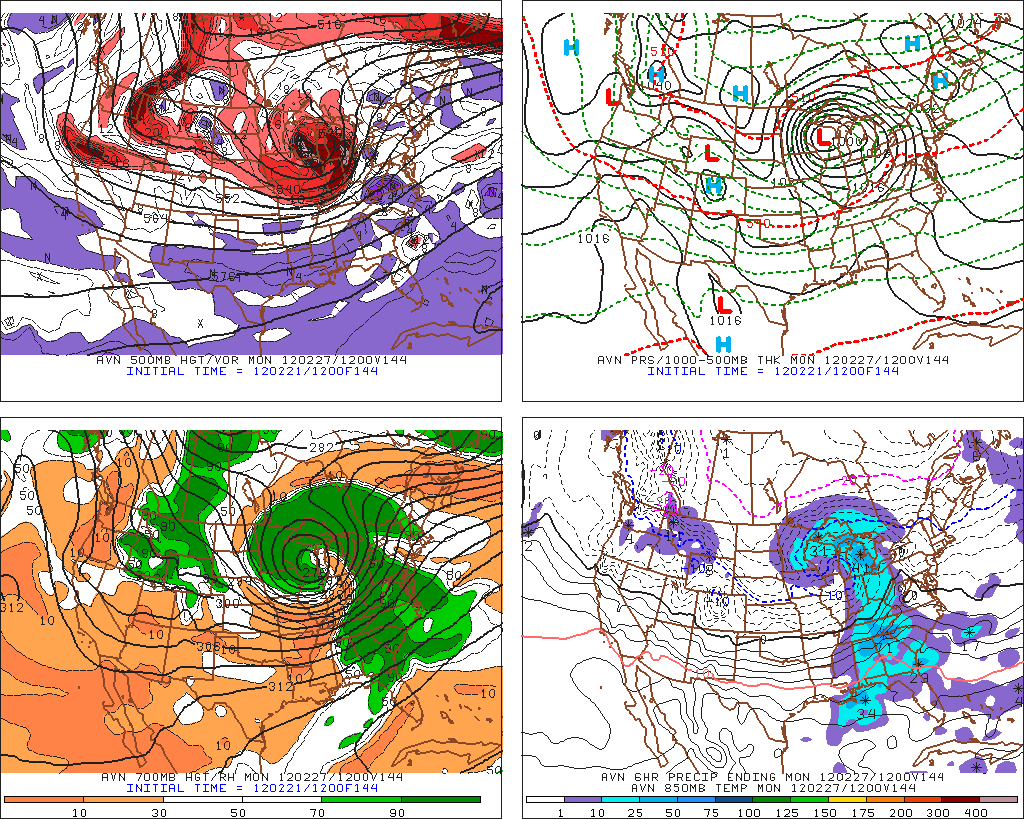
The 12z ECM shows a storm that ejects from the TX/OK Panhandle area and moves ENE into WI before deepening and cutting northeastward into the UP of MI by Monday evening. This solution would bring a swath of snow to the northern Plains east into northern IA, southern and eastern MN and a good chunk of WI and northern MI.

The 12z GFS was not much different than the 12z ECM in the end…the GFS is a bit north with the low track early on and does not cut the low to the northwest of the Great Lakes as sharply as the ECM does, but the end tracks and end results are not too far off. It should be noted however that the GFS is several hours faster in taking the low pressure east than the ECM.

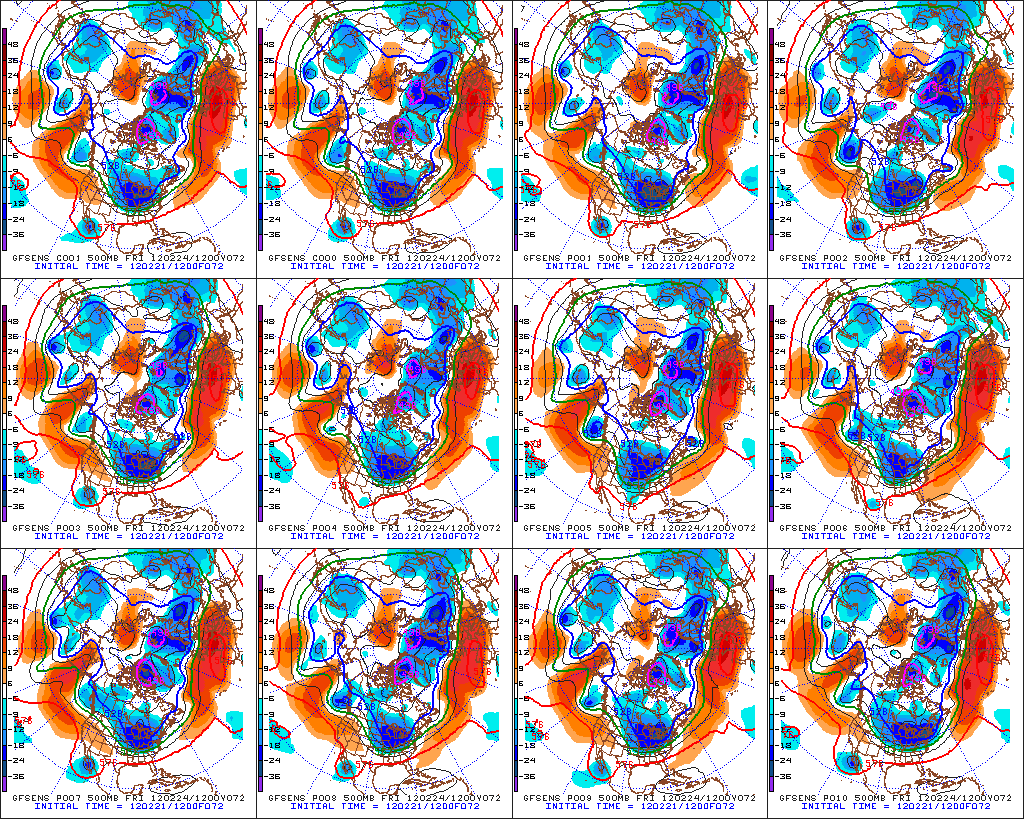
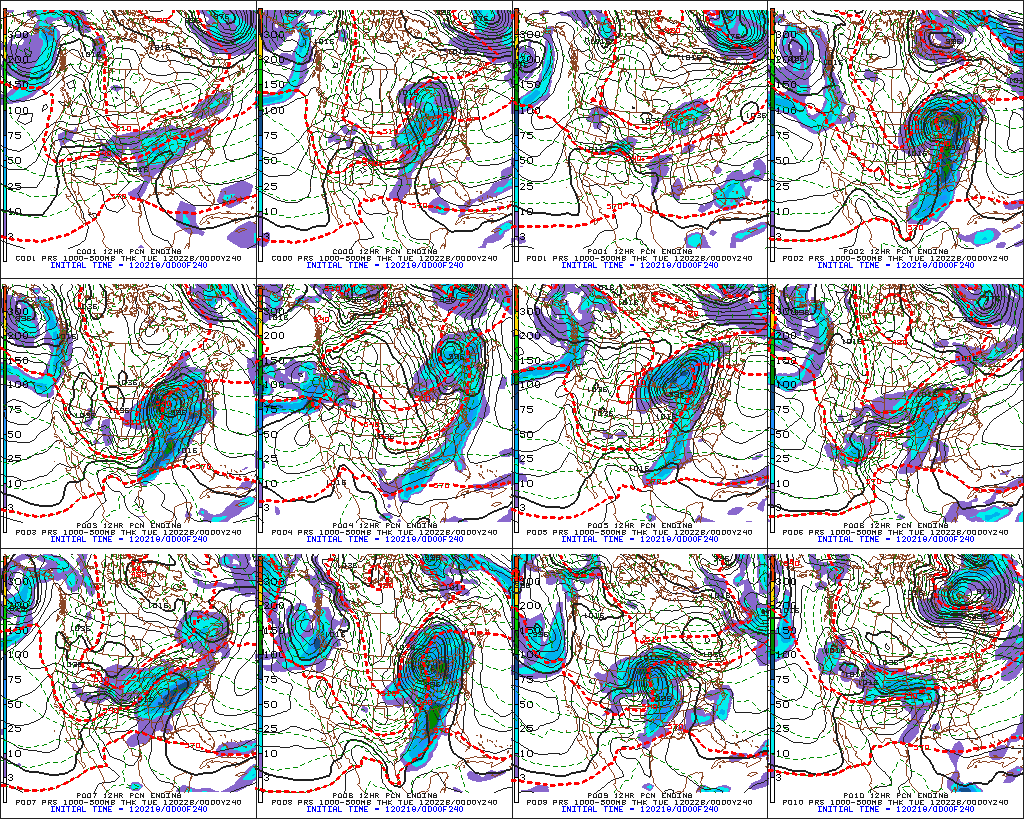
The 12z GFS ensembles however show more variation than the operational GFS/ECM have in their solutions. The ensembles show a wide range of solutions, from a weaker storm that ejects faster and tracks a bit farther south, to a wound up solution over the western lakes by Monday morning like the operational models are currently showing, to in one case almost no storm at all.

The 12z ECM ensemble mean shows a solution that is a bit faster and a bit flatter than both of the operational models, which seems to be the trend amongst the GFS ensembles as well, sans a few members.

So, what solution is most likely?

My initial inclination would be to expect the slightly more progressive (faster) and farther south solution with less of a hook north into Lake Superior than the operational models show. When referencing the large scale pattern shown in the European model ensemble mean to open the post, my logic is fairly simple:

Although brief, confluence from the departing storm over eastern Canada will favor a high pressure over south-central Canada that will make it hard for a storm to hook north.

However, there are some factors that may allow for the more NW track to win out…

The 12z GFS, shown above, was close to digging the northern stream shortwave far enough south to partially phase with the subtropical jet stream energy. If phasing were to occur, the jet streak would intensify, divergence in the left-exit portion of the jet streak (which the SLP will be co-located with) would increase and the storm would intensify faster, allowing the shortwave associated with the storm to take on a negative tilt west of the lakes and allow for a nice left-hook in the surface low track

As also noted above, the NAO will quickly return to a positive state by Monday and southeast ridging will try to develop. This may allow heights east of the Great Lakes to rise enough to help the storm take on a negative tilt west of the Great Lakes.

Given seasonal trends and the fast nature of the pattern, I will for now favor the less amplified solution which may allow good snows to get into much of IA/WI/MI Sunday night into Monday, however we will need to watch for a potential partial phase between the northern and southern branches of the jet stream and rising heights east of the Great Lakes, as those factors may allow for the more amplified solution to play out.

The very cold air and Canadian high pressure just north of the surface low should allow for a nice band of powdery snows and high winds to the north/west of the low track in either solution.

More tomorrow,

Jim.

Posted in Storm Speculation | Tagged , | Leave a comment

Model Support for a Triple Phasing Blizzard on Friday Dwindling

A slug of moisture associated with the northern branch of the jet stream is beginning to impact the northwestern US. It is this energy that will carve out a trough over the central US and eventually Great Lakes and New England, and potentially cause a storm system to develop over the eastern Lakes into New England and southeast Canada.

This afternoon’s runs of the GFS and European (ECMWF) models continue to show drastically different solutions with the potential Friday storm, but a trend since yesterday afternoon’s models has been clear.

This afternoon’s (12z) run of the GFS model shows the cut-off energy associated with the sub-tropical jet stream hanging back and NOT PHASING with the trough carved out over the north-central US. This is due to the trough over the northern US being a bit flatter and faster, not allowing it to quite reach the sub-tropical jet stream energy.

The 12z GFS ensembles for the most part agree with the operational GFS. Note how the majority of the members shown on the above image show the trough over the northern US (denoted by blue shading) bi-passing the cut off energy over northern Mexico. This is a strong trend against an extremely deep and phased cyclone.

The 12z ECMWF, shown above, still phases the northern trough with the southern cut off low. Note how the cut off energy has been drawn east and is about to be absorbed by the trough in the above image. The model does still wind up a decently strong low pressure, in the 980MB range in the St. Lawrence Valley, by Saturday morning. However, it should be noted that the ECMWF, when compared to yesterday’s run featured in my previous post, is slower with the phase and shows a low that is about 20mb weaker in the end! Although the European model remains in the “phased storm” camp, it has trended weaker with the phase and eventual storm over the eastern Lakes into northern New England and southeast Canada.

The large scale pattern, IMO, continues to argue against enough amplification to see a full phase with the subtropical cut-off energy. While ridging is building off the west coast, there is still a clearly seen fast flow off the Pacific on the above image as the northern trough tries to dig down into the Plain States. Note the tightly packed height lines along the west coast of the US, representing a fast flow. It is hard to get a fast flow to buckle.

Also, note the lack of true lacking over the Arctic or over the northwest Atlantic. This insures a fast flow in the polar jet all across the US, and will make it hard for the jet to buckle and dig down into the Gulf Coast states and tap the sub-tropical jet-stream moisture/energy.

Given this, the trend away from a wound up storm since yesterday is a logical one. And there has been a clear trend.

Yesterday evening I posted that both the 18z GFS and its ensembles trended away from the wound up and phased solution that the 12z GFS suite seemed to favor. Since then, last night’s 0z GFS suite, 6z suite, and now 12z suite have for the most part shied away from a more phased and wound up solution.

Even the European model, which had led the way with the phased and very deep solution, shows a later phase and weaker storm in its most recent run.

In my post last evening, I said there were a few things to watch for regarding this upcoming storm threat:

1. Does the subtropical jet energy trend weaker or stronger? A weaker piece of energy may mean a weaker storm.

The energy has not trended weaker or stronger.

2. Does the subtropical jet energy trend faster or slower? A slower solution might get left behind by the polar branch shortwave, while a faster one may mean phasing does not occur until the system is off the east coast.

The energy has trended slower, meaning it is increasingly likely that the northern trough bypasses it to the north/east.

3. Does the polar jet trend more zonal? This makes a phased solution less likely. A more amplified polar jet may make the amped up solution more likely.

The polar jet/northern trough has trended more zonal, which is represented well by the lack of phasing by the GFS suite.

So, while it is still to early to completely discount the Euro’s more phased solution, I believe the unphased solution should be more favored than yesterday, and has the best chance of winning out.

This may result in a light to moderate snow event from the lower Great Lakes points east if the northern trough can dig enough for a wave of low pressure to develop along the cold front diving southeast with the trough.

Posted in Storm Speculation | Tagged , , | Leave a comment

Will Winter Return With a Vengeance for Friday?

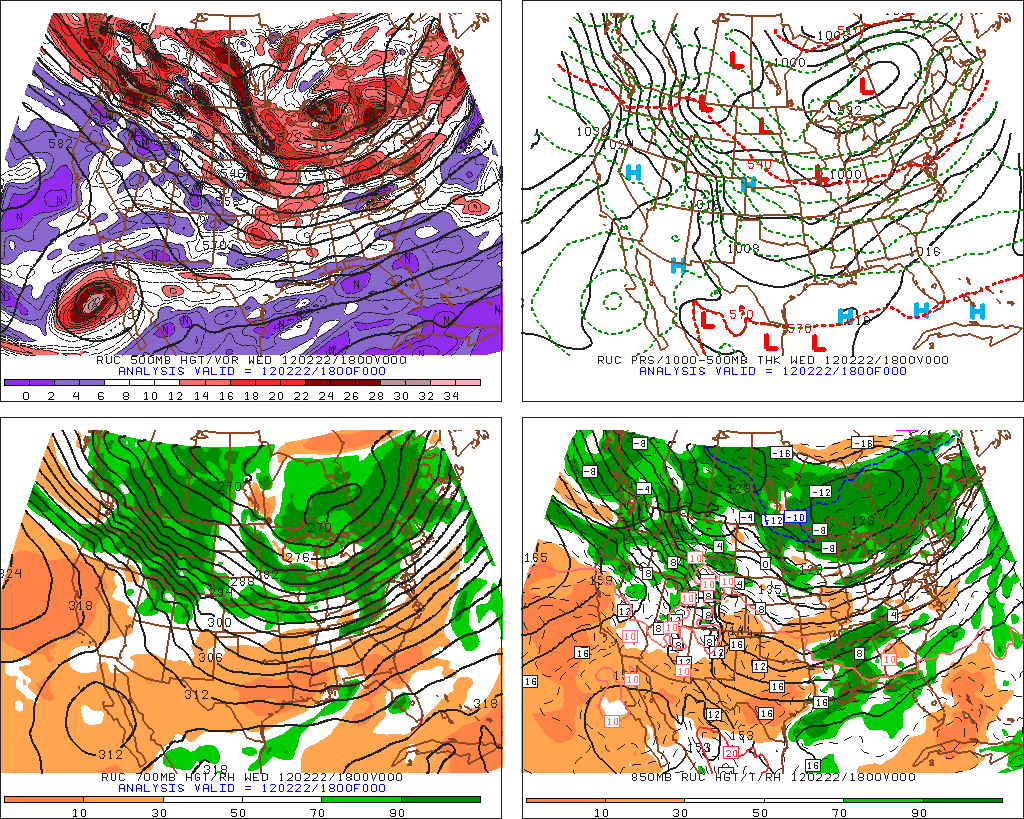
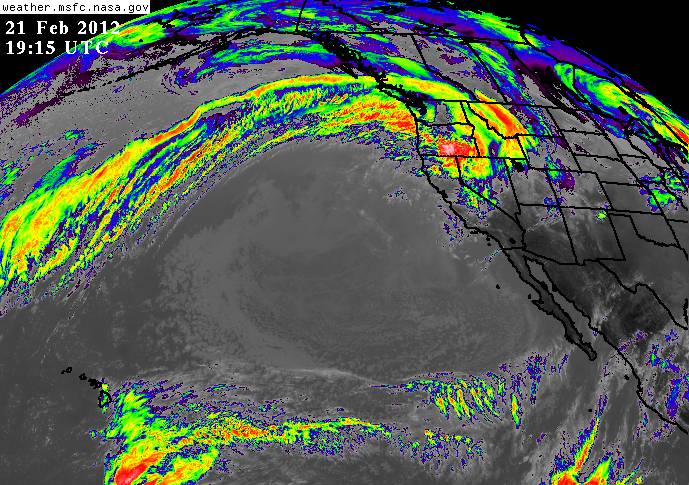
A very dynamic weather pattern is developing off the west coast of N. American, with a ridge off the coast causing a very active polar (blue) jet stream to ride over the ridge and dive southeast into the Rockies. As one can see above, there are multiple mid to upper level storms embedded within the polar jet stream, and these will move into the US over the coming days. Farther south, a feed of moisture extends from the tropics into Mexico and the Gulf Coast States.

As the ridging off the west coast continues to build in the coming days, storms will gradually move farther south, and may eventually tap the moisture feed and produce widespread areas of heavier precipitation.

As we look ahead to Thursday, it is evident that ridging off the west coast of the US extends north into Alaska, with energy dropping into the Rockies and trying to spread east. In addition, a moist piece of subtropical jet stream energy, seen on the above image by the blue shades over south Texas and northern Mexico, is advancing to the east-northeast, and is coming dangerously close to interacting with the trough developing over the Plain states. In the arctic, some weak ridging has developed over extreme northwestern Canada, indicating a neutral AO, however an upper level low is expected to remain in place over Greenland, keeping the NAO positive. This supports southeast ridging, and will make it hard for the pattern to slow down and amplify.

As for what happens next, we have many solutions being shown…the 12z European model (ECMWF) and to some extent its ensembles show a clean phase between the moist subtropical energy and the polar jet energy diving in from the northwest Thursday into Friday, resulting in a deep low pressure developing over the Ohio Valley and riding into the eastern Great Lakes by Friday morning:

The Euro continues to bring a deep storm into eastern Canada, and actually shows what would be close to a blizzard over a good portion of southeastern Canada Friday into Saturday:

Today’s run of the ECMWF is actually much deeper and farther west with this potential Thursday-Saturday storm than yesterday’s run, which I declared to be unlikely in my blog post last night.

The GFS and its ensembles continue to play a game of cat and mouse…yesterday afternoon’s (12z) run of the GFS and its ensembles almost unanimously disagreed with the amped up ECM solution for this storm…then the 0z run came around, and the GFS ensembles had several members jump to the amplified European model solution:

Several members showed a very wound up low tracking through the eastern Great Lakes or New England/Southeast Canada with an area of accumulating snows and high winds to the west of the low track.

Then, this afternoon’s 12z runs of the GFS ensembles had several members, at least half, develop a very strong area of low pressure with heavy snow and wind somewhere between the eastern Great Lakes and the Northeastern Seaboard.

This evening’s 18z run of the GFS ensembles, shown above, backed off the deep low cutting well west of the east coast idea some, but several members still have the deep storm tracking well west of the east coast.

So, what exactly determines if we see a deep storm develop Thursday into Friday and where it tracks?

Essentially, it has to do with if the trough developing over the central US can phase with the piece of moist subtropical jet-stream energy moving across the Deep South before the energy slides off the east coast.

The 12z Euro (which showed a deep storm bombing over the eastern Lakes) when compared to the 18z GFS (which did not show a deep storm bombing over the eastern lakes) valid at 12z Thursday, about one day before any deep storm would really bomb out, shows differences already. The GFS is a bit flatter with the polar jet across the US and is a bit faster with the polar jet energy. In addition, the Euro is bringing the cutoff energy east a bit faster than the GFS.

When rolled forward 24 hours, the Euro shows a well timed phase between a polar branch shortwave that digs down into the deep south and a piece of cutoff energy that moves east at just the right time, while the GFS is more zonal with the polar branch of the jet stream and is now showing the subtropical jet shortwave too far southeast to fully phase west of the Apps, resulting in a much weaker storm system.

The question becomes, which solution is more likely, phased or unphased? The trend this season has certainly been for the unphased solution to win out more times than not, and given the lack of true blocking in the current pattern, a well timed phase would need to occur for the more amped up solution to play out. Given this, I will continue to slightly favor the more weak/fast solution to play out, however model trends over the past 24 hours have been strong and the Euro has led the way thus far, so chances for a snowstorm from the eastern Lakes east in Upstate NY, New England, southern Ontario and southern/eastern Quebec have increased for Thursday night into Friday and Saturday.

What to watch with relation to this storm threat:

1. Does the subtropical jet energy trend weaker or stronger? A weaker piece of energy may mean a weaker storm.

2. Does the subtropical jet energy trend faster or slower? A slower solution might get left behind by the polar branch shortwave, while a faster one may mean phasing does not occur until the system is off the east coast.

3. Does the polar jet trend more zonal? This makes a phased solution less likely. A more amplified polar jet may make the amped up solution more likely.

As we head into next week, the active pattern will continue across much of the US. More details on that in the coming days.

Tuesday is statistically the least favorite day of the week among Americans, but I’m sure you’ll pull through!

Jim.

Posted in Storm Speculation | Leave a comment

A Northeastern US Snowstorm to end the Week?

A current look at the northern hemisphere reveals that a transient 50/50 low is allowing enough cold air into the eastern US for a storm system approaching the Atlantic seaboard to produce a swath of light to moderate snow from the Washington DC region south into parts of the Carolinas. Elsewhere, ridging is building off the west coast of the US which is forcing a trough to develop over the western US. This ridging will continue to build off the west coast, leading to a trough developing over much of the western/central US over the coming days.

As the ridging builds into Alaska in the coming days and becomes a –EPO block, temporarily, cold will build over Canada and will slowly seep southward into the northern portions of the US. At the same time, the trough will slowly move east from the western US, leading to several systems tracking across the northern US that will produce rain and swaths of light snow.

The European model ensemble mean, valid Wednesday morning, shows this transition well, with the ridging off the western coast of the US resulting in a NW flow into the northern Rockies and Plains. Because of the lack of blocking over the arctic/high latitudes, this trough will be transient, meaning it won’t remain in one place for too long. This will result in the trough being deepest over the Great Lakes region to end the week, where the best chance for multiple nuisance snow events will exist.

The best chance for any notable snows will come at the end of the week, when a piece of moist subtropical jet-stream energy, seen on the above image by the lower heights over the Baja of California, moves east and attempts to interact with the building trough and cold air over the Great Lakes.

The European model, shown above, develops a very strong low pressure late Friday into Saturday over eastern New England as it phases the subtropical jet stream energy with the trough over the Great Lakes. The European model showed a large area of 6”+ snow totals with this storm from Upstate New York east into much of New England. The question is, is the European model’s solution a viable one?

Back to the European model ensembles in the day leading up to the potential storm, there are a few things that point against the wound up operational Euro’s solution.

  1. The strongest ridging is extending up into western Alaska. This is farther west than what those of us in the northeastern US would like to see, because it favors lower than normal heights over the western US, which does not support a deep, sustained trough over the eastern US.
  2. There are lower than normal heights over Greenland, which again does not support a deep or sustained trough over the eastern US.

By 144 hours, a shortwave is digging on the west coast and the trough over the eastern US/Great Lakes is already dampening out, the flow is trying to become zonal.

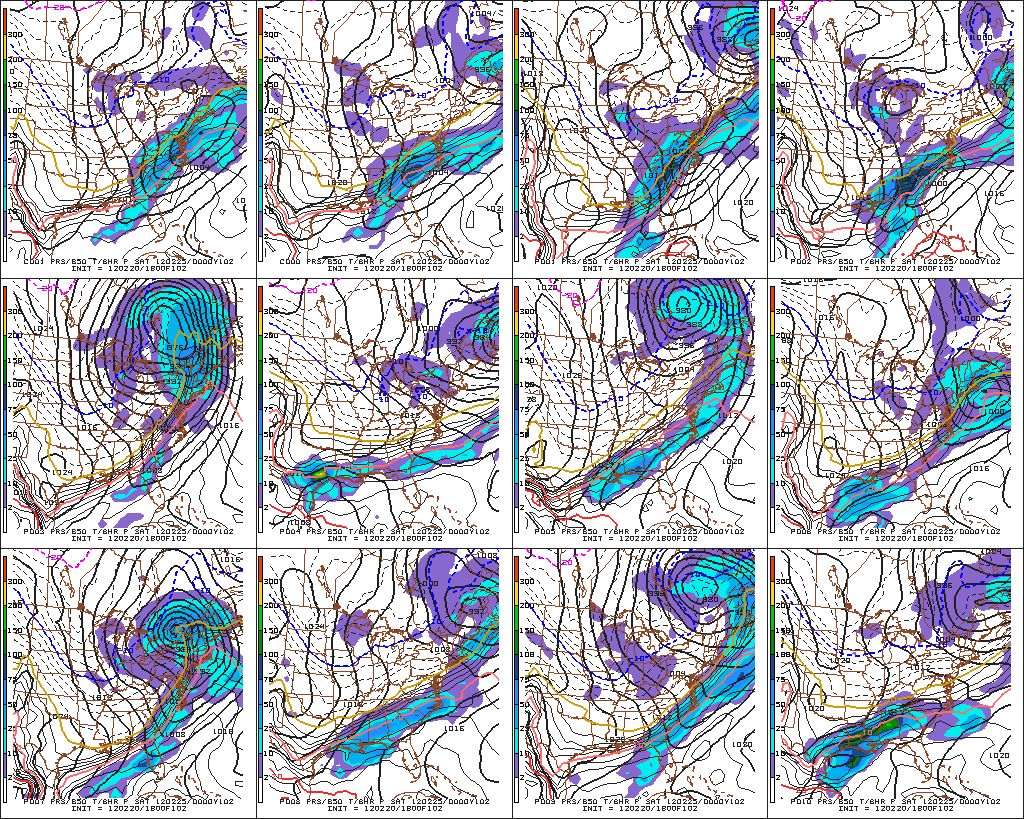
The ensembles do develop a storm in this time frame, but show it tracking farther east than the operational European model…they also show a weaker solution, but because the ensemble mean or average is shown, this does not necessarily mean that some ensemble members are not also showing a deep storm in this timeframe:

However, because of an unfavorable Atlantic and Pacific for a significant snowstorm over Upstate New York and New England in this timeframe, I believe the European model solution that was very deep and farther west with this storm is an unlikely solution. A more likely solution is a weaker frontal wave of low pressure with much lighter snows behind the cold front over the Great Lakes Friday and New England on Saturday, with some potential lake effect snow in the Great Lake Snow Belts.

The individual GFS ensemble members from Sunday afternoon agree with this…while many members do show a wave of low pressure riding up the front Friday into Saturday, most members (excluding one) show a much weaker solution than the operational European model:
I will continue to monitor this potential end of the week storm and a threat to start next week in the coming days. Enjoy your Monday,

Jim.

Posted in Storm Speculation | Leave a comment

A Race to the Finish

Meteorological spring may start March 1st, but it looks like it will be a sprint to the arbitrary winter finish line to round out the month of February across the Great Lakes and Ohio Valley.

The current pattern is a quiet one across the region. Due to the relatively fast flow and weak –NAO, we are seeing seasonably cool conditions temperature wise and a weekend storm will at best graze the southern Ohio Valley, where winter storm watches are posted.

However, the –NAO will be a transient one as an upper level trough expands across the arctic and north Atlantic, and a significant polar vortex develops to the west of Alaska. This will result in ridging off the west coast of the US and a northwest flow into the central US, along with a building southeast ridge due to the +NAO that will soon develop. This will put the Great Lakes and Ohio Valley into a battle zone and encourage a stormier pattern to round out the month.

The GFS ensembles show this transition well by the middle of this upcoming week. This will result in a series of relatively weak low pressure systems tracking across the Great Lakes and upper Ohio Valley Monday-Friday. The models have not timed these systems out well yet, but the general consensus is for snow across the upper lakes to start the week and a cold rain across the rest of the region, with snow becoming more likely with each system in all areas except for perhaps south of the Ohio River by Thursday and Friday. No major snows are expected, just nuisance events. Although the pattern will turn cooler by the weekend, true arctic air is not yet expected.

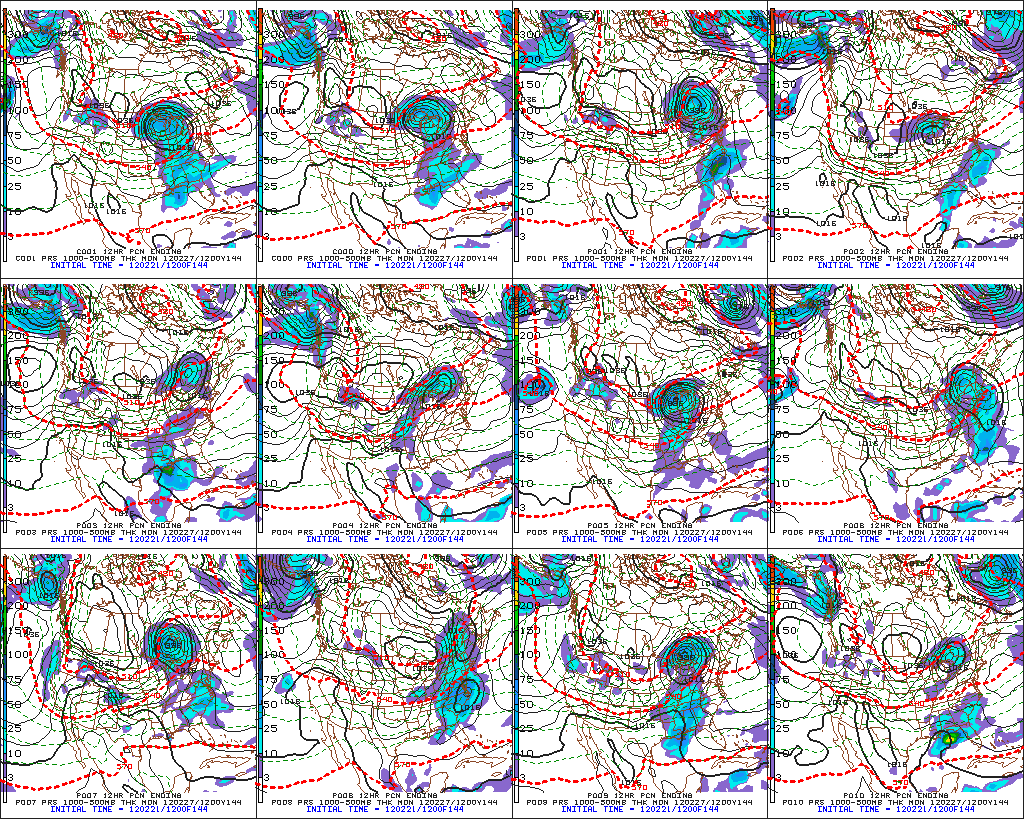
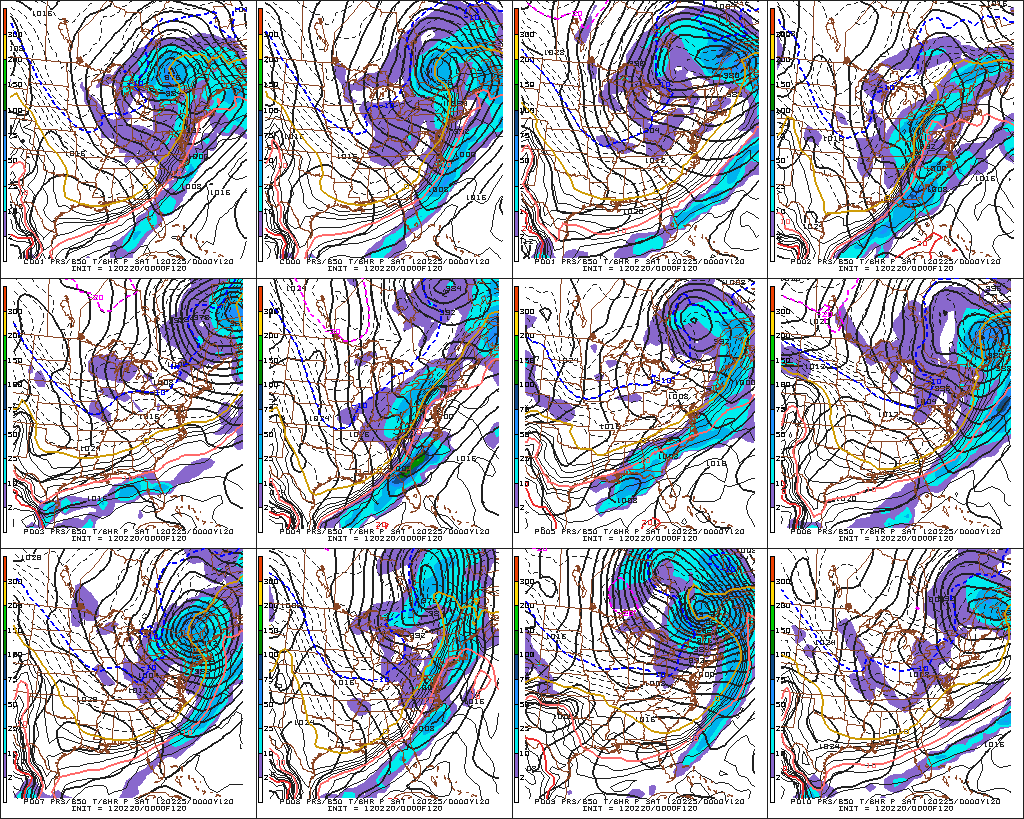
As we head into next weekend, the most extreme amplification will occur. A northerly flow will develop into the Rockies and it appears that some tropical moisture will come into play. Models are playing around with a major storm tracking somewhere east of the Rockies to begin next week. We are still over a week out and well phased storms have not been the trend all winter, so it’s tough to tell where any storm will track or how strong it will be. The GFS ensembles from last night show a wide variety of solutions, ranging from a weak storm that tracks across the Ohio Valley to a strong storm that tracks into the western lakes. Needless to say, we will have our eyes on this in the coming days.

Last night’s GFS ensemble members:

Posted in Pattern Discussion | Leave a comment

February to end With a Bang?

With this weekend’s snowstorm missing the Ohio Valley and Great Lakes well to the south and east, we look ahead to the next potential weather maker across the region.

The weather pattern appears as though it will turn active again by the middle of next week, with a ridge off the west coast directing  a parade of storm systems into the Plains. The forecast models show the cold air diving in to our west and no blocking over the arctic or north Atlantic, leading to low pressures tracking into the upper lakes for the latter half of next week, resulting in relatively low chances for major snow in the Ohio Valley/Great Lakes.

As we head towards the end of the month, we are seeing indications of further amplifications in ridging off the west coast of the continent along with an active subtropical jet stream. Given the lack of blocking over the arctic/north Atlantic, this may end up being a fierce storm that tracks well west of the Appellation Mountains, resulting in heavy rain and thunderstorms to the east of the track and a potential snowstorm to the west of the storm track.

We are still quite far out from this potential storm, but as we approach meteorological spring, expect things to stay busy in the weather department!

Posted in Pattern Discussion | Leave a comment