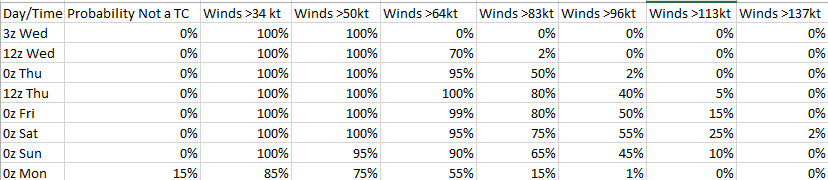
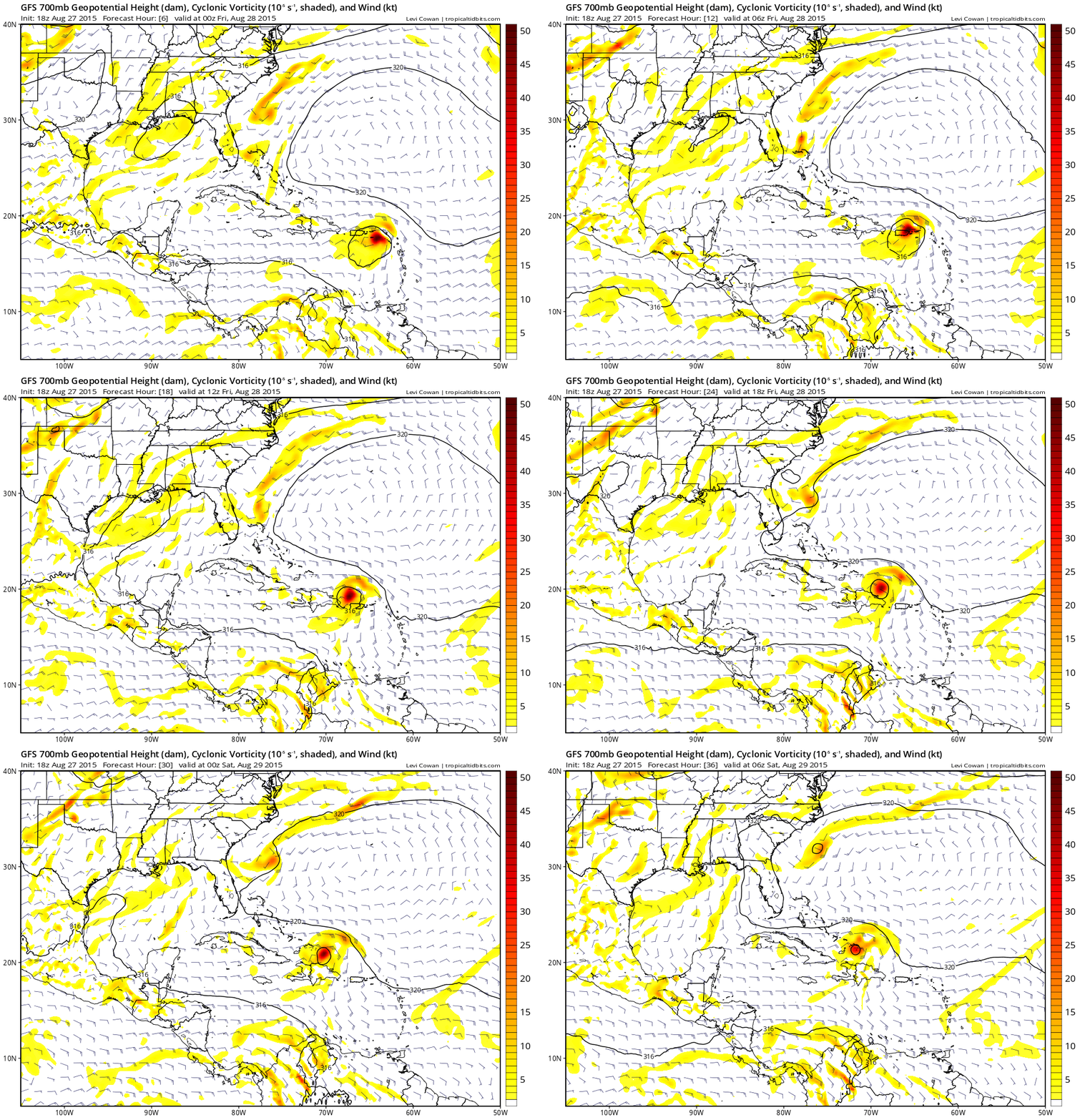
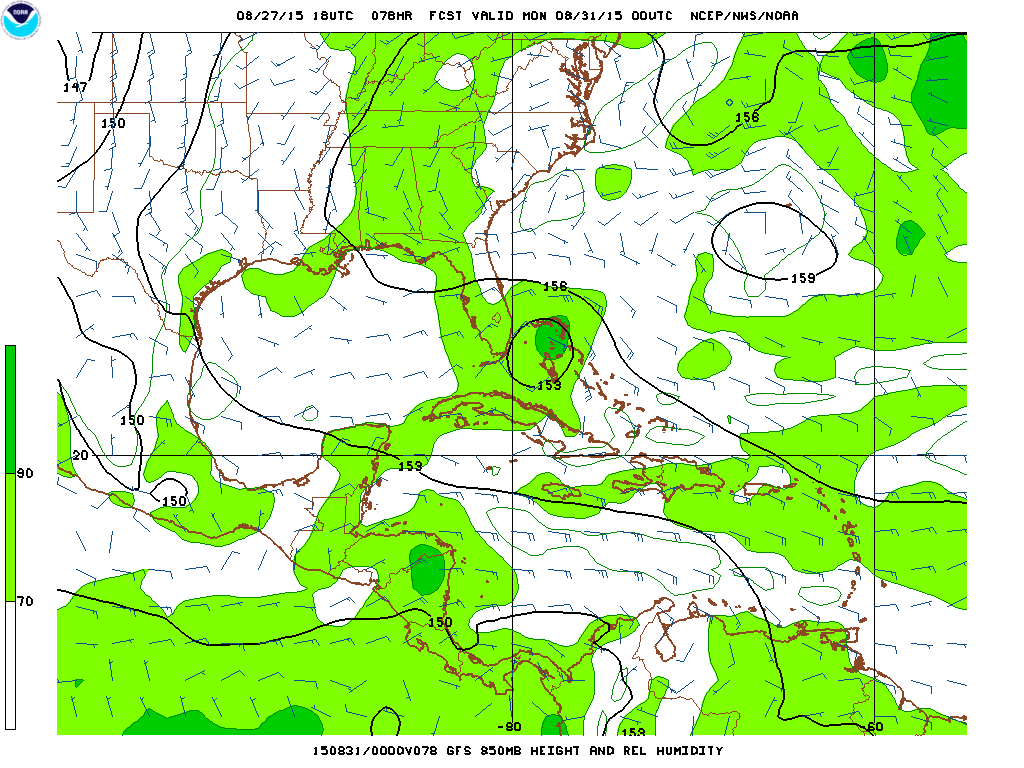
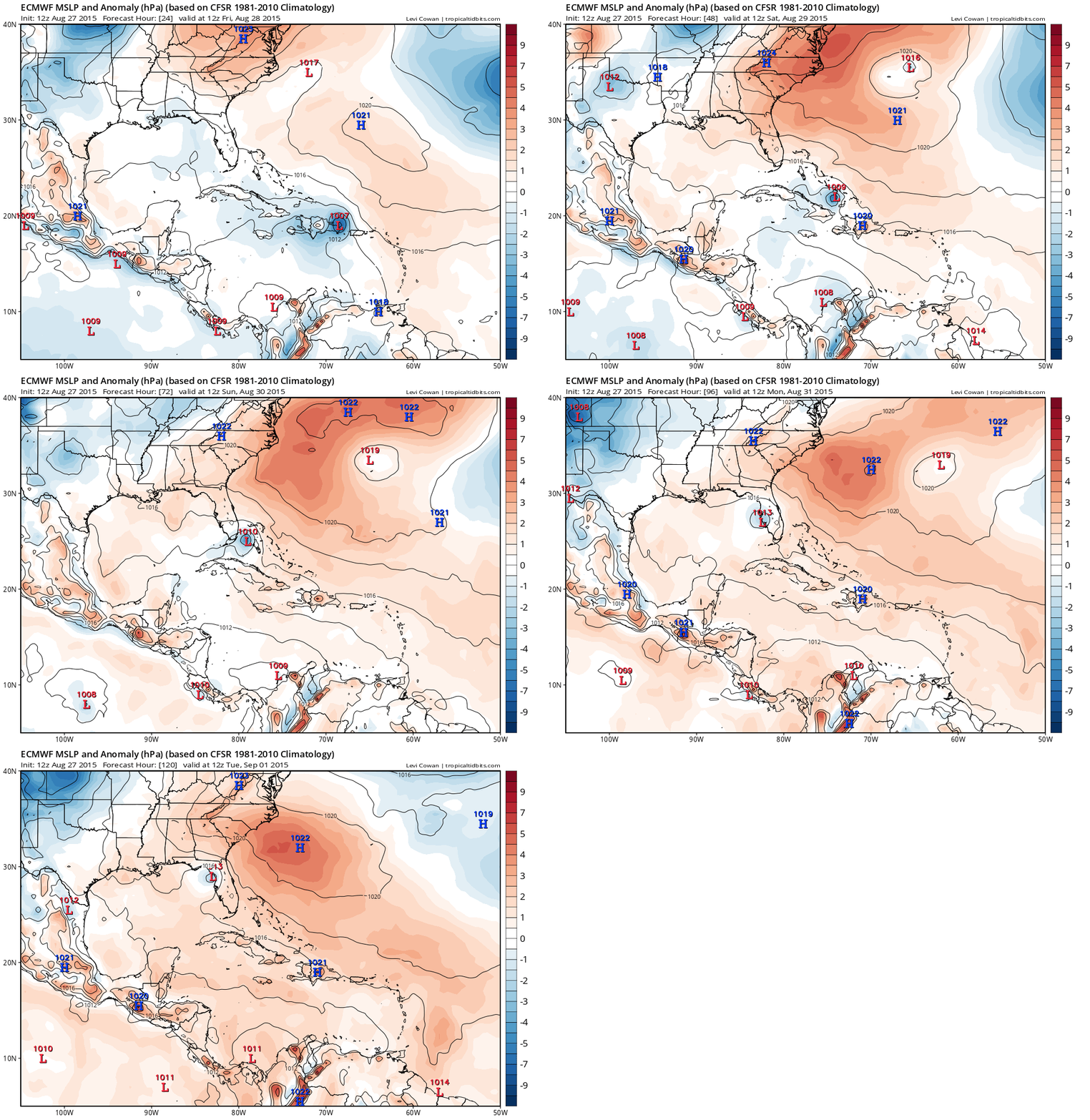
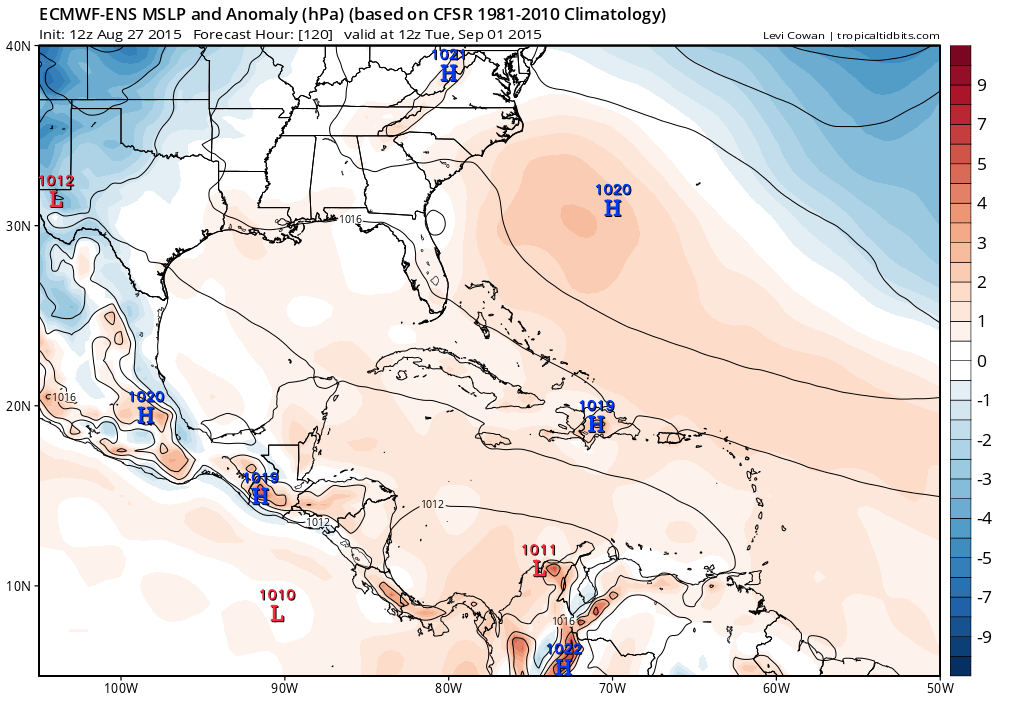
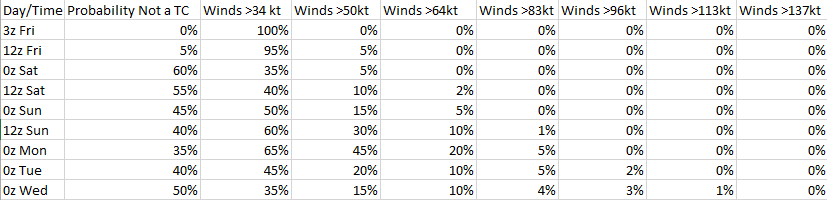
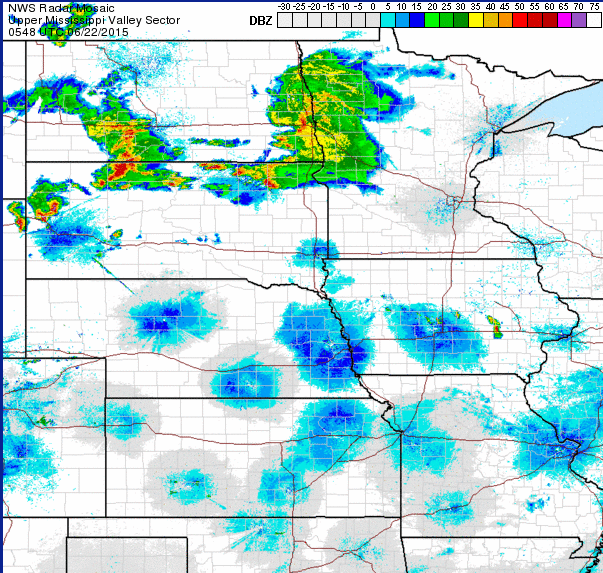
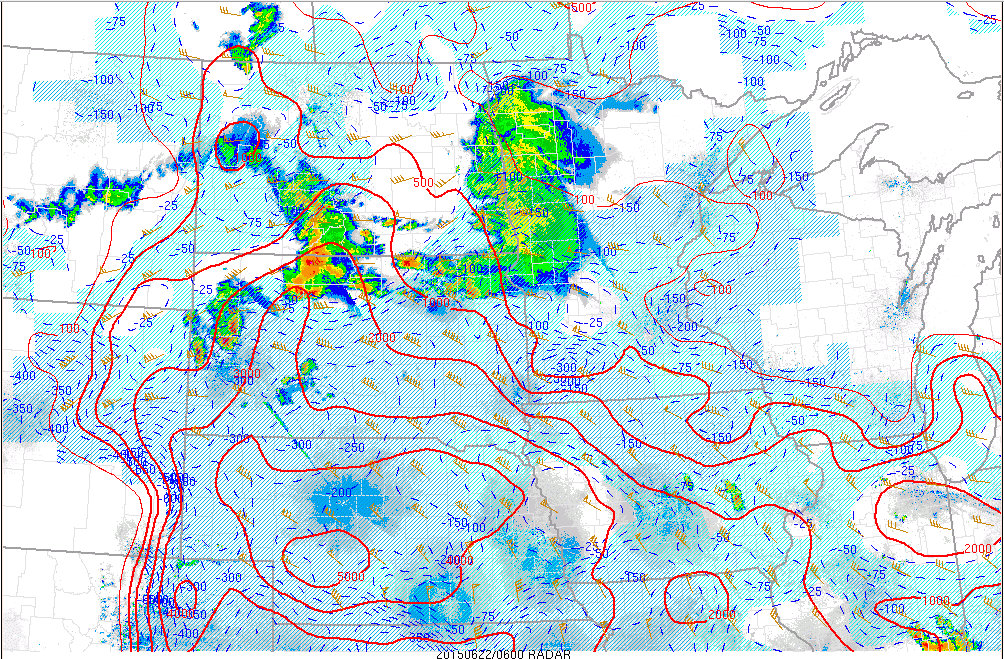
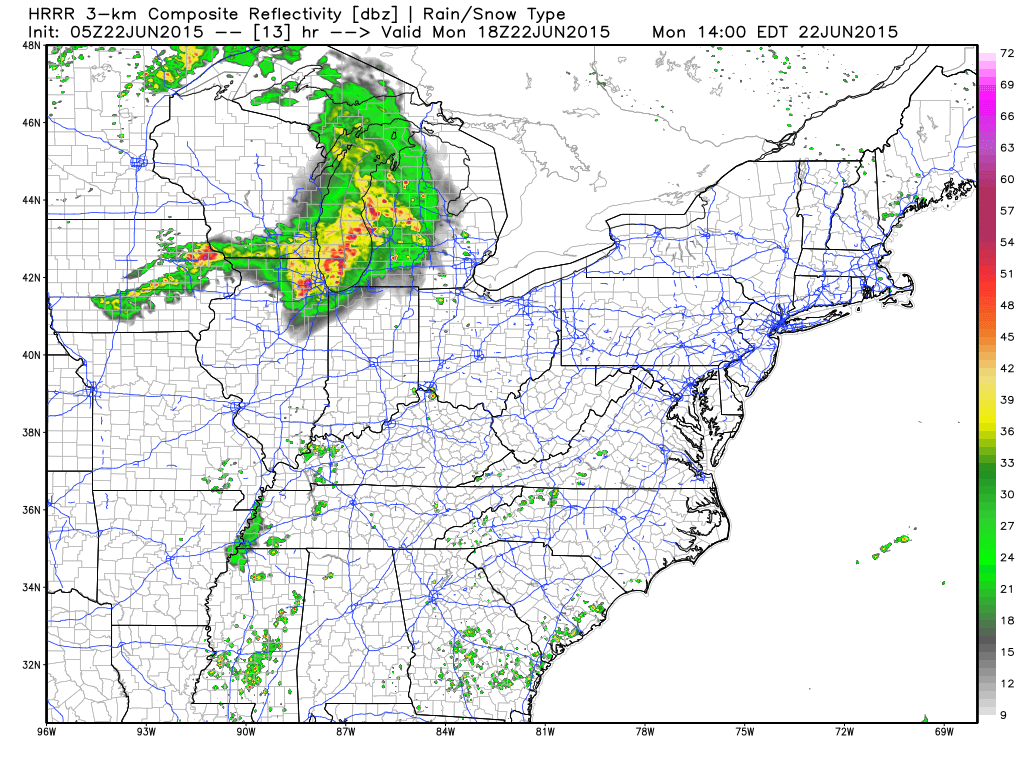
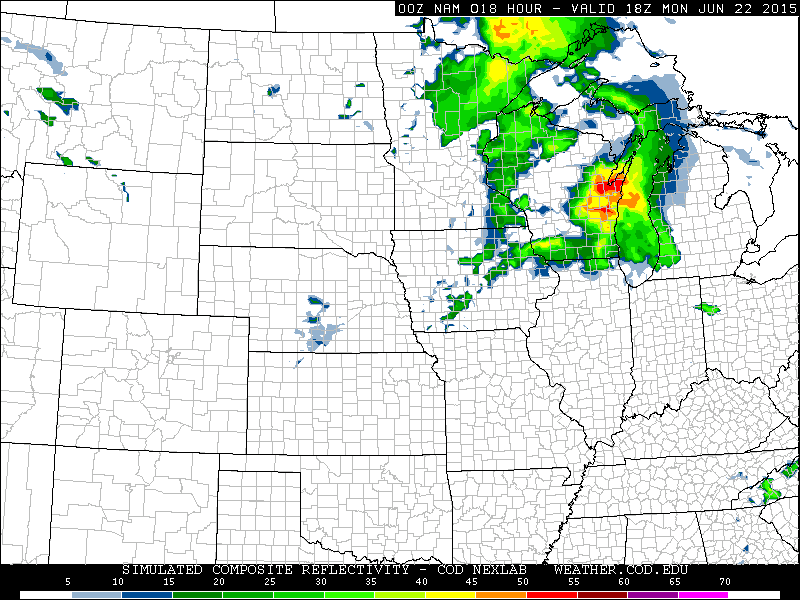
First Lake Effect of Season This Weekend

Quick summary of my thoughts on potential lake effect snow downwind of most Great Lakes this weekend:

Off of Lake Superior, I’m thinking that winds changing through the event will keep accumulations under control. A little trough drops south across the Lake and should cause activity to intensify this evening…850mb temps of -8 to -10C and 925mb temps of -2 to -3C should easily support accums in the higher terrain. The activity may swing west towards MQT for a time tonight, and the more northerly flow for a few hours behind the trough should hit the higher terrain west of MQT for a time tonight. The winds go more NW by Saturday morning which should shift the bulk of the activity east of MQT. The winds never stop shifting completely so I think 1-3″ in the higher terrain east of MQT in Alger county should about do it…maybe a half inch in the higher terrain west of MQT.

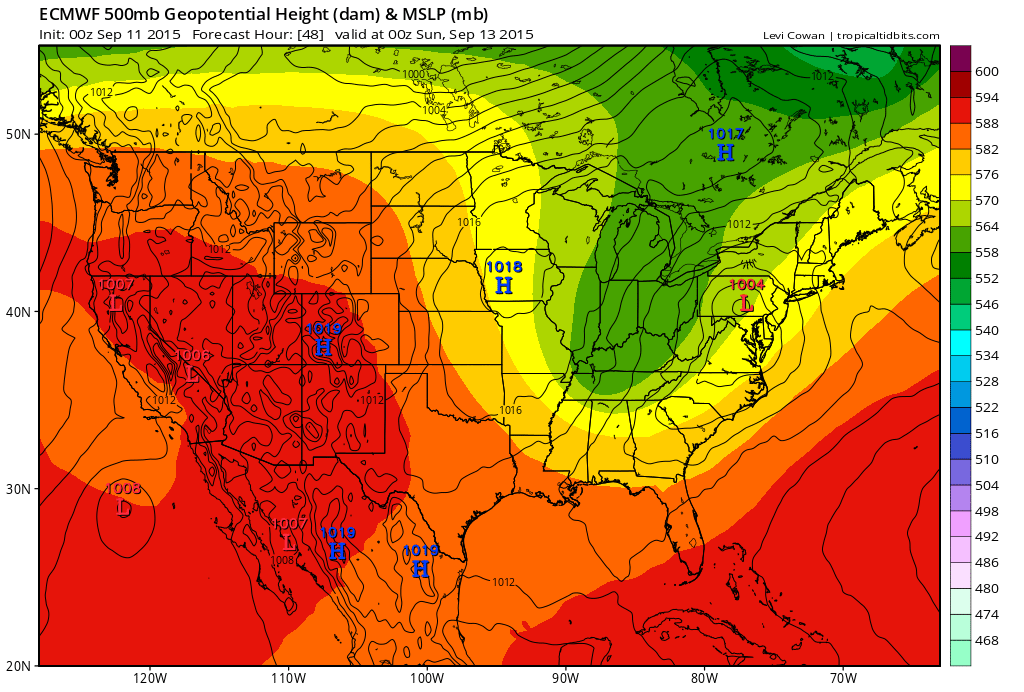
Off of Lake Michigan conditions become very favorable for decent lake effect this evening as the same trough drops through. Winds will initially be NNW which should hit areas between Traverse City and Gaylord, but will go more due N late tonight behind the trough which should shift things to just S and W of Traverse City. Winds start backing on Saturday to WNW and then whip around to the N again Saturday night as inversions start coming down…overall think maybe 1-2″ in the higher terrain where the bands affect over the next two nights, winds look too variable for a band to sit and allow for better accumulations.

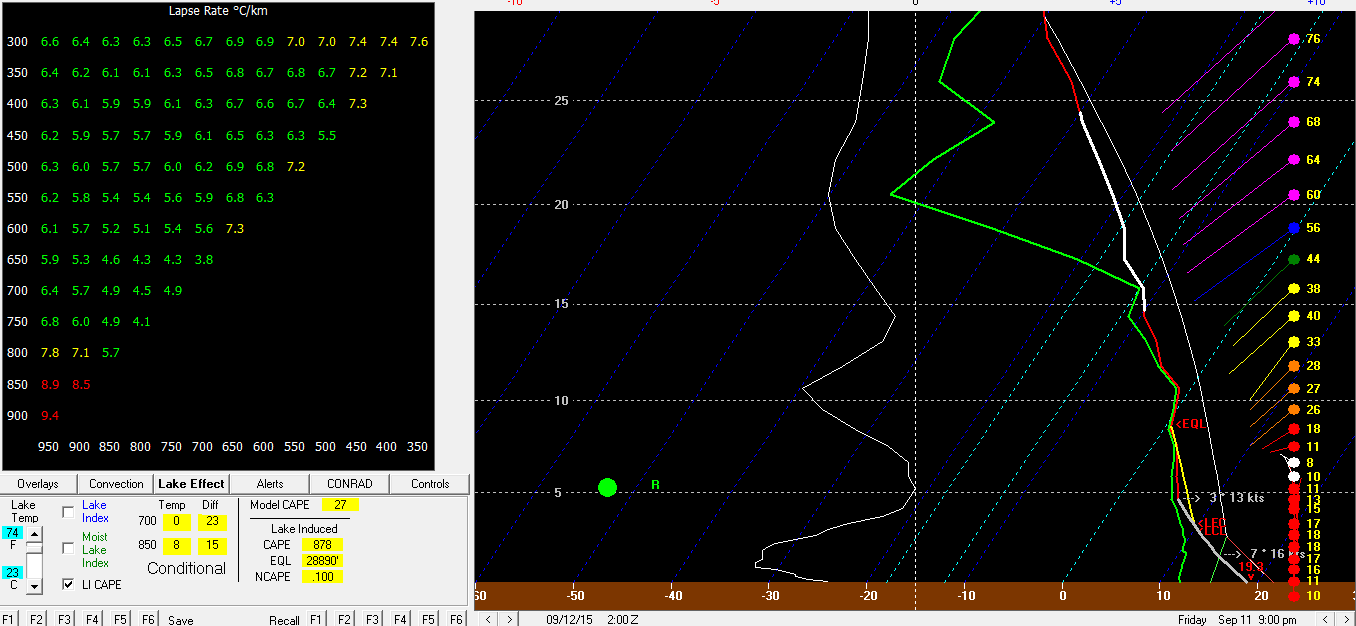
Off of Lake Huron I’m more intrigued…the winds look like they’ll hardly move from late tonight through late Saturday afternoon with extreme lake induced instability (CAPE on the order of 1000 J/KG+ from around midnight tonight through very early Sunday), very high equilibrium levels (15-20k feet through early Sunday) and deep moisture with help from upstream lakes (high RH air to near or above 10k feet late tonight through very early Sunday) in place. The winds are well aligned and will have the full fetch of the lake to work with. A very intense band with thunder and lightning is likely downwind of Lake Huron this evening through Saturday night, with little movement possible through much of the day Saturday. The winds will be NW late tonight through Saturday which I’d have to imagine supports the heaviest band staying just north/east of London, but I’m not a Lake Huron band expert.

Saturday evening the winds initially gain a more westerly component ahead of an approaching trough which should push any band farther east and possibly weaken it some for a few hours. The winds become decently well aligned for a few hours out of the NW again late Saturday night into early Sunday before becoming more northerly and pushing everything west. Instability and moisture slowly wane during the day Sunday which should cause a slow end to things.

Potential accums are definitely tough…with 925mb temps of -1C to -2C tonight, well aligned winds in the boundary layer on the order of 20-30 knots (not too strong) and a likely very strong band, I fully expect dynamical cooling to change precip over to snow tonight under any strong band. Temps warm a tad during the day Saturday, but assuming a band continues, it should remain all snow under it (maybe the lakeshore tries changing to rain during the afternoon?). Heavy wet snow will accumulate despite wet ground. There could be a 12 hour period tonight into Saturday where the band moves very little off of the southern end of the lake, and that could produce 6-10″. Things start moving around move Saturday evening through Sunday morning, but another 1-3″ could fall on spots very early Sunday if the winds can stabilize for a few hours. This could be a pretty significant event with a lot of tree damage.

Off of Lake Erie temperatures are a bit too warm in NE Ohio to get accums with this type of weaker multi-banded setup…maybe the higher terrain in Geauga or inland Ashtabula can get half an inch. In NW PA and perhaps into Chautauqua County in SW NY, there is more terrain and likely will be heavier precip rates beneath a likely Huron-Erie connection. It will take until later tonight for temps to support accumulating snows in the higher terrains, but there should be a few hours of fairly steady banding in central/eastern portions of Erie/Crawford Counties in NW PA, with likely accums in the higher terrain with 925mb temps of near -1C and extreme lake induced instability and moisture from Lake Huron supporting a moderate to heavy band. Winds here also shift more WNW for a time Saturday afternoon/evening before going more NNW for a time Saturday night before going WNW again Sunday morning. Think the shifting winds and slightly warmer mid-level temps during the day Saturday will keep additional accums Saturday afternoon fairly light…maybe another inch in the higher terrain. Late Saturday night into Sunday morning as the winds become more steady again from the NW or WNW, there could be a period of some accums, again probably in eastern Erie/Crawford counties in NW PA perhaps into Chautauqua County NW and perhaps into parts of Venego/Forest/Warren Counties. Overall due to less persistent banding and more marginal temps here I think maybe 2-4″ falls in the higher terrain. If a band persists for longer then maybe a local lolly to 6″ is possible.

Posted in Uncategorized | Leave a comment

10/1/15 Early AM: Joaquin to Pillage Bahamas; East Coast Landfall Probability has Decreased, but Still Possible

Disclaimer: The thoughts expressed in this post are mine alone, and in making any life or death decisions be sure to consult the National Hurricane Center, your local National Weather Service, and heed advice from your local authorities and emergency managers.

National Hurricane Center: www.nhc.noaa.gov

National Weather Service: www.weather.gov

General Discussion:

Hurricane Joaquin has rapidly intensified into a major hurricane over the last 24 hours. As of 11:00PM Wednesday, Joaquin was located just northeast of the central Bahamas and moving southwest at about 7MPH. Joaquin was packing sustained winds of 115MPH and a central pressure of 951mb, making it a category 3 hurricane. The pressure with Joaquin dropped 20mb in 12 hours between 11:00AM and 11:00PM Wednesday and 37mb in 24 hours between 11:00PM Tuesday and 11:00PM Wednesday.

Joaquin has tracked farther south than forecast over the last 24 hours, which has immediate implications for the Bahamas. The vast majority of the island chain is under a hurricane warning, with tropical storm warnings for the westernmost and southernmost islands. Joaquin is still intensifying and has a good chance of becoming a category 4 hurricane Thursday into Friday as it moves very close to or over the central and northeastern Bahamas. Joaquin is expected to continue moving southwest through Thursday before slowly turning north by Friday, clearing the island chain completely by Saturday. Damaging winds, storm surge and flooding rainfall will occur in parts of the Bahamas.

After the Bahamas, Joaquin is still expected to move north on Saturday. Yesterday it was discussed that a bend back northwest in the track towards the Mid-Atlantic or Southeast coast was possible but NOT guaranteed. Due to Joaquin tracking farther south than forecast over the last 24 hours, the probability of a direct East Coast landfall has diminished considerably; a track out to sea now appears to be at least as likely as or somewhat more likely than an East Coast landfall. This is still far from a guarantee, so interests from Georgia to New England should still keep tabs on Joaquin.

Regardless of whether or not Joaquin makes landfall, tropical moisture interacting with a frontal boundary is still expected to produce heavy and locally flooding rain across parts of the Southeast US, Mid Atlantic and possibly southern New England Friday through Sunday, with strong onshore winds across the Mid-Atlantic causing at least minor to moderate coastal flooding and significant beach erosion.

Scientific Discussion:

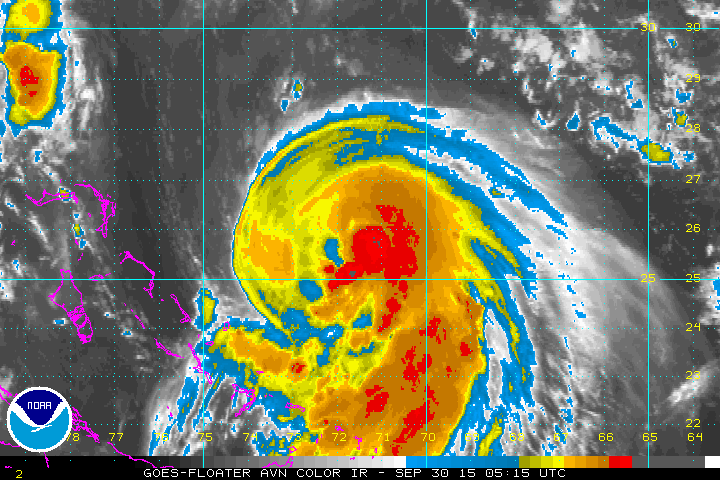
Joaquin IR

As expected, Hurricane Joaquin looks much better organized than it did Tuesday night, with a symmetric CDO featured by consistent, extremely intense convection along with occasional hints of an eye today. The eyewall convection has at times exhibited a bit of a bursting pattern, some evidence that modest northerly shear and dry air may still be affecting the hurricane, however on the balance Joaquin’s inner core has gradually organized over the last day with rapid intensification occurring as a result.

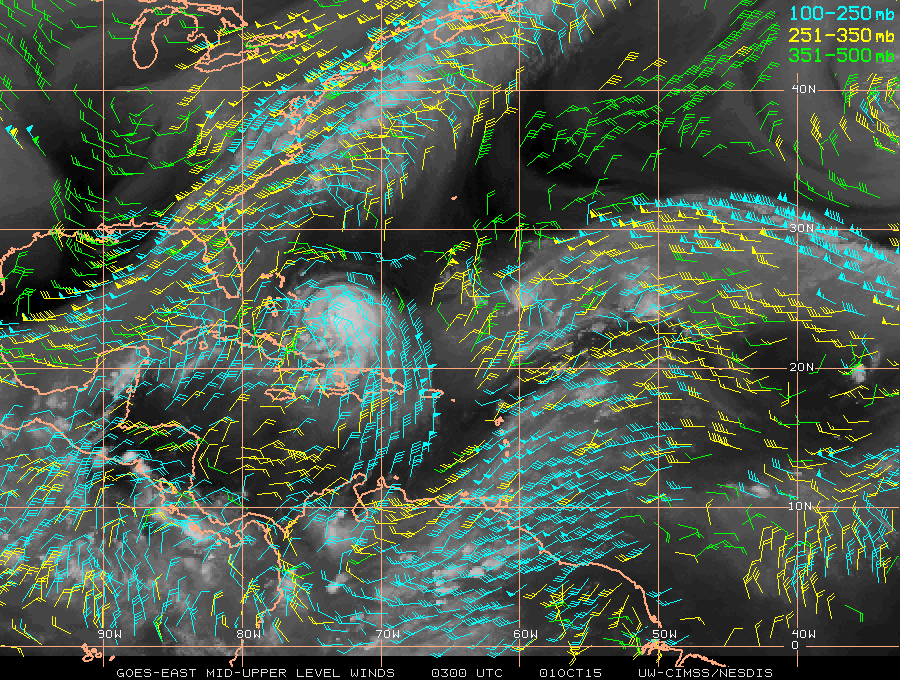
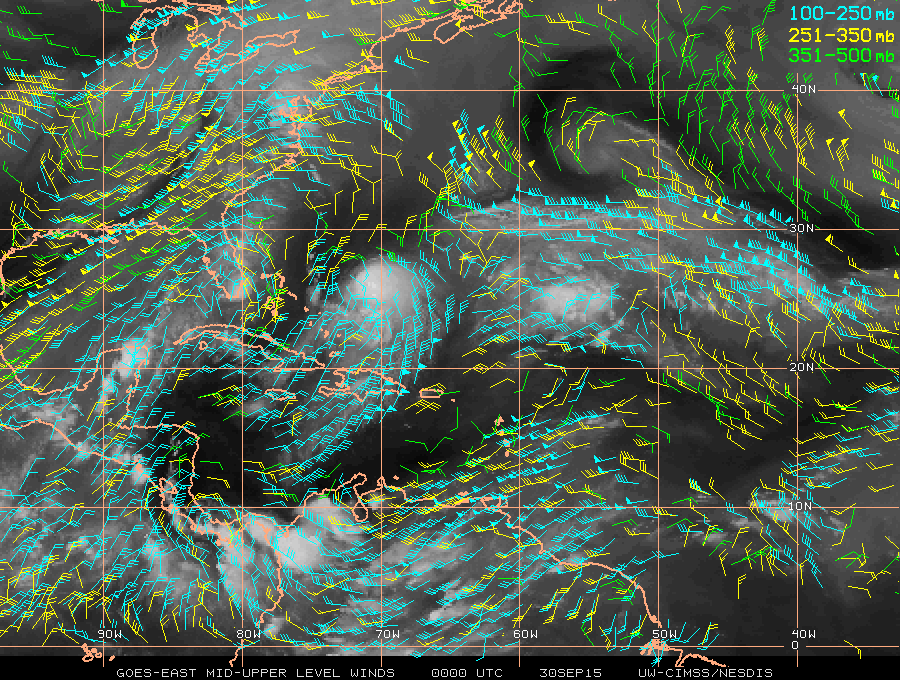
Joaquin upper winds

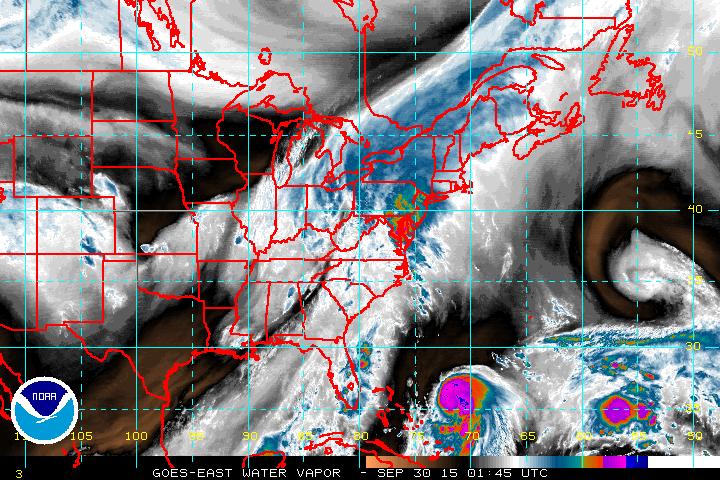
Current satellite derived upper level winds continue to reveal an excellent equatorward outflow channel south of the hurricane, which along with warm waters and an unstable environment is allowing for very robust convection to occur consistently with the storm. There are still some hints at northeasterly shear in the upper level winds due to an upper level anti-cyclone to the west of Joaquin, with some dry air to the north and northeast of the storm, which may explain why the eyewall convection has bursted at times over the last 24 hours and prevented an eye to persistently maintain itself.

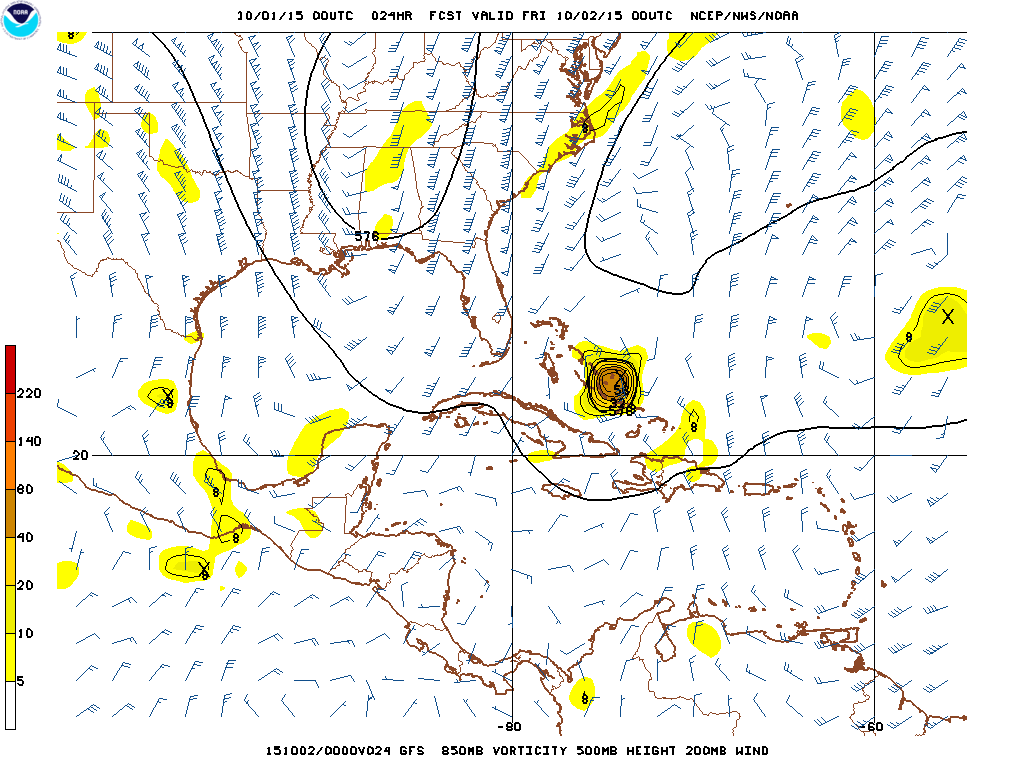
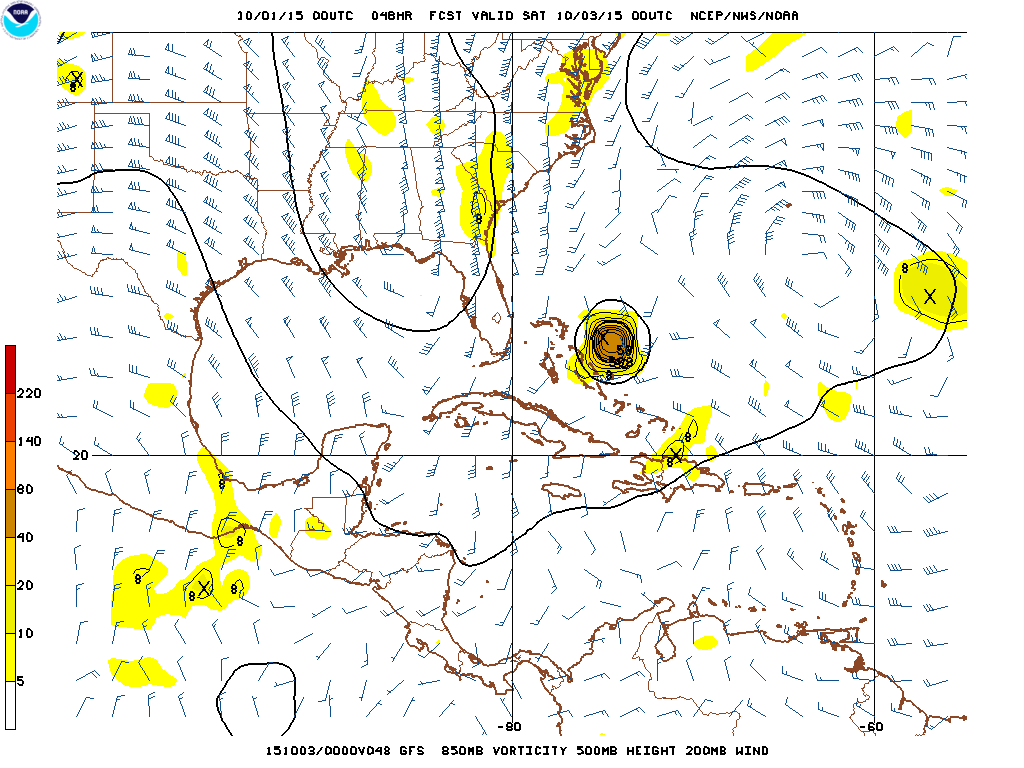
Joaquin GFS 24

By Thursday afternoon and evening, the 0z Thursday GFS shows the northeasterly shear relaxing as Joaquin becomes more co-located with the upper level anti-cyclone that is currently shearing it. Given very warm SSTs across the Bahamas, with warmth extending down to a significant depth which will mitigate upwelling of cooler waters to an extent, and the very vigerous convection that has been consistently noted with the eyewall convection since Tuesday night, this relaxation of shear would likely allow the eyewall to become more symmetric and completely closed off, allowing an eye to form for good at some point on Thursday. Once an eye forms and clears, consistent eyewall convection to -80C or colder suggests that Joaquin should strength quickly to a category 4 hurricane and perhaps get close to category 5 status by Friday.

Joaquin GFS 72

By Friday, outflow will be exceptional from Joaquin, with an upper low to the east and a trough digging over the SE US providing for strong dual outflow channels. Given continued warm water that Joaquin is still expected to be located over at this time, and the likelihood that a major hurricane will have a positive interaction with divergent and increasing upper level winds near the right-entrance quadrant of the jet streak east of the SE US trough, the potential does appear to be there for Joaquin to become a category 5 hurricane before the end of the work-week over or extremely close to parts of the Bahamas. There are two potential mitigating factors for this extreme intensification:

  • Eyewall replacement cycles will likely start occurring at some point, resulting in fluctuations in intensity. Often times, eyewall replacement cycles that occur in storms outside of the deep tropics fail to successfully complete, leaving a weakened storm afterwards. Eyewall replacement cycles are difficult to predict more than 12 hours ahead of time.
  • Upwelling of cooler waters. Although the Bahamian waters are very warm to a deep depth, a very slow moving major hurricane could eventually upwell enough cooler water to disrupt the inner core convection of Joaquin and cause some weakening. This is most likely to occur if a completely stall occurs.

Regardless, a major category 3 and most likely 4 hurricane is the expected intensity through Friday, with some potential for a category 5. This will occur very close to or over portion of the Bahamas, making this a very high impact event for the island chain.

After Friday, the intensity would likely slowly decrease as Joaquin either moves NNW towards the US Coast or more NNE out to sea as Joaquin begins encountering slowly cooler waters, some dry air and gradually stronger shear no matter which way the hurricane tracks. Different dynamics would be in play with both tracks would could result in slower rates of weakening, but overall a gradual weakening trend should commence by Saturday.

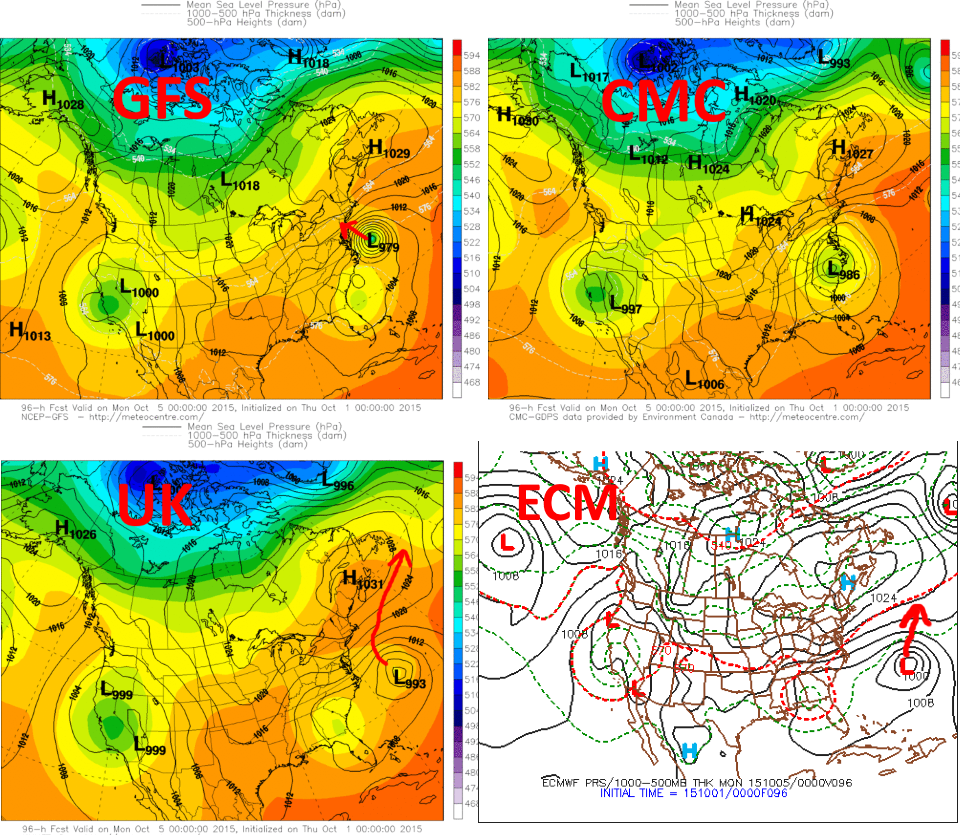
Joaquin 4 model

Yesterday I said there were 3 main track outcomes with Joaquin in the medium range of the forecast:

  • “The trough digs enough and/or Joaquin is far enough north that the flow around the SE US trough pulls the system north or northwest. The trough and Joaquin phase and the trough becomes strongly negatively tilted and cut off, allowing Joaquin to likely move into the Mid Atlantic coast.
  • The trough doesn’t dig enough, or Joaquin is too far south, and the trough kicks Joaquin to the northeast. The NW Atlantic ridge is too weak and the low south of the ridge too strong to push Joaquin back towards the US Coast, the storm goes out to sea.
  • The trough starts kicking Joaquin to the northeast, but the NW Atlantic ridge is strong enough to keep Joaquin in the fray, and the system eventually starts bending back to the north-northwest, potentially towards the northern Mid Atlantic or New England.”

Yesterday, the trend among the models was for a stronger Northwest Atlantic ridge, a more aggressive digging with the SE US trough, and a track into the US East Coast on MOST models. The only model that never trended towards a landfall way over the last two days was the ECM/European model. As can be seen above, the 0z Euro and UKMET models now show a whiff well out to sea and a close buzz but miss respectively, while the GFS shows a storm trekking towards NYC and the Canadian shows a North Carolina landfall. The 0z GFS, while still showing an entertaining solution, trending significantly farther “right” (east/north) with its track of Joaquin in the medium term portion of the forecast, while the UKMET trended way right and missed the coast.

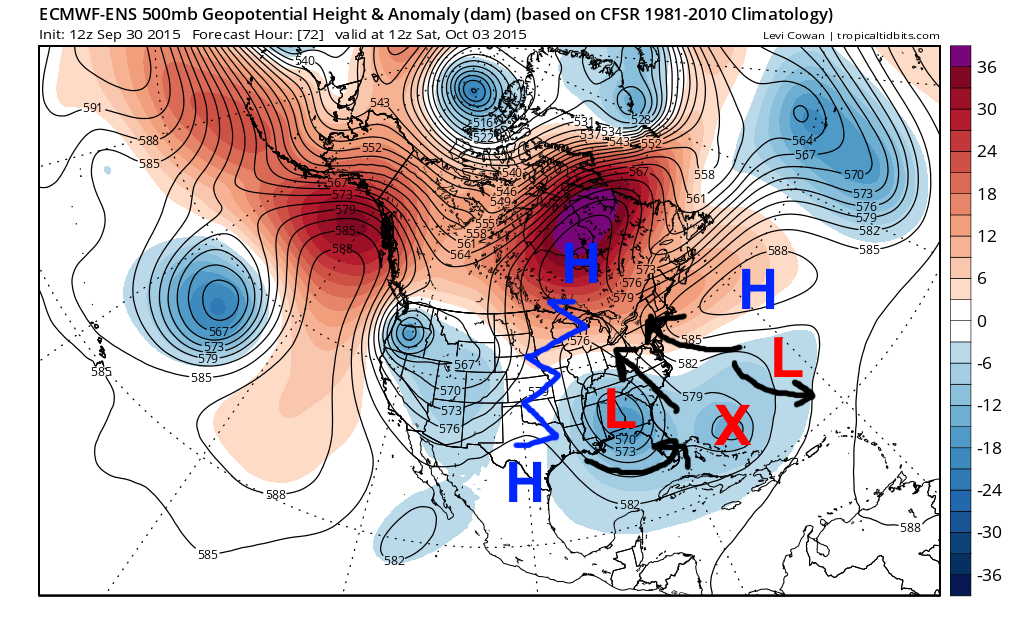
Joaquin ECM ENS 72

In general, the trends in the “big players” noted in my previous post have held true in newer modeling; the upper low gets all the way to central Alabama, with ridging over the NW Atlantic extending all the way into the Mid-Atlantic coast, allowing the steering flow off of the SE US coast to turn southeasterly by the weekend. However, there is one big change: THE LOCATION OF JOAQUIN! Joaquin has tracked much farther southwest over the last day towards the Bahamas, due to its stronger intensity allowing an upper level ridge currently west of the hurricane to have a stronger influence on the hurricane’s motion. I mentioned this in my post yesterday, but seemed to downplay its significance some:

“In the near term, as Joaquin continues to intensify, it appears that the ridge to its west may have increasing influence, as it appears to be stronger in the upper levels, per the layer of deeper steering currents shown in the above image. This could cause a west-southwest, but slow, motion to continue through the near term. However it’s important to note that if Joaquin does move farther north that it would feel increasing influence from the eastern US trough and ridge over the NW Atlantic. It’s also important to note that a stronger Joaquin would likely help pump up heights in the ridging over the NW Atlantic, which could ultimately try to push the storm farther west while also helping the trough over the eastern US amplify further.”

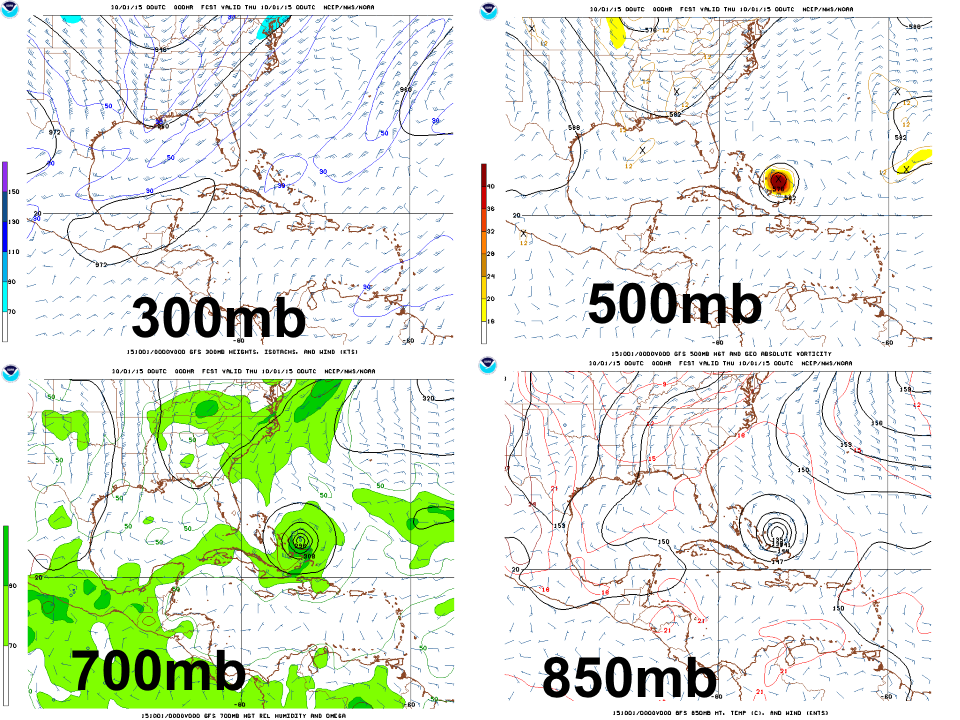
Although the latter portion of that paragraph is true, the NW Atlantic ridging and SE US trough will both be plenty amplified, likely due in part to Joaquin helping to pump up the mid-latitude ridging to its north, the first part of the paragraph was also very true, and caused a more significant southwest jog in Joaquin’s motion than I expected. You can see why this occurred when looking at various levels of the atmosphere at 8PM Wednesday evening:

Joaquin current 4 panal

(Click on image for larger version)

Note how the ridge over the Yucatan/NW Caribbean is much more defined at 300mb and 500mb than it is at 700mb and 500mb; also note how the ridge northeast of Joaquin appears to be the dominating low level steering feature. This means that as Joaquin grew stronger over the last day and was influenced by a deeper steering flow, it felt more of a “tug” to the south by the upper level ridge to its west, resulting in the storm moving more southwest over the last day as opposed to west or WSW. This makes a big difference by Friday and Saturday when potential interaction with the SE US trough and a low east of Joaquin –partly associated with the remnants of Ida— occurs.

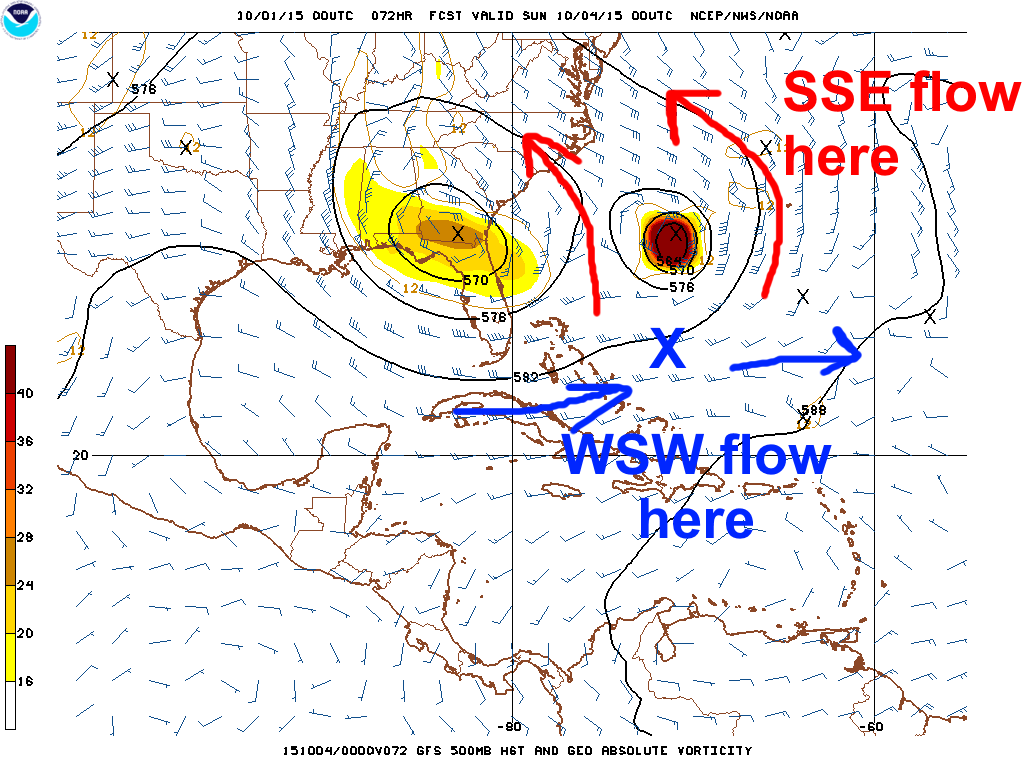
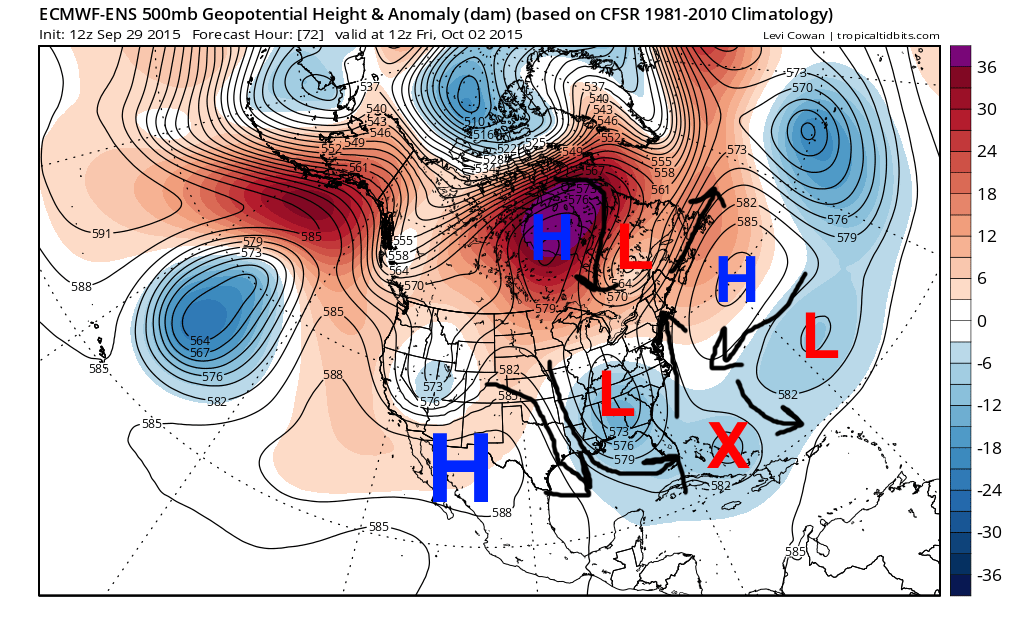
I want you to focus your attention to the 12z European ensemble 500mb mean height image above. A farther south Joaquin does a couple of different things:

  • Joaquin is actually closer to the low to the east of the hurricane than the upper low over the SE US. The logic behind the US landfall would be that Joaquin would move north of the Bahamas and get caught in the large scale SSE steering flow off of the SE US coast and then Fujiwhara with the SE US upper low, causing the hurricane to sling northwest and towards the coast while the upper low dove east. If Joaquin is closer to the low to its east, it would be more likely to Fujiwhara with that low, causing Joaquin to actually get pulled more east, similar to what the Euro has been showing for nearly 3 days.
  • As I pointed out yesterday, in order for the above to occur, it was imperative that Joaquin be north of the base of the SE US trough as it begins moving east Friday into Saturday. If Joaquin is along or south of the base of the trough, the winds around the trough push it east; if it’s north of the base of the trough, the winds pull it north. This can be seen well on the GFS image below; note how if Joaquin is any farther south than what the model has, the trough kicks it east:

Joaquin GFS 500 72

If Joaquin is even 100 miles south of the GFS forecast 3 days out, not at all a stretch and in fact close to the Euro and 0z UKMET, the winds around the trough have a TOTALLY different impact on the storm.

WITH THAT SAID, CAN A US EAST COAST LANDFALL STILL OCCUR?

YES, here’s how:

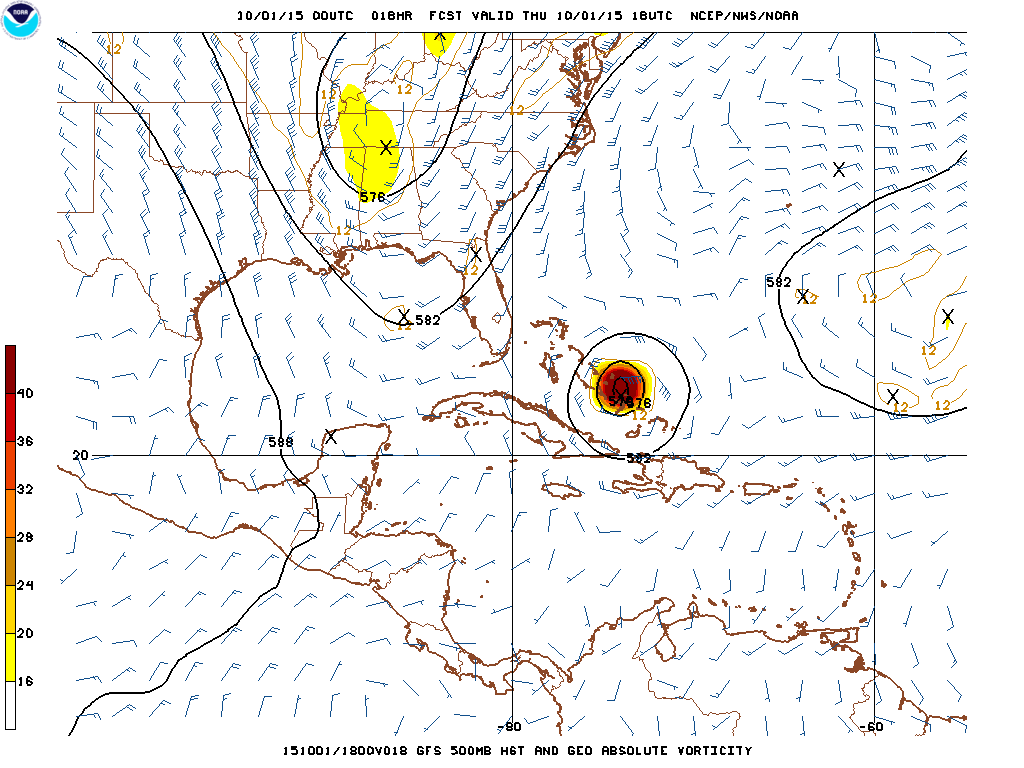
Joaquin GFS 18

The upper level ridge west of Joaquin that has imparted a southwest motion on the hurricane over the last 24 hours is expected to weaken fairly soon, by Thursday afternoon/evening, as the upper level trough starts impinging on it from the north. Note how on the above GFS image valid 2:00PM Thursday, there anti-cyclone west of Joaquin appears to be smaller and weaker than it currently is. This should cause the current southwest motion to stop on Thursday. This may not be enough however; since Joaquin has tracked so much farther south than expected already, the upper trough, even in the above image, appears to want to cause a westerly steering flow near Joaquin, with the hurricane only near the edge of the east flow around the ridge to its NNE, all while the low associated partly with what’s left of Ida to the east attempting to move west and impart a more southeast motion on the hurricane. I’m starting to think that since Joaquin is farther south and won’t be drawn northward by the trough initially that although the SW motion may stop Thursday, it may stop only to result in a stall through Friday. By Friday, the trough is digging in, and if Joaquin can’t get north by then, the trough kicks it east, with some help from the low to the east of Joaquin as well. This type of scenario would stall Joaquin very near to or over the central Bahamas as a very powerful hurricane.

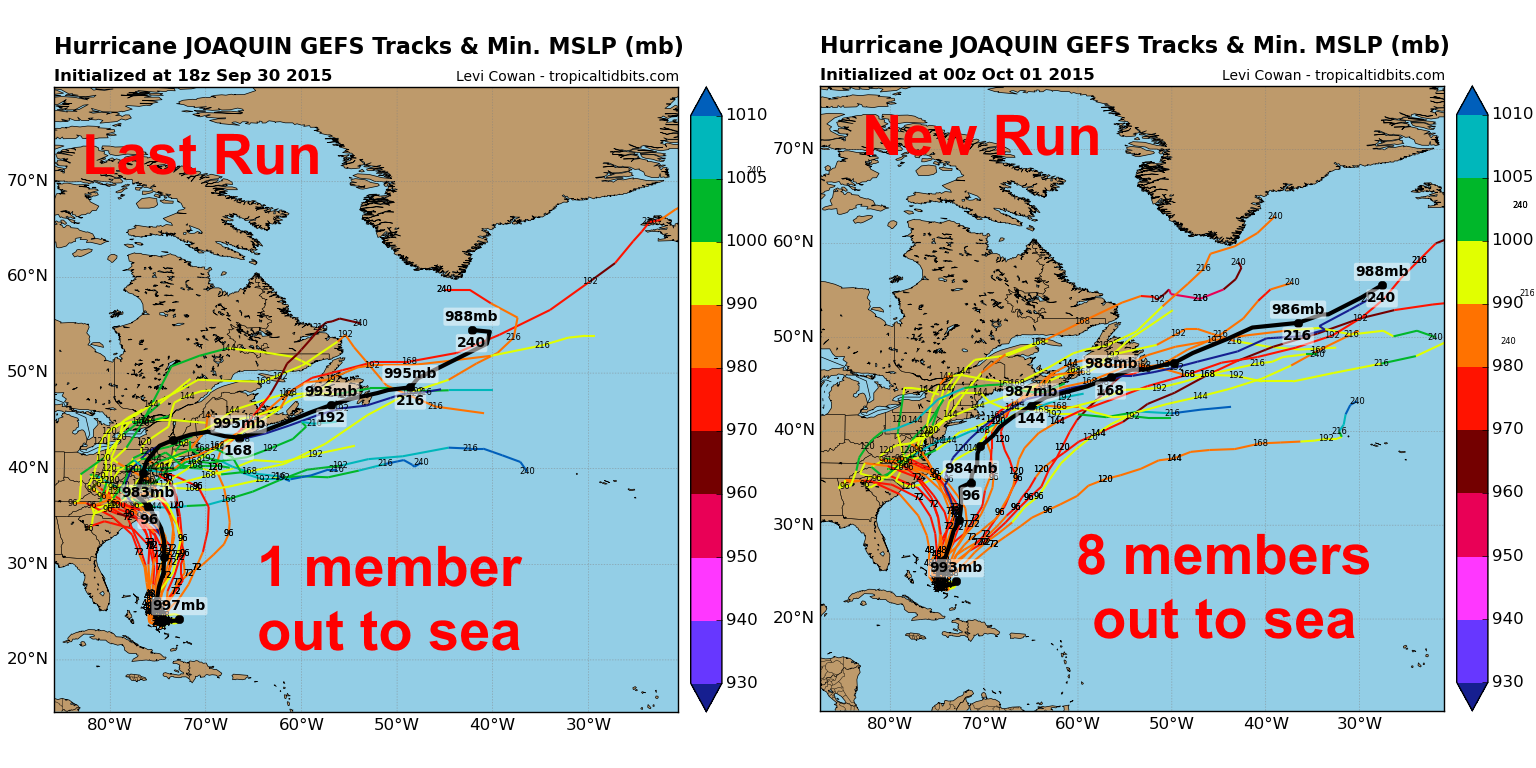
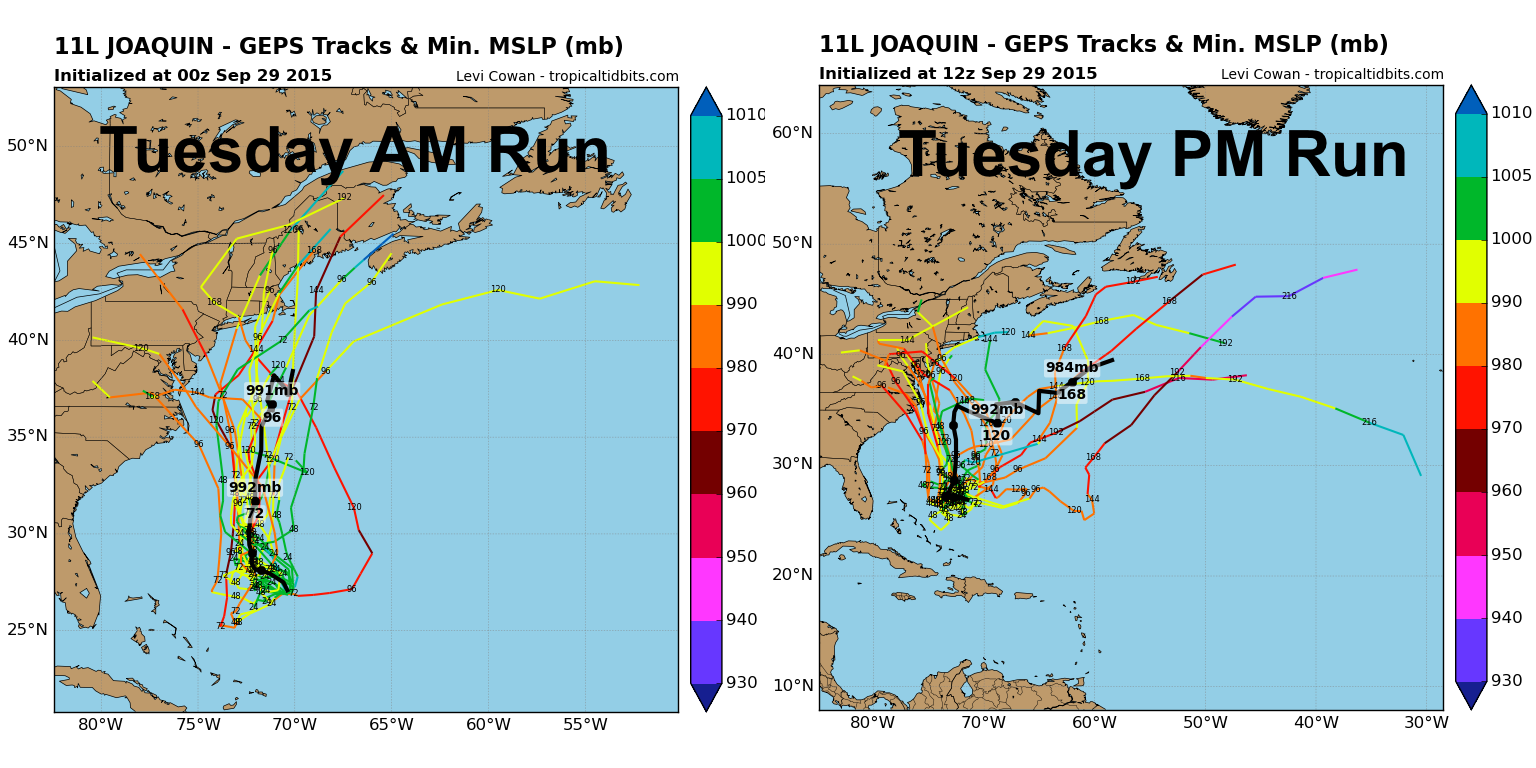
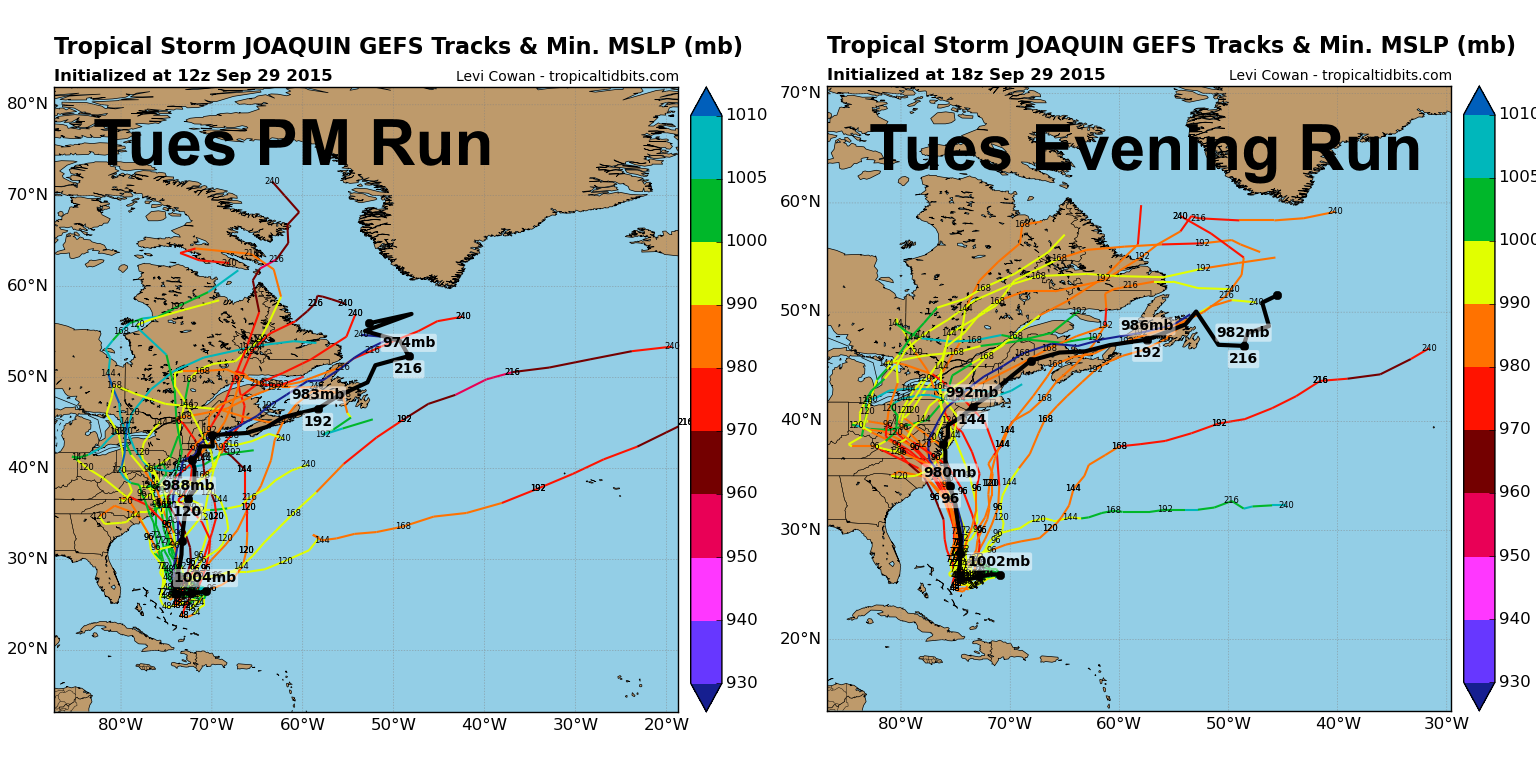
Overall, the more significant southward component of motion of Joaquin over the last day makes it harder for a binary interaction to occur between Joaquin and the SE US trough that would hook Joaquin towards the eastern seaboard. It still isn’t impossible that this occurs, however Joaquin would have to cease all southwest motion very soon and then find a way to move north, even though the steering flow may not allow that to easily happen. It is extremely important to note that for 3 days the European model has consistently shown an out to sea track; the European model has also consistently outperformed all other guidance in terms of moving Joaquin much farther southwest in the near term than expected by other models and frankly myself. The 12z European ensembles went from having a fair number of members still take Joaquin into the coast to only having about 15% of the ensemble members pull it off. Also, big changes have occurred over the last two runs of the GFS and Canadian ensembles, with many more members now taking Joaquin out to sea (despite the operational runs still taking Joaquin into the coast):

GFS ensembles:

Joaquin GEFS trend

Canadian ensembles:

Joaquin CMC ens spread

You may be saying that a large majority of the Canadian ensembles still take Joaquin into land, which is certainly correct, however, the Canadian ensembles fail to accurately capture the current southwest motion, which is of the utmost importance as discussed above. The new GFS ensembles capture this movement more so than the 18z run, and respond in kind with many more members going out to sea. Unfortunately, unless the southwest motion stops immediately, the GFS ensembles still are botching the very near term forecast, meaning further adjustments will probably occur.

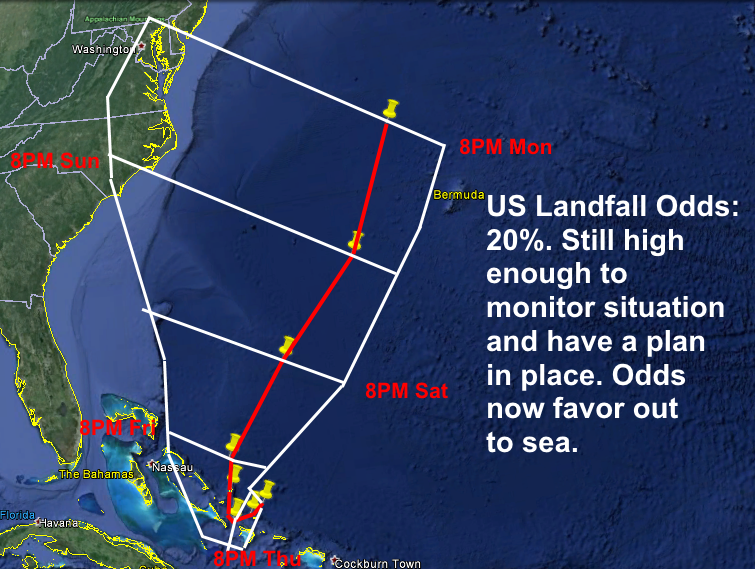
For my “deterministic” track forecast, based on everything discussed here, I have little choice but to take the track off the East Coast. Due to a still not impossible scenario that takes a hurricane towards the East Coast, the coast will be in my cone of uncertainty. For my actual track, I will blend the 0z GFS and Euro operational runs for the first 48 hours, and then blend the GEFS mean and 0z operational Euro. There’s a real possibility that further eastern shifts could be needed, however at this point I feel like this route allows me to firmly show I’m much less enthused about an east coast landfall while not biting 100% on the Euro. To an extent this is a “less wrong” approach, but still sends the message I intend, and is unfortunately a big change from my forecast yesterday.

As a note, potentially flooding rain from a PRE well west of Joaquin and minor to moderate coastal flooding due to a strong pressure gradient well north of Joaquin are still expected across parts of the SE US and Mid-Atlantic, mainly Friday-Sunday.

Forecast Map:

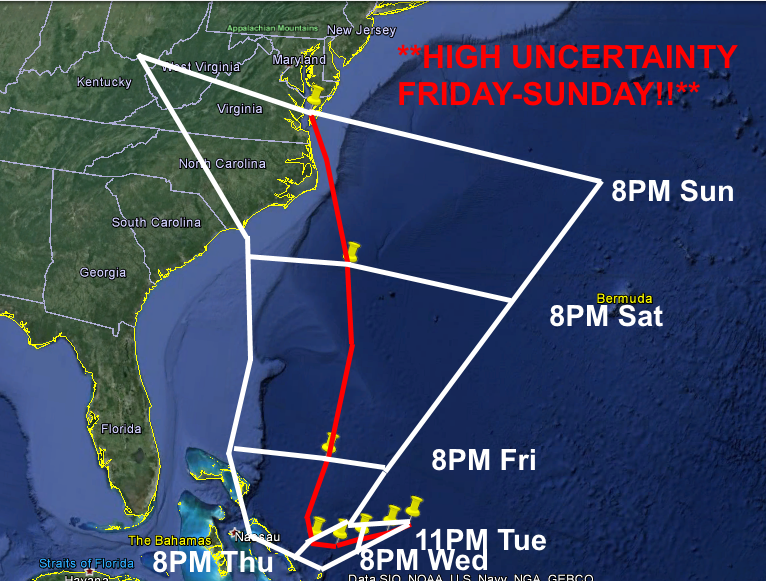
Joaquin track 2

Location coordinates and intensity:

2:00AM Thursday…23.5N, 73.4W…105kt

8:00AM Thursday…23.2N, 73.9W…105kt

8:00PM Thursday…23.0N, 74.3W…120kt

8:00AM Friday…24.1N, 74.5W…120kt

8:00PM Friday…25.1N, 74.4W…120kt

8:00PM Saturday…28N, 72W…105kt

8:00PM Sunday…31.0N, 69.0W…85kt

8:00PM Monday…35N, 67W…70kt

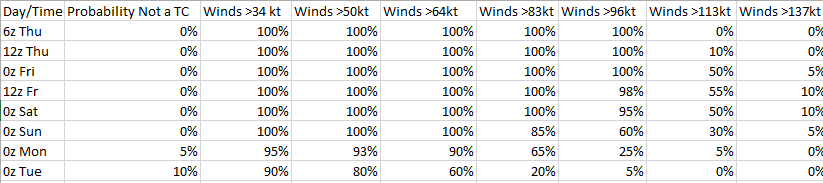
Intensity probability table:

Joaquin probs 2

Posted in Uncategorized | Leave a comment

9/29/15: All Eyes on Joaquin

Disclaimer: The thoughts expressed in this post are mine alone, and in making any life or death decisions be sure to consult the National Hurricane Center, your local National Weather Service, and heed advice from your local authorities and emergency managers.

National Hurricane Center: www.nhc.noaa.gov

National Weather Service: www.weather.gov

General/non-scientific summary:

Tropical Storm Joaquin continues to intensify to the east of the Bahamas Tuesday evening, with maximum sustained winds as of 11:00PM of 70MPH. Any further increase in intensity would result in Joaquin becoming a hurricane, and this is expected to occur Wednesday morning. From there, rapid intensification is possible, and Joaquin could become a major hurricane by Thursday or Friday.

Joaquin is currently drifting west to southwest at about 5MPH. This generally heading is expected to continue through Thursday night, and would take Joaquin perilously close to the eastern Bahamas as a potentially strong hurricane Thursday and Friday. A hurricane watch has been issued for the central Bahamas.

After passing dangerously close to or over the Bahamas to end the work-week, Joaquin will turn north off the Southeast US Coast as a trough deepens over the Southeastern US. Whether the storm turns due north or northwest and heads towards the Mid-Atlantic or Southeast US coast, or turns more northeast and heads out to sea is uncertain, and will depend on the track and intensity of Joaquin through Friday.

Regardless of whether or not Joaquin directly impacts the East Coast as a hurricane or hybrid hurricane/Nor’Easter, a tremendous amount of rain is expected across the Mid-Atlantic and New England on top of already saturated soils as tropical moisture piles up along a frontal boundary in that area. Even if Joaquin misses the coast, a prolonged onshore flow Wednesday through Saturday would still cause at least minor to moderate coastal flooding. So, locations in the Southeast US, Mid-Atlantic and New England need to closely monitor Joaquin, as fairly significant flooding impacts are likely at minimum. If Joaquin does turn towards the coast, a very high impact and costly weather event would occur. Persons with interest form the Carolinas north all the way to New England need to closely monitor the progress of Joaquin.

Scientific Discussion:
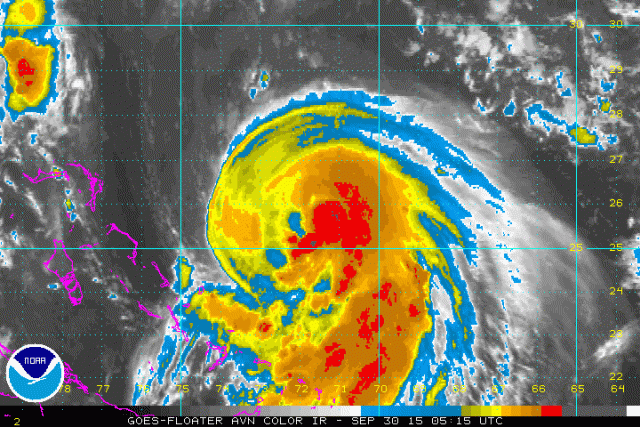
Jo IR

Jo micro

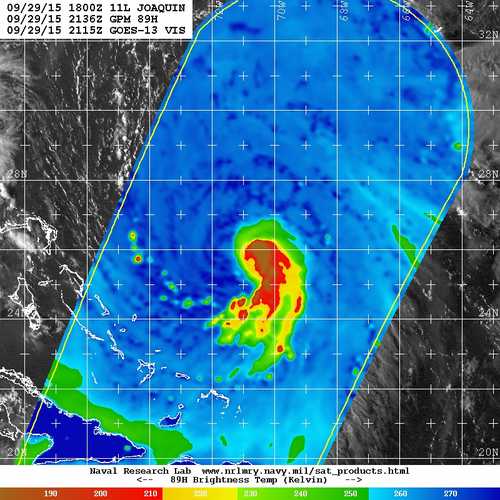
Recent convectional IR satellite imagery along with the most recent microwave pass that captured Joaquin (from around 5:00PM EDT Tuesday) show that Joaquin is still a sheared tropical cyclone, however very intense and persistent convection is occurring on the eastern side of the circulation, with evidence of curved banding and perhaps a formative mid-level eye on microwave data. Note how there’s a swirl of low level clouds on the microwave image near the northwestern edge of the convection, indicating the low and mid-level vortex of Joaquin weren’t quite well aligned at 5PM, as a result of moderate northwesterly shear on the cyclone. Although the structure wasn’t perfect this afternoon, as of 11:00PM Joaquin had maximum sustained winds of 70MPH and a minimum pressure of 988mb, which is a high end tropical storm.

Recent infrared loops seems to suggest that the centers may be slowly continuing to align as shear relaxes, as the swirl of low clouds associated with the low level center are becoming harder to distinguish, meaning the center may be slowly tucking farther under convection. Given the formation of an inner core starting to take place with the mid level vortex and very persistent, robust convection, once the vortex becomes more vertically aligned, rapid intensification is a reasonable possibility. This is supported by a strong equatorward outflow channel as seen on infrared imagery.
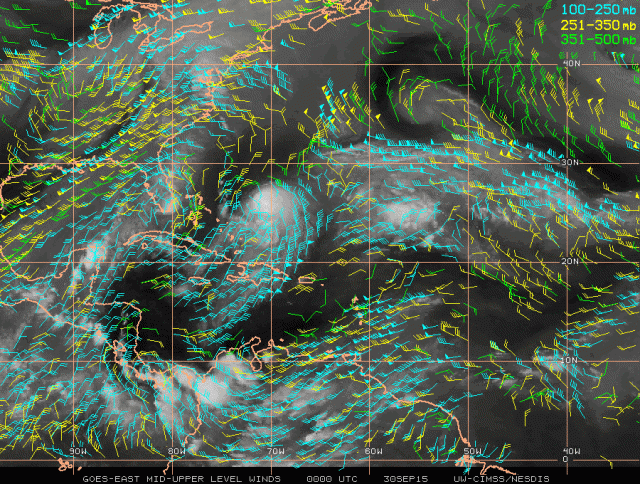
Jo upper winds

As discussed above, northwesterly shear has been affecting Joaquin thus far during its brief life as a tropical cyclone due to an upper level anti-cyclone to the west of the storm. As Joaquin continues to fire off intense thunderstorms and drift west, and as the anti-cyclone slides east a little bit, this shear will relax. There is already exceptional outflow to the south of the storm, and outflow would also occur to the north of the storm as the fringes of a jet streak over the southern and eastern US affect Joaquin over the next few days.
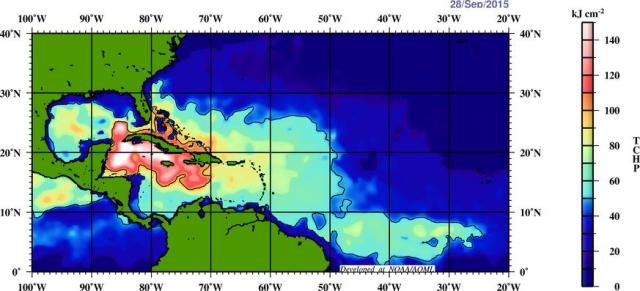
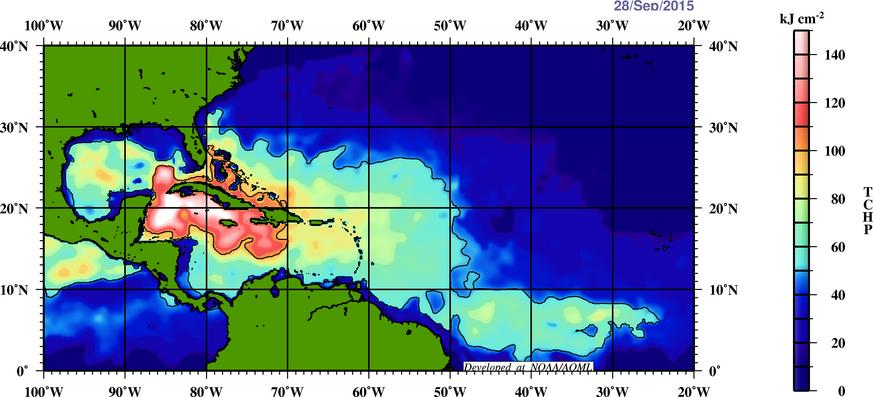
Jo TCHP

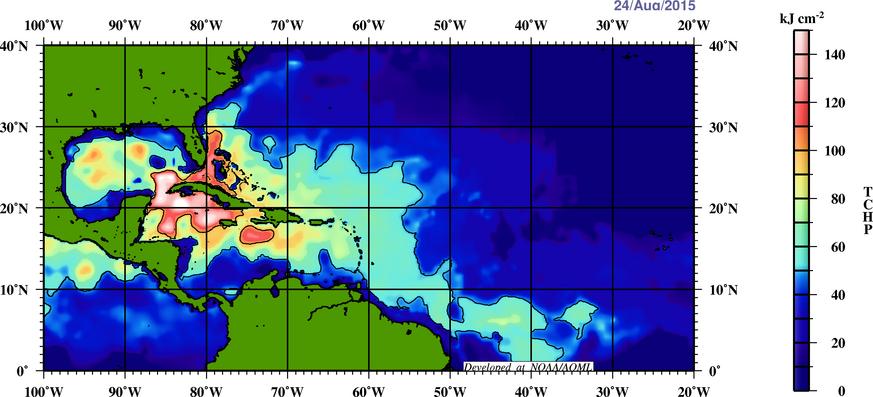
In addition to the low shear, strong outflow environment Joaquin appears to be moving into, water temperatures are very warm over and east of the Bahamas, with widespread 29-31C waters in this area. As per the image above, the warmth extends down to a reasonable depth until you get well north of the Bahamas, suggesting that even the Joaquin is slow moving, it shouldn’t upwell enough cold water to become detrimental over the next few days, assuming it keeps moving some.
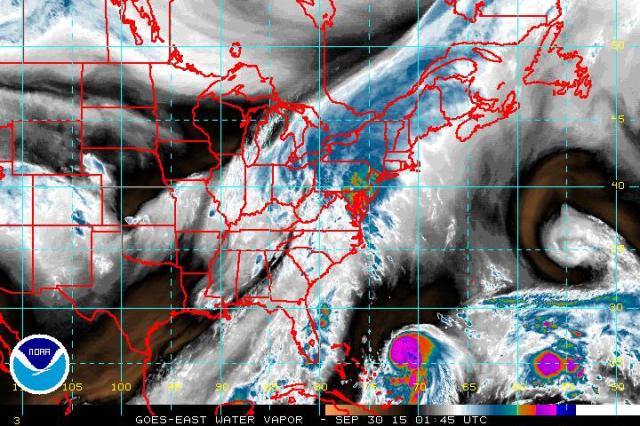
Jo WV

There is some dry air north of Joaquin, however in general there is very moist and unstable air over the western Atlantic. Dry air usually doesn’t interrupt convection in stronger tropical cyclones if shear is low, which is expected to be the case soon, and otherwise the thermodynamic environment favors strengthening over the western Atlantic.

All told, signs point to rapid intensification of Joaquin being a distinct possibility over the next couple of days due to low wind shear, strong outflow, a favorable thermodynamic environment and warm to very warm water temperatures in the path of the storm. I expect Joaquin to become a hurricane on Wednesday and quite possibly a major hurricane by Thursday or Friday.
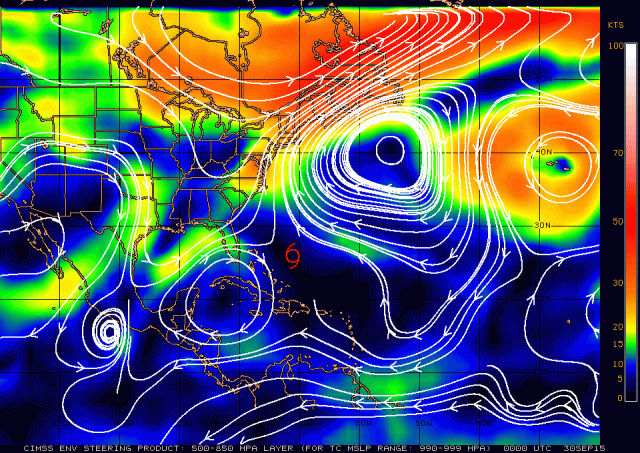
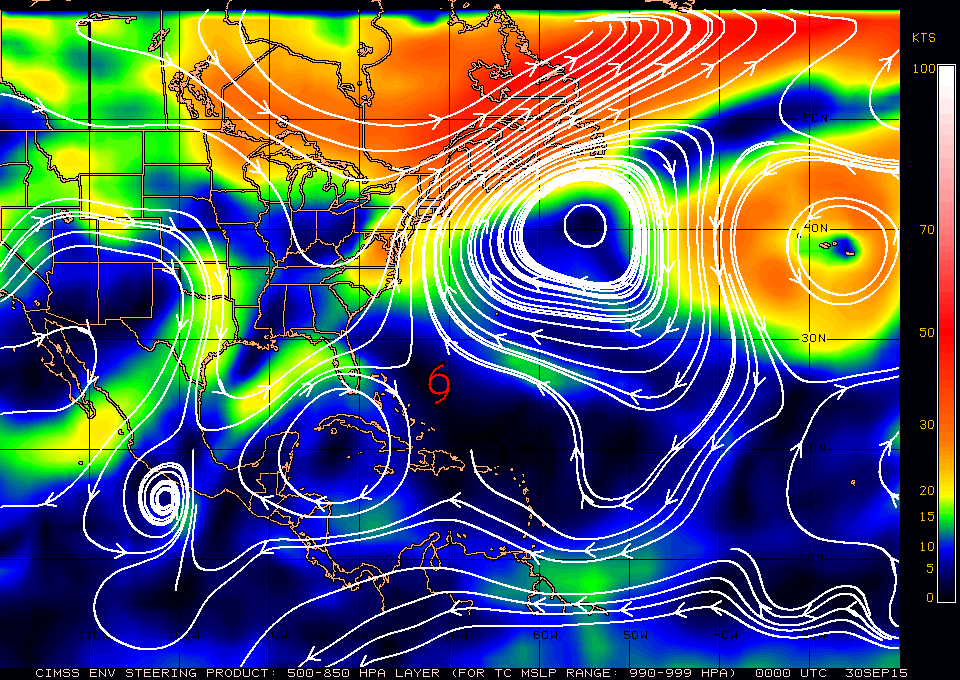
Jo steer current

The track forecast of Joaquin in both the short and medium term is complicated, but of the utmost important due to potential impacts to the Bahamas and US East Coast. Joaquin is currently located within an area of weak steering currents; a large ridge is located over the NW Atlantic ocean, attempting to impact a west or northwest motion on the storm, while another, smaller ridge located over the northern Caribbean is attempting to impart a southeast motion on the storm, while at the same time a trough of low pressure is starting to dig across the eastern US, that may try imparting a northerly motion on the storm. Not to be forgotten, the remnants of Ida are located east of Joaquin, and while they’re too weak to have a steering impact now, if they reorganize then it’s quite possible they try to tug Joaquin more southeast as well.

Right now, the ridge over the Northwestern Atlantic appears to be “winning” for the most part with a general slow, westward drift. The question is, will that continue?

Jo steer current

In the near term, as Joaquin continues to intensify, it appears that the ridge to its west may have increasing influence, as it appears to be stronger in the upper levels, per the layer of deeper steering currents shown in the above image. This could cause a west-southwest, but slow, motion to continue through the near term. However it’s important to note that if Joaquin does move farther north that it would feel increasing influence from the eastern US trough and ridge over the NW Atlantic. It’s also important to note that a stronger Joaquin would likely help pump up heights in the ridging over the NW Atlantic, which could ultimately try to push the storm farther west while also helping the trough over the eastern US amplify further.
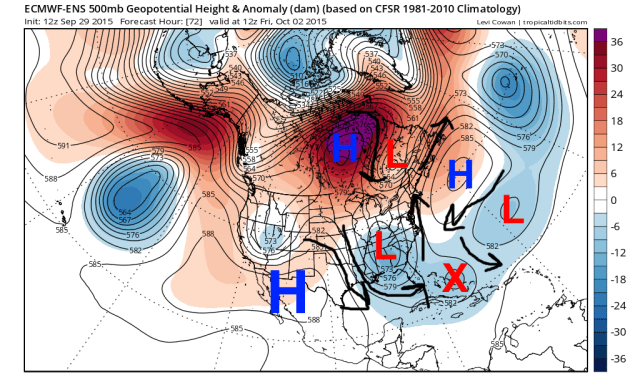
Jo EPS 48

Several features are expected to be influencing the steering of Joaquin (X on the map) by Friday. The trough over the Ohio Valley/SE is expected to dig in response to ridging stretching from Mexico though the Midwest to near Hudson Bay. The NW Atlantic ridge is expected to prevent the trough from quickly sweeping off the East Coast. In addition, the ECM Ensembles (above) show a bit of a low south of the NW Atlantic ridge, possibly associated with the remnants of Ida. The low and high create a “rex block” which is hard to move, however, if the low becomes stronger east of Joaquin, it may have a larger impact on the steering of the system.

At this point in Joaquin’s life, there are three main options:

  • The trough digs enough and/or Joaquin is far enough north that the flow around the SE US trough pulls the system north or northwest. The trough and Joaquin phase and the trough becomes strongly negatively tilted and cut off, allowing Joaquin to likely move into the Mid Atlantic coast.
  • The trough doesn’t dig enough, or Joaquin is too far south, and the trough kicks Joaquin to the northeast. The NW Atlantic ridge is too weak and the low south of the ridge too strong to push Joaquin back towards the US Coast, the storm goes out to sea.
  • The trough starts kicking Joaquin to the northeast, but the NW Atlantic ridge is strong enough to keep Joaquin in the fray, and the system eventually starts bending back to the north-northwest, potentially towards the northern Mid Atlantic or New England.

At this point, it’s hard to say which option is most likely. Wednesday afternoon’s CMC and UKMET models chose option 1 and showed Joaquin landfalling in the Mid-Atlantic this weekend. This afternoon’s GFS model and Euro both showed option 2 and took Joaquin out to sea, although significant rain associated with a predecessor rain event (PRE) still occur over parts of the Mid-Atlantic and New England. The 18z GFS trended significantly stronger with its representation of Joaquin and showed option 1 playing out, a significant run to run change in the model.

The 12z ensembles had some mixed signals, but were interesting nonetheless.

Canadian Ensembles:
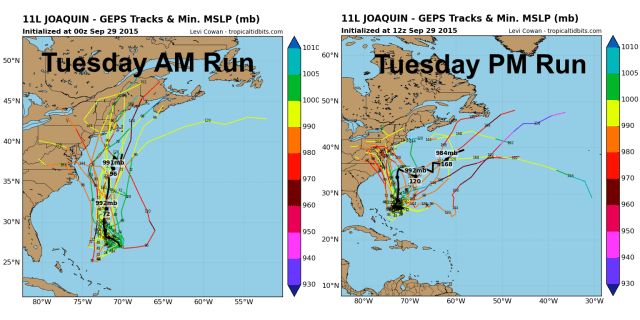
Jo GGEM ensembles

The Canadian ensembles that were run late Monday night/early Tuesday mainly kept Joaquin on an option 2 or 3 track, with three members going into the Mid Atlantic, five going into New England and 5 staying completely out to sea. The Tuesday afternoon run showed more than half of the members taking Joaquin into the Mid Atlantic, with one brushing New England, and the rest (five) staying out to sea completely. A definite trend to the “left”. It’s also worth noting that more 12z members took Joaquin very close to the Bahamas.

GFS Ensembles:
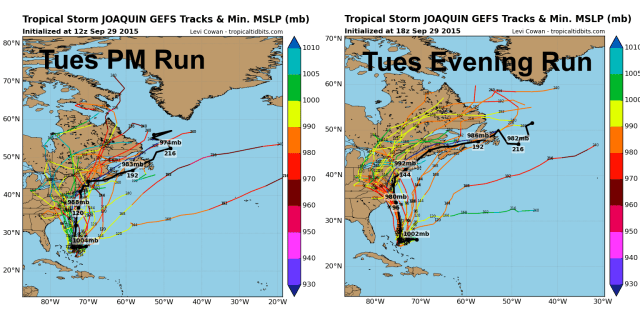
Jo GEFS

Much like the Canadian ensembles, the GFS ensembles have trended significantly LEFT today, with the emphasis shifting from about even across the Mid Atlantic and New England to more Mid Atlantic hits.

ECM ENS:
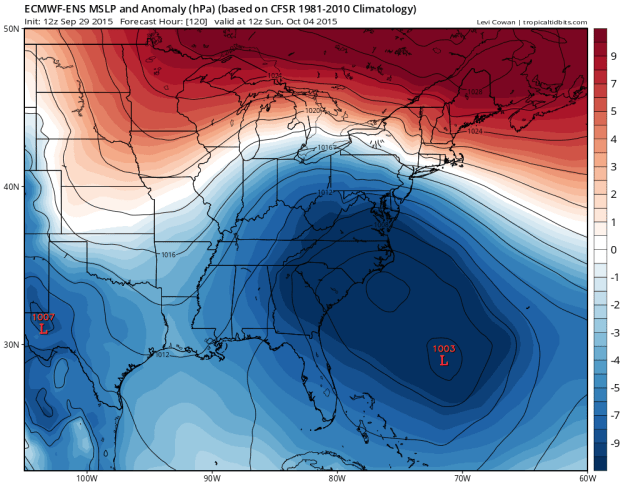
Jo ECM ENS slp

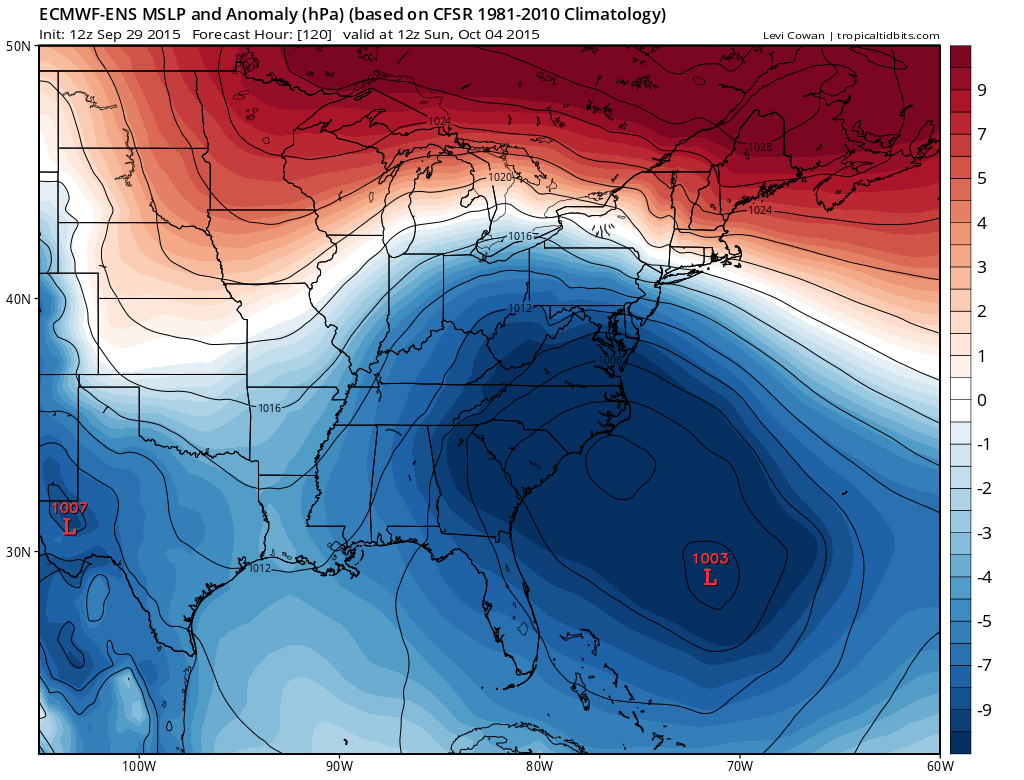
The European ensembles in general, on the mean, appear to keep Joaquin off the coast, however it appears that a sizeable camp take Joaquin into the Carolinas or extremely close to them.

In general, there is ensemble support for all three possible solutions above, although in general the trend today from every model except for the operational Euro has been to the west or left, towards the East Coast or farther south on the coast. You can see why when looking at the changes in the patterns on the ensembles for the Friday-Saturday timeframe:
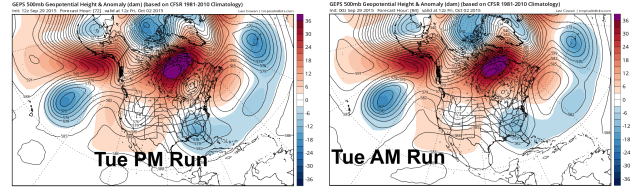
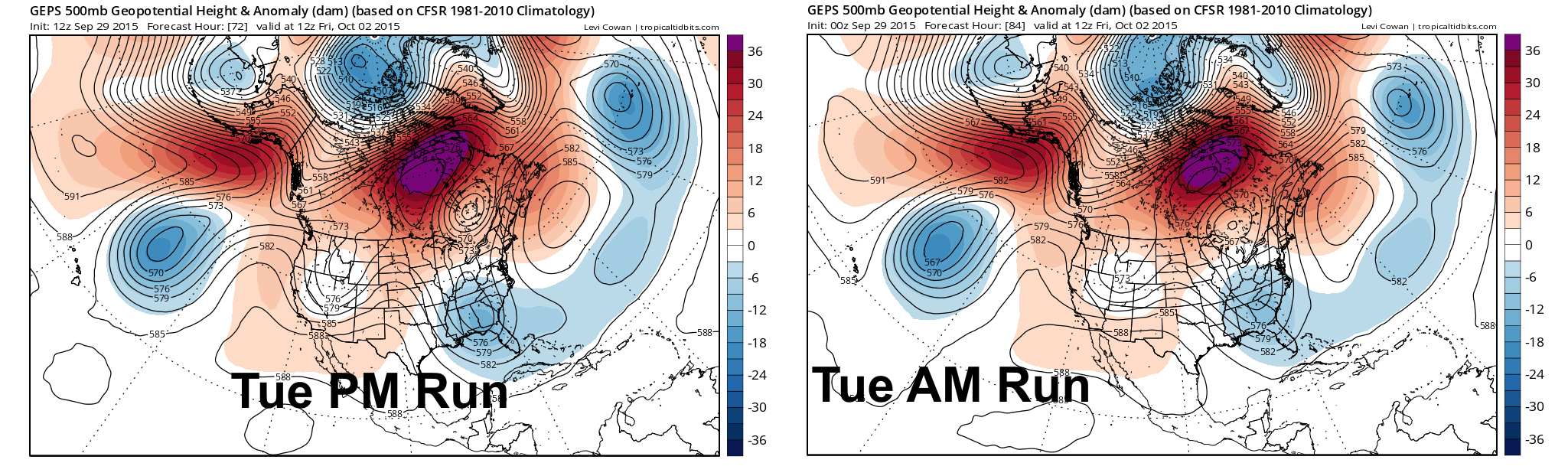
Jo GGEM ensembles trend

The GGEM ensembles show a much more robust trough over the SE US that digs farther and cuts off sooner. If Joaquin is too far south of the base of the trough, it would get kicked east by it. If it is along or north of the latitude of the base of the trough, and the trough cuts off sooner, it’s more likely to get pulled back west by it.

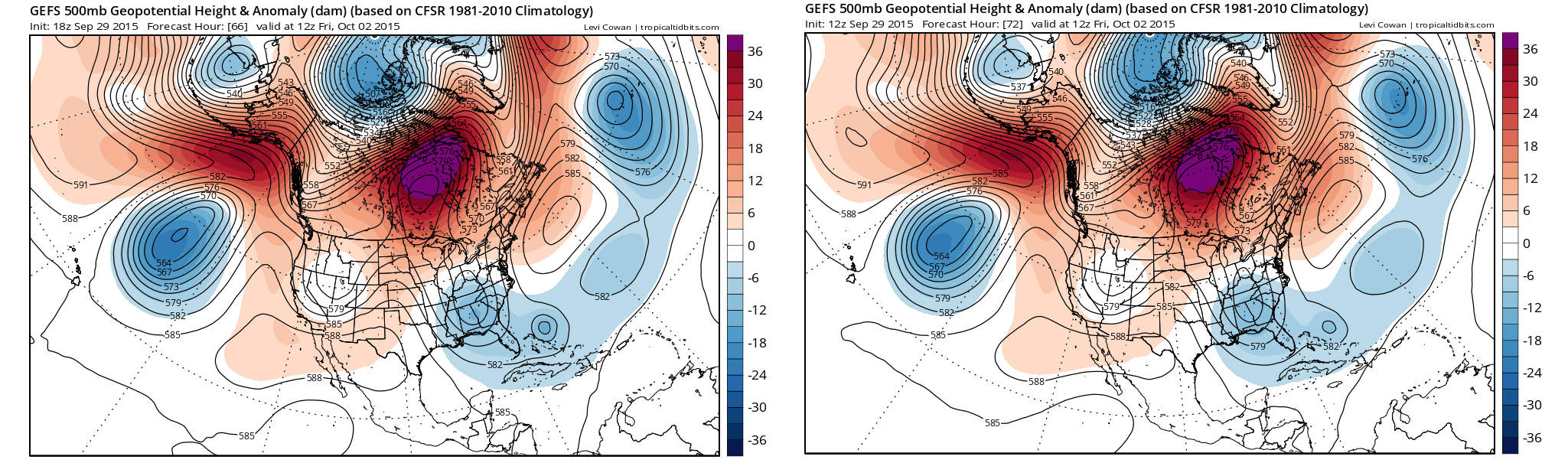
A similar trend is noticeable on the GFS ensembles:
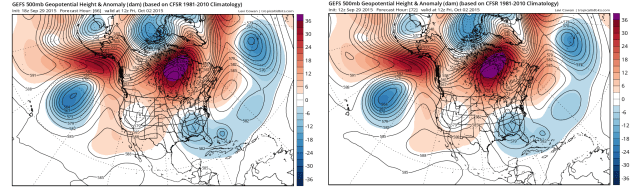
Jo GEFS change

Also of note, the later runs of the ensembles also appear to be slightly stronger with the NW Atlantic ridging, which may be key in helping the trough stall/dig while making it harder of Joaquin to slip east.

The Euro ensemble images are only freely available on 24 hour intervals and I don’t want to post off of a pay site right now, but the trend is noticeable in both NW Atlantic ridge strength and SE US trough strength/location.

The TREND has been for a pattern more conducive for Joaquin tracking towards the eastern US.

It should ALSO be noted that the trend on the GFS runs (0z Wednesday run continues the farther west trend) occurred when the model finally started properly depicting Joaquin’s expected near term strengthening. This makes sense, as a stronger hurricane would help amplify the ridging over the NW Atlantic, which at the end of the day makes a Joaquin eastern US landfall more likely.
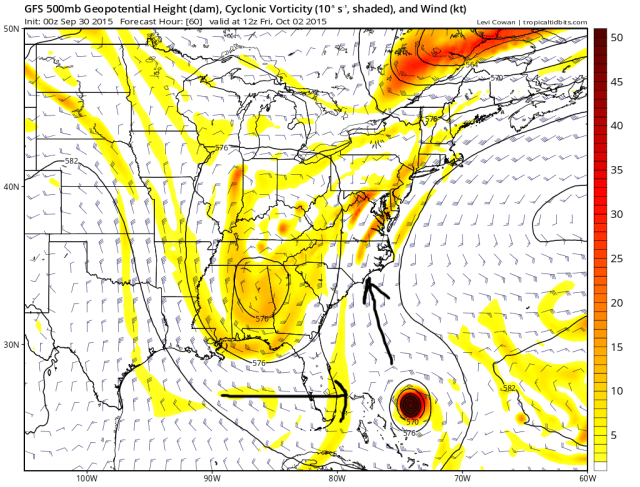
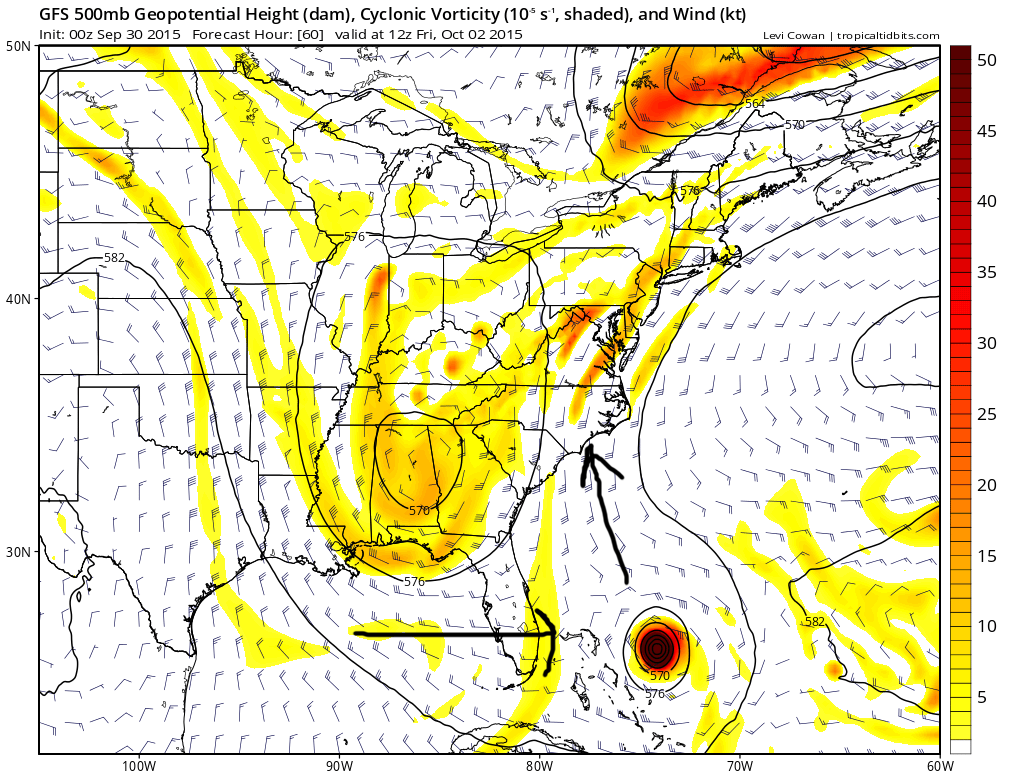
Jo GFS 500 72

Where Joaquin goes over the next 2-3 days is also important. The farther SOUTH Joaquin is, the more likely it is to be “punted” east by the base of the trough. Note how near Joaquin’s latitude on the GFS there are westerly winds south of the trough, but just north the winds turn northerly. The farther north Joaquin is, the better the odds it doesn’t curve out to sea.

It’s somewhat counterintuitive, because a stronger Joaquin may track slightly more south in the near term, but could also help beef up the ridging which in turn may cause the trough to dig farther south anyways. The recent west trend in the models is generally associated with the global models showing a stronger Joaquin, so I believe a stronger system is more prone to hooking back towards the east coast.

As of right now, I believe the left trend in today’s models made sense. My forecast track will follow the model consensus to very close to the central Bahamas, and then follow a 0z GFS/Canadian/UKMET/GFS ensemble blend. Further adjustments left could be needed if the trend for a pattern more conducive for a hard left turn towards the coast continue. The track forecast is delicate, so a miss out to sea is still possible. Continue to monitor this over the next few days!
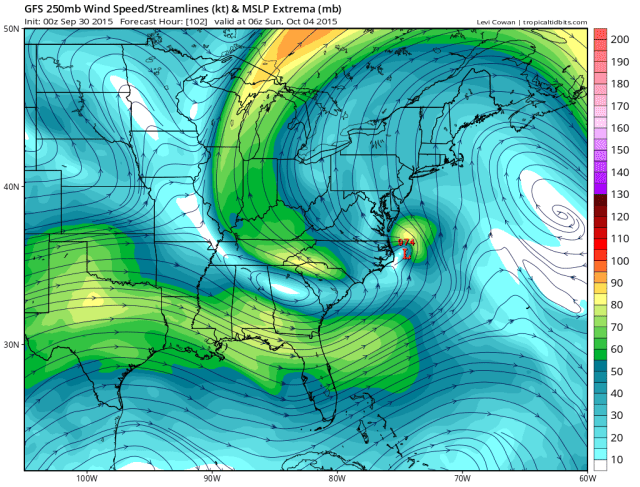
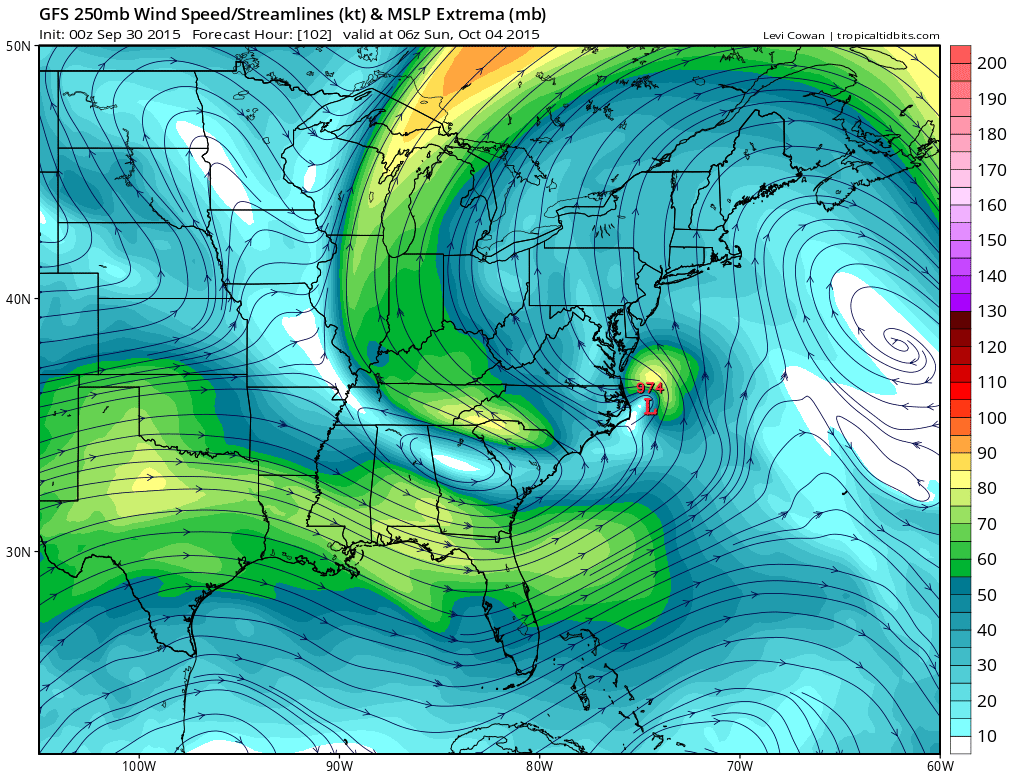
Jo GFS 102 250

Should Joaquin hook back towards the coast, strong upper level divergence near the right-entrance quad of a jet streak downstream of the SE US upper level trough could provide a baroclinic assist as Joaquin approaches land and moves inland. Water temperatures drop off quickly north of the VA/NC boarder, however this large scale ascent may help Joaquin grow larger and slow how quickly the pressure rises once it starts weakening near and upon landfall.

This jet streak could also start shearing Joaquin just prior to landfall. Unless Joaquin goes well north towards New England, I believe it would be mostly tropical at landfall due to warm SSTs up to near the landfall point and shear not increasing until just prior to landfall, although some degradation to the storm’s structure as it nears the coast and some weakening would still likely occur.
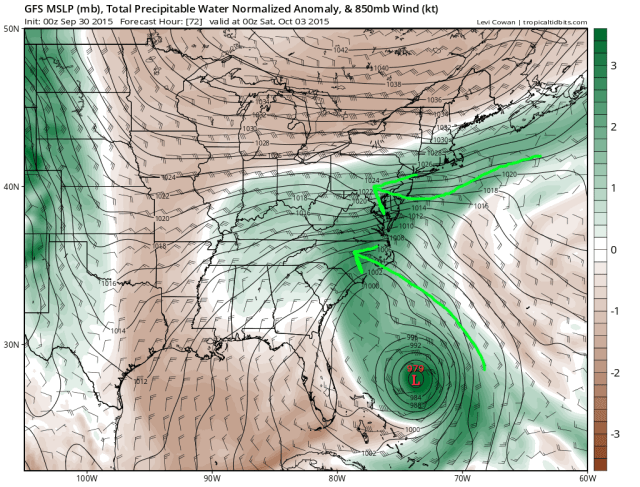
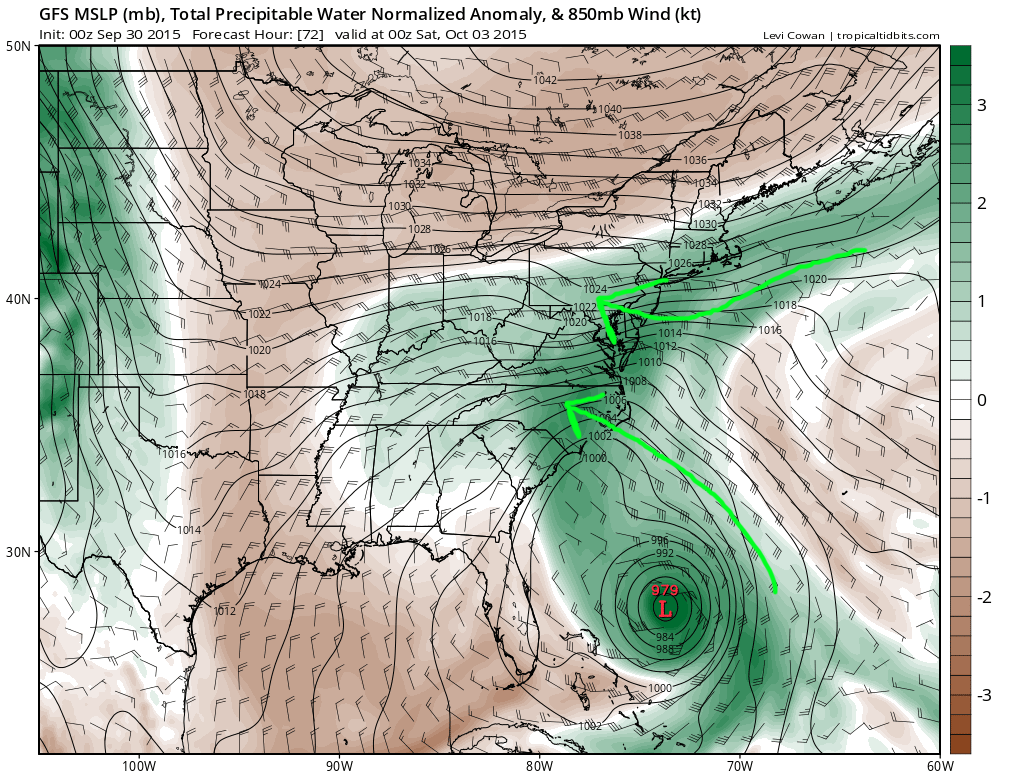
Jo GFS PWAT

Whether or not Joaquin makes a direct landfall on the east coast, a prolonged period of easterly winds will bring abnormally high moisture into New England and the Mid Atlantic. This moisture will run into a frontal boundary stalled near the coast and produce days of heavy rainfall for these areas on top of already saturated grounds. If Joaquin’s center actually crossed the coast, some areas would see even more excessive rainfall.
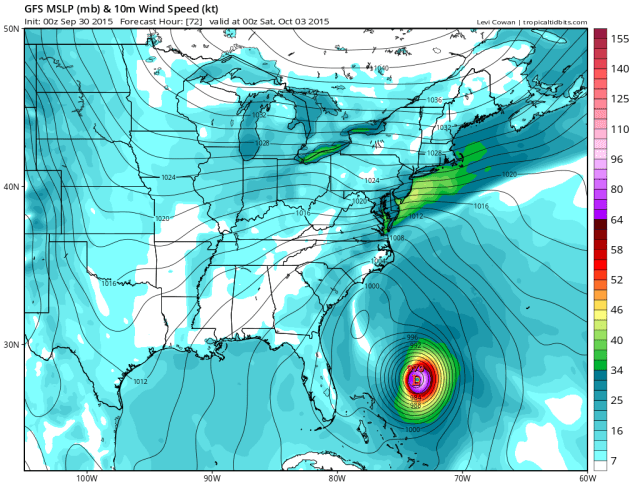
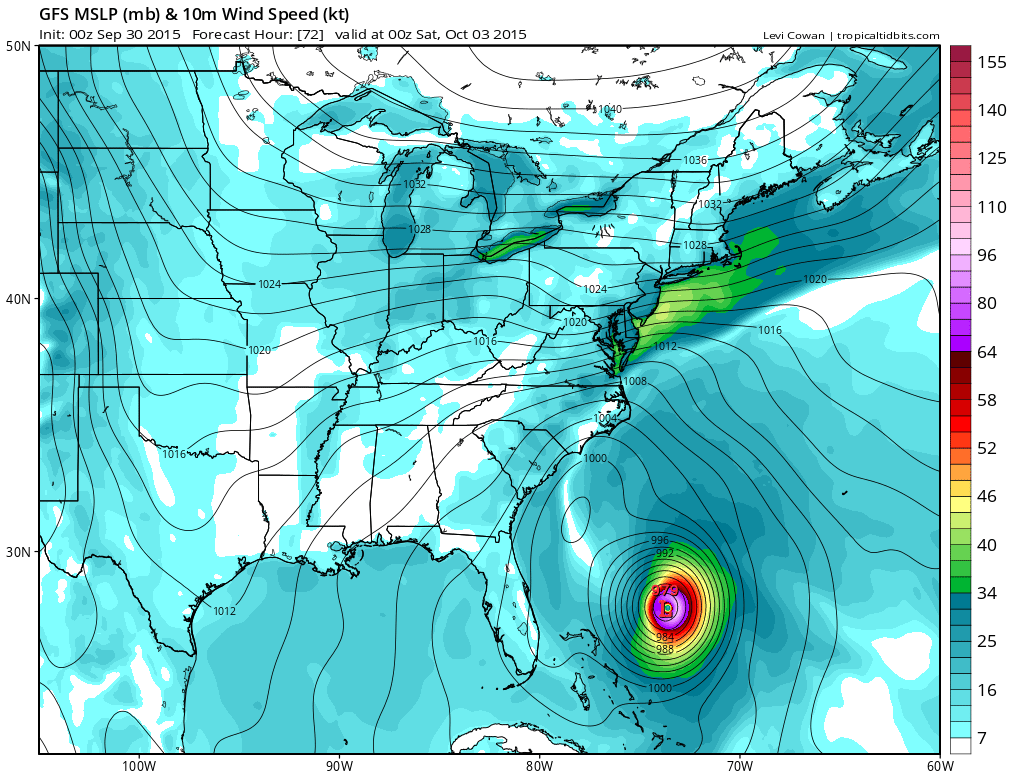
GFS 72 wind

In addition, a strong pressure gradient between Joaquin and a high pressure over Canada will cause a prolonged, strong onshore flow into the Mid Atlantic well ahead of the storm. Regardless of if Joaquin hits the coast, moderate coastal flooding seems quite possible. Severe storm surge could occur if Joaquin hits the coast directly, especially since water will be piling up WELL before the storm.

Significant flooding and downed trees could occur well inland into Appalachia should Joaquin make a direct landfall and sling shot more west like some models like the HWRF, 0z GFS and 12z UKMET show.

Forecast Map:
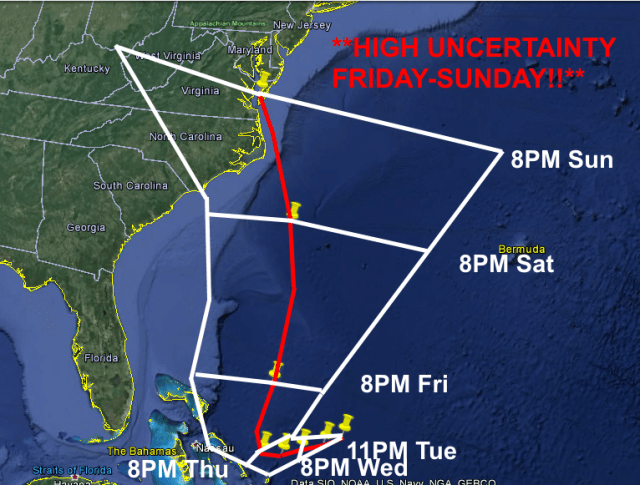
Joaquin map

Coordinates/Intensity:

11PM Tue…Initial…25.8N, 71.7W…60 kt TS

8AM Wed…25.5N, 72.4W…65 kt Cat 1

8PM Wed…25.2N, 73.3W…85 kt Cat 2

8AM Thu…25.0N, 74.0W…95 kt Cat 2

8PM Thu…25.0N, 74.8W…105 kt Cat 3

8PM Fri…27.5N, 74.5W…110 kt Cat 3

8PM Sat…33.0N, 74.2W…100 kt Cat 3

8PM Sun…37.5N, 76.0W…80 kt Cat 1

Intensity probability table:
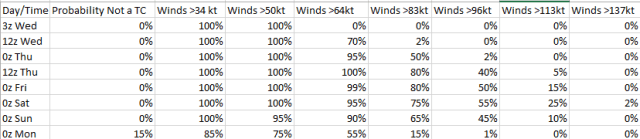
Joaquin probs

Posted in Uncategorized | Leave a comment

Significant Lake Effect Rain This Weekend

I’ll be home this weekend and the Indians are playing the Tigers in Cleveland, so of course it will rain!!

General Summary:

An unseasonably cold airmass will move into the Great Lakes this weekend. A low pressure system tracking to our east Friday night through Saturday night will spread in a “general” rain Friday night, with some lake enhancement to the rain occurring. Moderate rain amounts are possible Friday night. On Saturday more traditional lake effect rain will take over, with additional moderate amounts of rain looking possible. With a northerly wind on Saturday, the west side should get in on some of this lake effect rain too. More significant lake effect rain looks likely Saturday night as a disturbance increases moisture and instability over Lake Erie and also provides a better focusing mechanism for rain. Moderate to locally heavy additional rainfall amounts are possible Saturday night, including on the west side. On Sunday the atmosphere will gradually warm and dry out as winds shift more westerly, which will gradually push the lake effect to just the east side and cause a decrease in intensity.

All told, 1-2″ of rain is likely downwind of Lake Erie this weekend with less well south. Locally higher amounts and some flooding are possible where persistent rainbands develop. Outdoor plans will be a wash for much of the weekend.

Meteorological Details:

NAM 24

Pretty complicated forecast starting Friday afternoon in terms of when it will rain and how heavy it will be. A secondary cold front will move across NE Ohio early Friday afternoon with perhaps some widely scattered showers, and by evening some isentropic lift behind the front will overspread the area along with decent large scale ascent from a seasonably strong jet streak and positive vorticity advection overspreading the area. The 0z NAM has a nice surge of mid-level RH in this timeframe. This all should be enough to generate a period of synoptic rain Friday evening…however, the duration and intensity of the synoptic rain is uncertain. The hi-res NAM, Canadian, NMM and ARW for instance are sharper and slower with the trough and farther west with the surface low development Friday night into Saturday and have a 6-12 hour period of synoptic rain, while the standard 12km NAM and GFS are more progressive. The 12z Thursday Euro was slower than the 12km NAM and GFS but faster than the hi-res models and Canadian, and the 0z Euro which I just peaked at is a little slower and farther northwest with the synoptic rain. Given the trend overall over the last few model runs has been to slow everything down, and given the fact that closing off upper lows tend to progress slower than modelled, I’m going to conservatively lean towards the somewhat slower and farther west idea with synoptic rain Friday evening. I could see a general quarter inch of synoptic rain in the CLE area, maybe closer to 0.5″ for CAK with maybe closer to an inch towards YNG.

LER 1

Even if the synoptic rain isn’t heavy in CLE proper, with a NNE low level flow Friday evening and lake induced CAPE values of 500-1000 J/KG and good moisture, some lake enhancement of the rain is likely, which could push rain totals for the Friday afternoon-night timeframe to half an inch to an inch near the lake, with enhancement occurring on the west side too due to an easterly component to the winds. Shear is pretty bad above 5k feet Friday evening (but things do become better aligned later Friday night) which could keep things from getting out of control to an extent Friday night in the lake enhanced rain.

Even the slower models pull the heavier synoptic rain east by Saturday morning, but the surface low tracking farther west and the upper trough closing off and moving east slower allows enough ambient moisture in the low to mid levels to hang back on Saturday for a more pure lake effect rain to continue. The GFS shows winds holding at NE through much of Saturday while the NAM has more due north winds that are somewhat better aligned…both models have lake to 850mb temp differentials of 15-18C during the day Saturday with limitless equilibrium levels. The GFS really dries things out for a while on Saturday while the NAM maintains better moisture…given the NAM is less progressive than the GFS and I’m leaning in that direction (if not even slower than the 12km NAM), I tend to think we’ll stay moist enough on Saturday for lake effect to continue…I also think the winds will gradually back to a more northerly direction on Saturday.

ECM 48

By Saturday evening the Euro, Canadian and some of the hi-res models close off the upper level trough pretty much over OH or just to our northeast (pay sites that have the Euro at a higher resolution and in more timesteps show it occurring) while the surface low tracks towards Lake Ontario. This is a nearly perfect evolution both aloft and at the surface for significant lake effect precipitation with a nearly due north wind.

LER 2

The 0z NAM develops an astounding thermodynamic profile Saturday evening with over 2000 J/KG of lake induced CAPE for several hours and well aligned winds below 10k feet. Most models slowly drop an inverted trough across Lake Erie Saturday night in a mainly north flow with an increase in moisture and as seen above unbelievable instability. The NAM and GFS are both a bit dry Saturday night, however the 0z Euro keeps 70% or higher RH at 700mb in place through 12z Sunday which would easily do the trick. The combination of a cyclonic flow…a surface trough…orographic lift in the N or NNW flow and extreme lake induced CAPE suggests that heavy rain is possible Saturday night in the primary and secondary belts.

Conditions start to deteriorate for lake effect on Sunday as the low and trough begin moving east, but the winds will gradually turn more westerly and enough moisture and lake induced instability hangs around for light to moderate rain to continue much of the day in the Snowbelt.

All told, between the shot of synoptic rain and some enhancement Friday night…off and on lake effect on Saturday…the potential for heavy lake effect Saturday night…and at least some lake effect continuing through much of Sunday…I don’t see how areas within 20-30 miles of the lake from Lorain and Medina points east don’t see at least 1″ of rain from Friday PM through Sunday, and amounts of over 2-3″ in several areas would not surprise me. 1-3″ won’t cause much flooding, but if it gets any higher there will be issues.

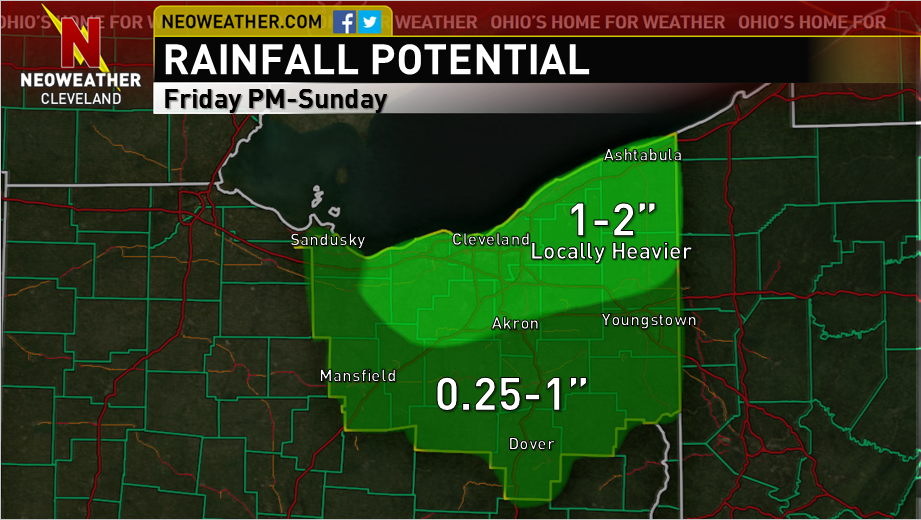
That said, I was “lucky” enough to have the forecast earlier this evening for the website I help with and included this rain map for the weekend…in the text associated with the map I mentioned locally 3″ or more of rain. Honestly after the 0z models came in slower with everything (which means more synoptic rain and better lake effect conditions hanging on for longer) I think this map may be conservative. If the hi-res models are right and we get 1-2″ of synoptic rain Friday night, weekend totals could locally push 4″+ in spots!

9-11 LER

In addition to all the rain…although a northerly flow isn’t ideal for waterspouts over the nearshore waters due to weaker convergence over the lake, the thermodynamic profile strongly supports waterspouts this weekend. Also, the NAM develops enough CAPE for small hail with any storms that roll in off the lake Saturday evening.

Posted in Uncategorized | Leave a comment

8/27/15: Forecast for Erika Continues to be Extremely Complicated in Both Short & Long Term

General discussion:

A very disorganized Tropical Storm Erika will pass near or over Puerto Rico tonight into Friday morning and near or over the Dominican Republic on Friday. Exactly how close Erika passes to Hispaniola will have a large impact on how strong the storm is this weekend as it moves over the Bahamas. The environment when combined with potential interaction with mountainous terrain suggests that Erika will either maintain its strength or weaken through Friday. Warm water temperatures, low upper level wind shear and good upper level outflow over the Bahamas this weekend into early next week suggests that if Erika can maintain itself as a tropical cyclone over the next 24 hours that intensification could occur over the Bahamas. Because of this, people in the Bahamas are urged to continue monitoring the progress of Erika; however, we could see anything between rain and breezy conditions with an open tropical wave if Erika loses its closed circulation due to interaction with Hispaniola to a hurricane by Sunday or Monday if Erika is able to maintain its identity until the weekend. We will know much more Friday night.

As for the track forecast and potential US impacts early next week, the storm will likely move somewhere over the Turks and Caicos Friday night into Saturday and through the central Bahamas and northern Bahamas Saturday night into Sunday on a west-northwest heading. Steering currents over the Gulf of Mexico, Florida and off of the southeast US coast will be rather weak Sunday into early next week, however, a stronger storm would likely turn north and potentially stay just east of Florida, while a weaker storm may continue moving more west-northwest and move into the Florida peninsula and/or into the Gulf of Mexico early next week.

The track forecast for Erika starting Saturday will be strongly influenced by the intensity forecast. Due to considerable uncertainty regarding the intensity of Erika after Friday and weak steering currents in the region, the track forecast is unusually uncertain at this point in time. In general I am leaning towards the farther west/weaker solution at this time, however.

Necessary Disclaimer: The thoughts in this post are mine alone and should not be used for any decision making purposes. For official forecasts, go to:

www.weather.gov (National Weather Service)

www.nhc.noaa.gov (National Hurricane Center)

Heed any advice from local emergency management officials this weekend and into early next week.

Although the forecast is less than clear cut, interests in the Turks and Caicos, central and northern Bahamas, the entire Peninsula of Florida and the southeast US coast from North Carolina southward should closely monitor the progress of Erika over the next several days.

Meteorological Discussion:

Erika IR

Erika remains a fairly disorganized tropical storm as it was two days ago when I last posted; as expected. However, Erika thus far has held its own despite moderate westerly shear. There is a lot going on right now as I type this, and the next day of Erika’s life will have significant impacts on what happens to it down the road. I will likely re-iterate this several times in what is going to be a long write-up, but this is a complicated forecast with large implications for the SE US coast, Florida and still possibly the eastern Gulf of Mexico.

Infrared satellite imagery shows a large burst of disorganized convection well south of the low level circulation, and a smaller burst near St. Croix. Where the low level circulation is currently located is in doubt; the 8PM EDT/0z NHC advisory had the center at 16.7N, 64.7W and an initial recon pass found a very lose circulation in a similar area:

Erika recon

However, as can be seen above on their second pass there was no evidence of a circulation in that vicinity! They fixed what I believe is a weak low level eddy for their second and third pass. Radar and surface observations suggest that another low level center of circulation formed very near St. Croix in this same general timeframe, with the pressure at TISX (airport on St. Croix) falling quickly to 1006mb and then quickly rising after the feature went by. Several wind gusts over 50 knots were recorded on St. Croix. Here is the old “recon center” on radar and the newer possible center:

Erika radar

As this center moves towards Puerto Rico over the next few hours, surface observations on the island will give us a much better idea on whether or not this is a closed off surface center…although radar seems to strongly suggest as much. This potential center appears to be have a heading of slightly north of due west based on radar, probably around 280. Such a heading would take Erika directly into Hispaniola early Friday.

After discussion with others and continued observations as I’ve typed this, I believe that the center that moved over St. Croix is just a very strong eddy rotating around a very broad low level center. I believe recon is fixing another, weaker eddy as the center. After analysis of satellite loops I will use the NHC’s 11PM EDT/3z center location of 16.6N, 65.3W as my initial center point.

It is possible that the heading of Erika continues to change; Wednesday night into Thursday morning, a consistent strong burst of convection south of the surface center pulled the center south, resulting in a due westerly heading that took Erika much farther south than forecast. Thursday afternoon the burst of convection south of the center waned and a new burst formed east of the center, resulting in almost a due northwest motion for several hours, followed by a more due west motion over the last couple of hours per the TJUA radar. An average motion over the last 12 hours, overall, is probably about 285, and I’ll use that for the initial motion in my forecast. It is possible that convective bursts continue to cause unexpected wobbles in the motion of the low level center.

Erika current steering

Erika is currently being steered by a strong sub-tropical high pressure to its north. The combination of this high being a little bit stronger than expected and convection consistently firing south of the center has resulting in the track being farther south than anticipated over the last day or so. As Erika reaches the western edge of the nearly stationary sub-tropical ridge, it should gradually gain a stronger northerly component of motion.

The 18z GFS, 12z ECM, 0z early hurricane track models, current motion and current steering flow suggest that in the near term Erika will move over western Puerto Rico and over a good portion of the northeastern Dominican Republic over the next 24 hours, emerging over the Turks and Caicos late Friday night into Saturday morning. It is possible that Erika sees a NW tug as it hits the Windward Passage late tonight thanks to frictional convergence as the surface center passes Puerto Rico and I will show that to an extent on my track forecast. How exactly the low level center interacts with the mountainous terrain of Hispaniola and if bursts of convection cause continued wobbles in the motion of the center do add some uncertainty to this forecast, but I will bring Erika or whatever is left of it out to the Turks and Caicos late Friday night, as I believe the convection will become focused north of Hispaniola and attempt to drag the low level center (if there is one left by that point) farther north.

Erika WV

The environment immediately ahead of Erika features moderate to perhaps strong westerly shear due to 1) a shear axis trailing a TUTT to the northeast of Erika and 2) another upper low near western Cuba.

I suspect that the interaction with the mountainous Hispaniola and shear over the next 24 hours will likely cause Erika to at least temporarily degenerate into an open wave…however, the GFS and Euro both maintain a robust mid-level circulation past Hispaniola, which could foster redevelopment over the Turks and Caicos. This can be seen clearly on the 18z GFS depiction of 700mb height/wind/vorticity over the next 36 hours:

Erika GFS GIF

The environment by this weekend as discussed in my previous post is still expected to be quite favorable for re-intensification of Erika thanks to very warm water temperatures, low shear and good upper level divergence/outflow over the region:

Erika SST

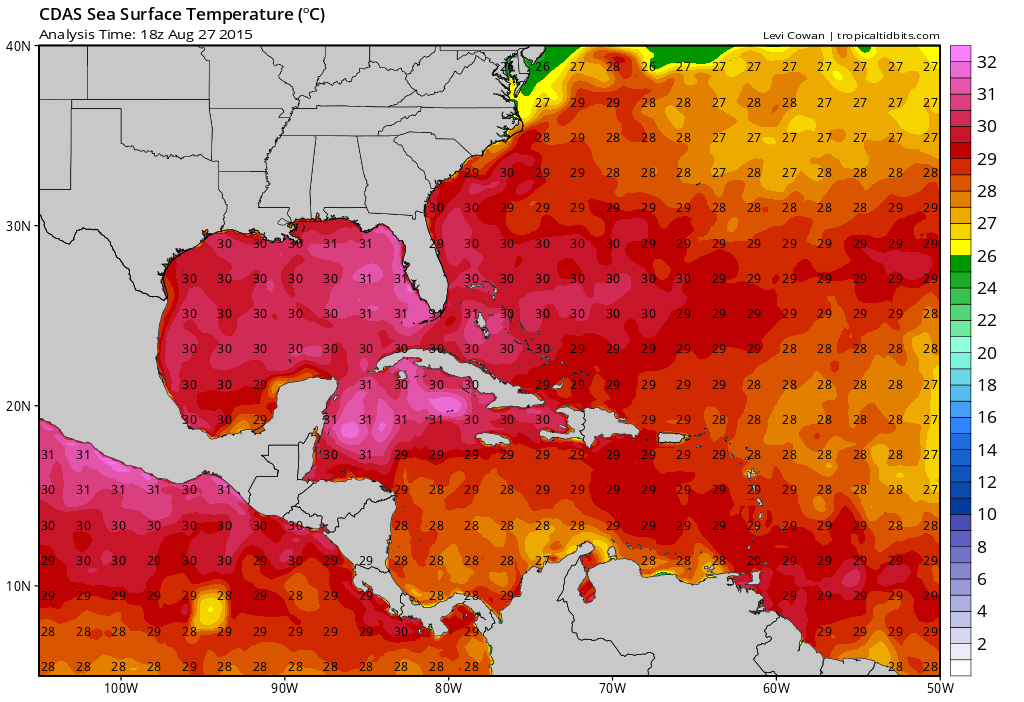
Sea surface temperatures ahead of Erika increase to 29-31C (84-88F) over the Bahamas and off the Florida and southeast US coast, and as I discussed in my previous post these warm waters exist to deep depths, meaning there is plenty of fuel for a tropical cyclone in this area and that cooler waters wouldn’t quickly upwell under the system and slow intensification.

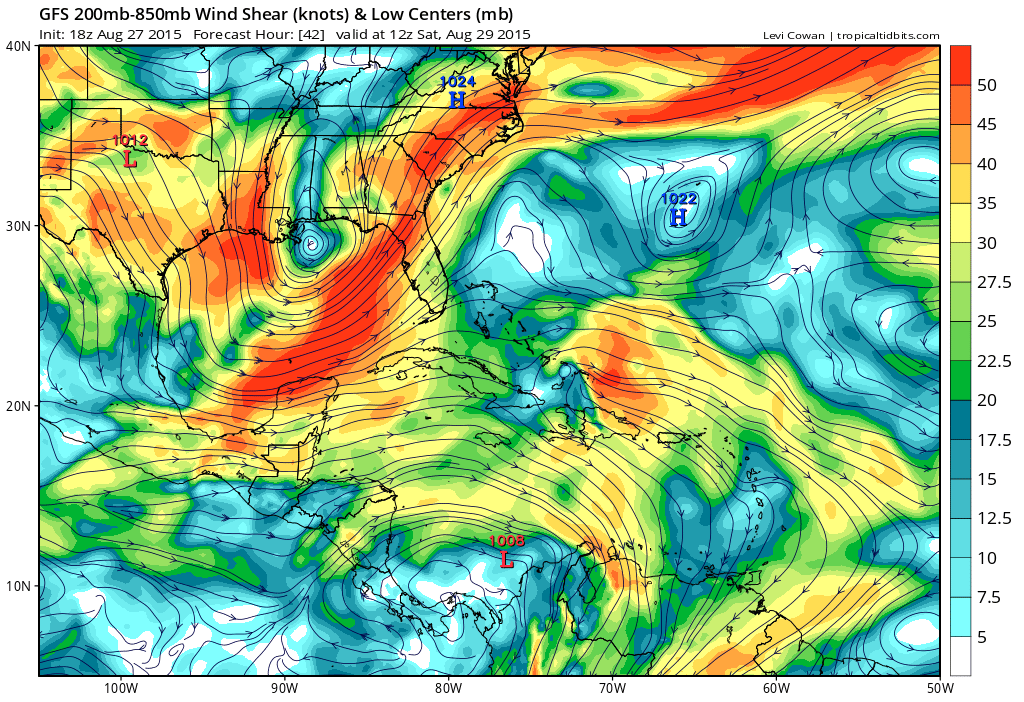
Erika GFS 42

By Saturday morning, the GFS still continues to start weakening shear over Erika as it moves over the Turks and Caicos. There is still some light to moderate westerly shear over the system at this time, but note how shear is beginning to relax near the system, with winds starting to fan out away from it, indicative of good outflow. The 12z Euro also shows a similar idea Saturday morning:

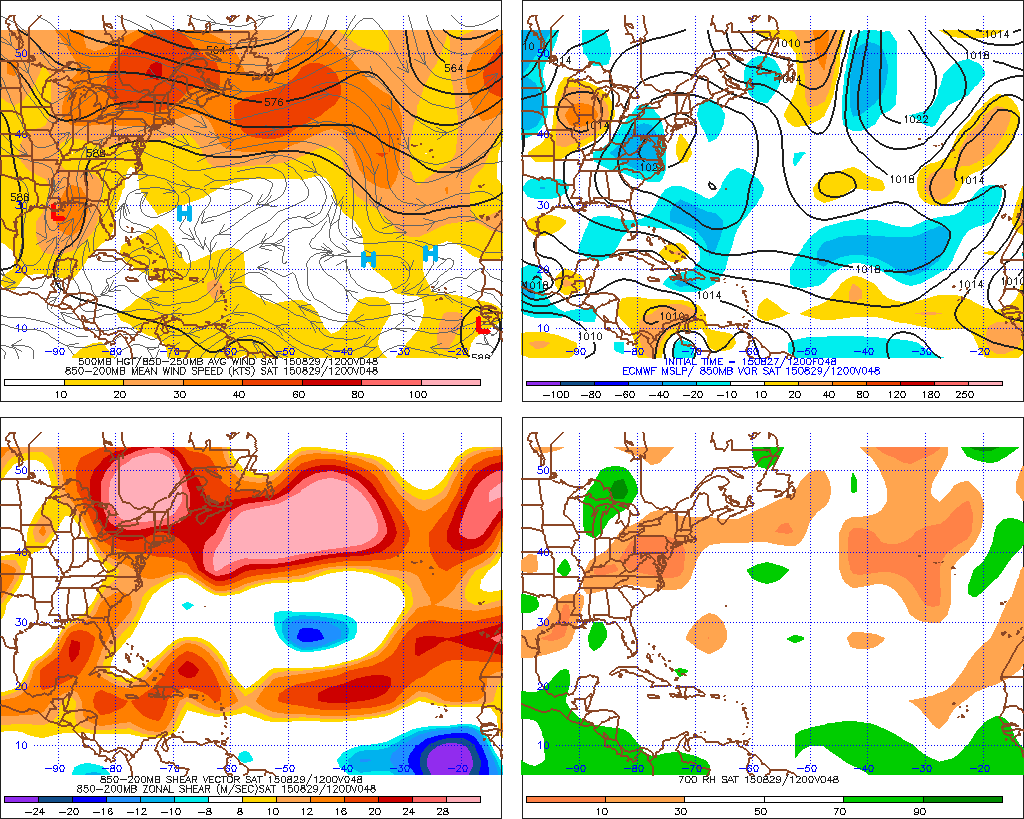
Erika ECM 48

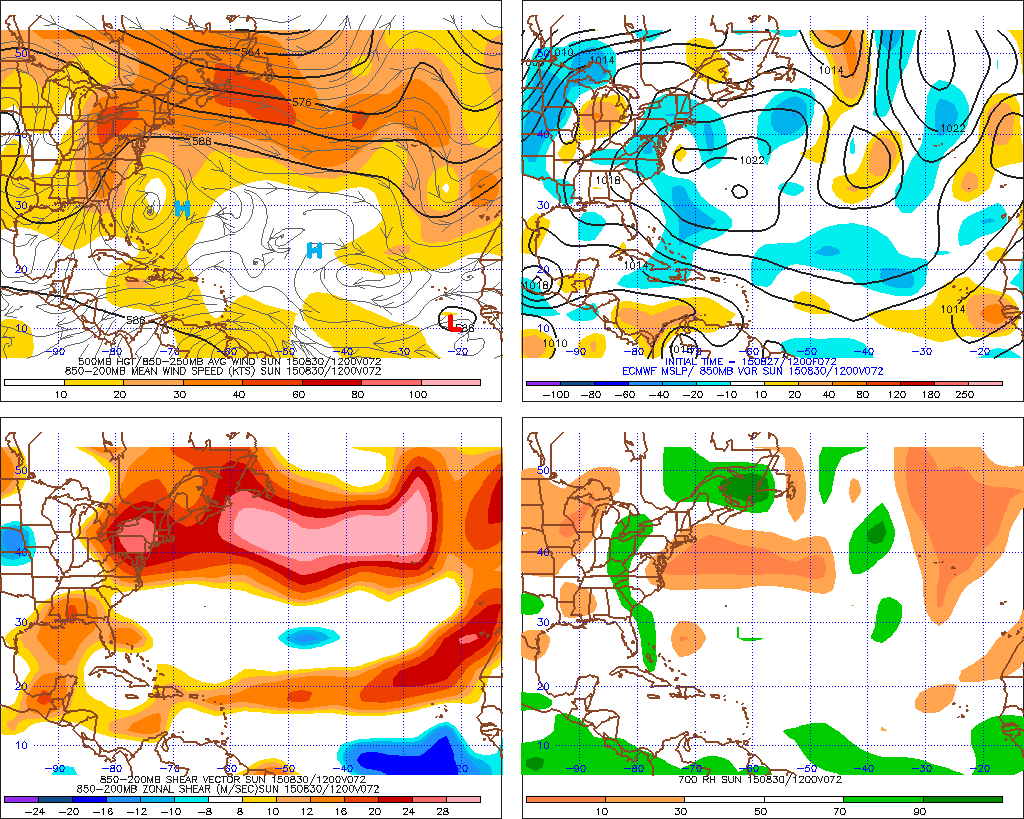
By Sunday morning, both models show an *outstanding* upper level environment over the Bahamas as Erika passes through, with strong outflow and low shear thanks to an upper level anti-cyclone over the storm; this image is a classic pattern for an intensifying tropical cyclone, with an upper level anti-cyclone over the storm and a jet streak ventilating the storm and providing for strong outflow:

Erika GFS 66

The 12z Euro looked similar (although it is noticeably faster with Erika and is approaching Miami Sunday morning as a minimal tropical storm):

Erika ECM 72

This all adds further intrigue into both the intensity and track forecast. Let’s again explain why the track forecast Sunday into early next week depends strongly on how intense Erika is by that time:

Erika GFS 850

The Sunday evening steering currents on the 18z GFS in the lower levels (what would steer a minimal tropical cyclone) show a very modest weakness in the ridging off the SE US coast, but in general show reasonably strong ridging into the SE US that would keep an open wave or weak tropical cyclone moving generally WNW or NW. However, the 500mb map features a larger weakness in the ridge due to a weak upper level trough over the Mississippi Valley, with the ridging centered farther east than at 850mb…suggesting that a stronger system steered by a deeper layer of winds would likely start turning more northerly quicker than a weaker one:

Erika GFS 500

The trough in the upper levels is very weak and essentially cut off from the flow thanks to a strong –PNA driving the polar jet into Canada, so predictability of this feature may still be questionable; the European ensembles over the last two days of runs have trended slightly weaker and farther northeast with this trough, and have trended slightly stronger with ridging in the western Atlantic for the forecast time verifying Sunday morning:

Erika ENS GIF

On the balance, this likely means that a stronger storm would likely recurve slightly closer to the coast. Whether or not a strong storm hit the coast may depend on when exactly it got stronger. If the system did recurve off the coast, the pattern would support a strong storm moving slowly off the SE US coast, but likely would then whisk it out to sea before it got into the Mid-Atlantic:

Erika ENS 120

Although the steering flow off the SE US would likely be very weak early next week, IF Erika got strong in time to recurve east of Florida, the flow around the ridge would likely move it slowly northeast before it eventually started getting caught up in the westerlies off the Mid-Atlantic coast. We will have to monitor the forecast depth of the trough over the NW Atlantic over the next few days to ensure that a recurve away from the Mid-Atlantic and New England would remain the favored solution for a stronger Erika; if that trough becomes shallower or shifts farther east it could open the door for a track farther north…however, a lot would have to go very well for that to happen, and at this point I’m treating it as a very low probability event.

Here is some of the latest guidance on Erika:

0z early track models:

Erika ATCF

18z GFS ensembles:

Erika GEFS

JUST IN 0z GFS through Sunday evening:

Erika GFS GIF 2

12z ECM:

Erika ECM GIF

12z ECM ensemble mean valid day 5:

Erika ENS 120 sfc

Overall, putting together the intensity forecast considerations and track forecast considerations, here are my final conclusions:

A significant interaction with Hispaniola is likely over the next 24 hours thanks to slightly stronger ridging north of the storm than previously expected and convection firing down-shear of the center dragging the center farther south than expected at times over the last two days. The combination of moderate to strong wind shear and interaction with the mountainous terrain of Hispaniola over the next 24 hours will in my opinion either cause Erika to generate into an open wave or weaken into a very broad and disorganized circulation, especially when considering the very marginal organization as discussed above.

Steering currents and all model guidance suggest a turn slightly more towards the northwest by Saturday taking Erika through the Turks and Caicos and north of Cuba. Although factors strongly support re-intensification of Erika over the Turks and Caicos and Bahamas Saturday into Sunday, it will likely take a day or two for the low level center to reorganize and allow proper intensification to begin. Due to this, Erika will likely remain weak and steered by the somewhat faster and more easterly low level flow through the weekend. The fact that the Euro has been fairly consistent with a faster/farther left track and the new GFS with data from an upper air surveillance mission inputted into the model’s initialization gives me more confidence in this idea. With this said, I will lean towards the GFS timing a little bit as current satellite loops suggest the 12z Euro is running several hours too far…and it seems too fast this weekend when the steering flow weakens some. This gives Erika roughly 48 hours to organize before potential impact with Florida.

Given limited time to re-organize and what I think will be at least a 24 hour process for the low level circulation to tighten back up after passing Hispaniola, I currently think it’s unlikely Erika intensifies beyond tropical storm strengthen before hitting Florida. Due to the faster/weaker/farther left solution I’m favoring, I am not going to show a recurve east of Florida for my track forecast for Erika. Erika would likely begin to stall over Florida and possibly begin recurving there as it begins rounding the southwesterly edge of the low level ridging. If Erika stalls over Florida and slowly weakens, low-level ridging re-intensifying could result in a slow down and bend back west with the track.

My forecast will call for degeneration into an open wave over the next 12-24 hours and re-intensification into a tropical storm before impact with Florida, followed by weakening. There are still alternative solutions on the table; a quicker re-organization after passing Hispaniola could still result in quicker intensification and a recurve just east of Florida with an increased threat to the southeast US coast as a hurricane, but I am leaning against that. It still can’t be ruled out that Erika never regains tropical storm status and heads into the eastern Gulf as an open wave, where it may battle marginal wind shear and have further trouble re-organizing.

Map:

Erika projected

Track positions/intensity:

Initial: 11PM EDT Thursday: 16.6N, 65.3W. 40 knots (TS)

12 hours: 8AM Friday: 17.6N, 67.5W. 40 knots (TS)

24 hours: 8PM Friday: 19.0N, 70.0W. 30 knots (open wave)

36 hours: 8AM Saturday: 20.4N, 73.0W. 30 knots (open wave)

48 hours: 8PM Saturday: 22.0N, 75.6W. 35 knots (TS)

60 hours: 8AM Sunday: 23.9N, 79.0W. 40 knots (TS)

72 hours: 8PM Sunday: 25.8N, 80.0W. 50 knots (TS) (nearing landfall)

96 hours: 8PM Monday: 27.6N, 81.6W. 35 knots (TS) (inland)

120 hours: 8PM Tuesday: 29.0N, 83.0W. 30 knots (TD) (inland)

Wind probability table:
Erika probs

Note: The wind probability table doesn’t assume a track down the center line (although that is considered “most likely” and reflected in the probabilities). The probabilities take into account solutions that are less likely but still possible, such as a system intensifying quicker and staying east of Florida (which is why category 3 and 4 probabilities, while small, increase some while the overall forecast calls for weakening). There is a chance that a system is a classifiable tropical depression but not a tropical storm and not dissipated, which is why the dissipated and tropical storm or greater probabilities don’t always add up to 100%.
Posted in Uncategorized | Leave a comment

Tough Road Ahead for Tropical Storm Erika; Still “Something to Watch” for Bahamas, Florida, Southeast and Gulf Coast

General Discussion:

Remember to consult the National Hurricane Center, your local National Weather Service Office, and heed advice from local emergency management officials when making decisions regarding Tropical Storms/Hurricanes.

National Hurricane Center: www.nhc.noaa.gov

National Weather Service: www.weather.gov
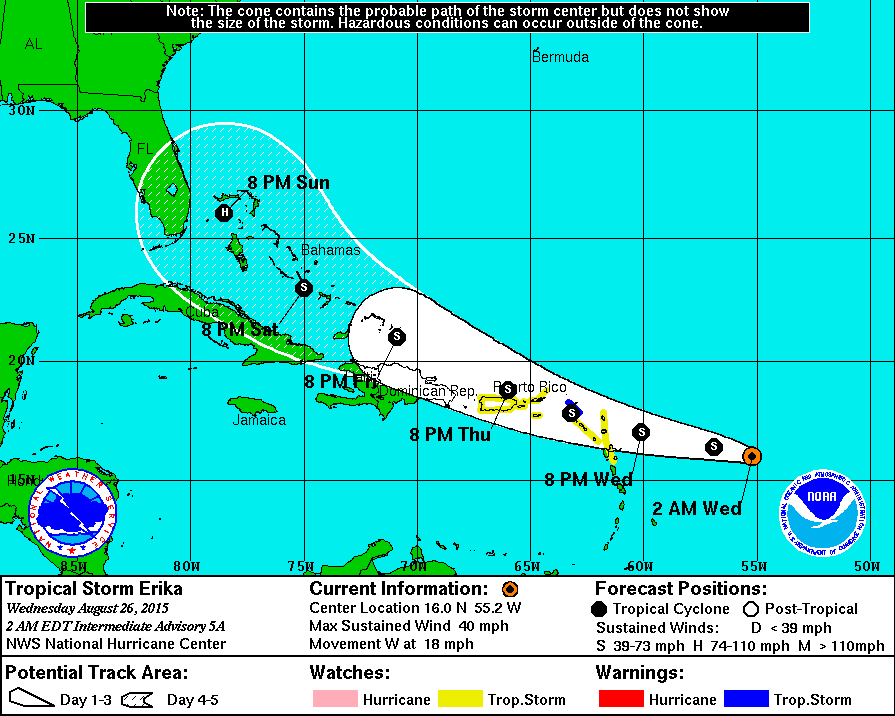
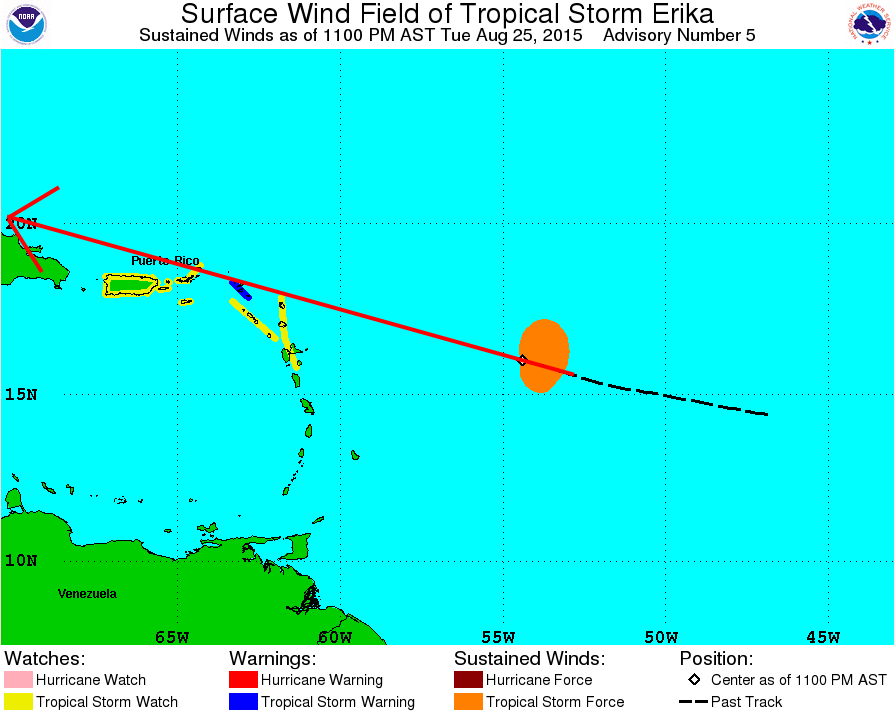
Erika NHC

Tropical Storm Erika is currently located a few hundred miles east of the Leeward Islands and is rapidly moving to slightly north of due west at a brisk speed of 18MPH. Erika is currently poorly organized and is a minimal Tropical Storm with sustained wind speeds of up to 40MPH. Due to marginal to at times unfavorably strong wind shear and dry air surrounding Erika, minimal intensification is expected through the remainder of the work-week…however, Erika may pass close to or over the Leeward Islands, the US Virgin Islands, Puerto Rico and Hispaniola between Wednesday and Friday as a Tropical Storm packing heavy rains and breezy conditions as per the National Hurricane Center forecast above.

Forecast uncertainty increases dramatically by Friday and into this weekend, however it appears as though there is high potential for Erika to pass near or over Hispaniola/Cuba or into the general vicinity of the Bahamas this weekend. The intensity of Erika by later this weekend is highly uncertain, but some strengthening is possible. There is some implied threat to Florida based on this forecast scenario, however it needs to be stressed that the forecast track and intensity of Erika this weekend into early next week are highly uncertain. Interests in the Bahamas, Florida, Gulf Coast and the Southeast are encouraged to monitor the progress of Erika this week and into this weekend.

Meteorological Discussion:

Erika s-w ir

Recent satellite loops of Tropical Storm Erika feature a swirl of low clouds associated with the low-level center of circulation, with this swirl of low clouds suggesting that the center is partially exposed to the northwest of the convection associated with the storm. In addition, convection has really been “pulsing” (IE, not sustained, large bursts) and hasn’t been very strong. These are all signs that Erika is battling wind shear and a somewhat dry/stable environment.

Erika microwave

A reasonably recent microwave pass confirms what convectional satellite imagery already suggested; convection with Erika is not very robust/well organized, consisting of one decent convective cell removed a good distance from the low-level center. The convection consistently firing well south/east of the surface circulation associated with Erika suggests the circulation is tilted with height due to the wind shear. Although it is not impossible for tilted/sheared tropical cyclones to intensify, the current organization of Erika suggests that it is very likely that any intensification in the near-term will be slow if any occurs at all.

Erika WV

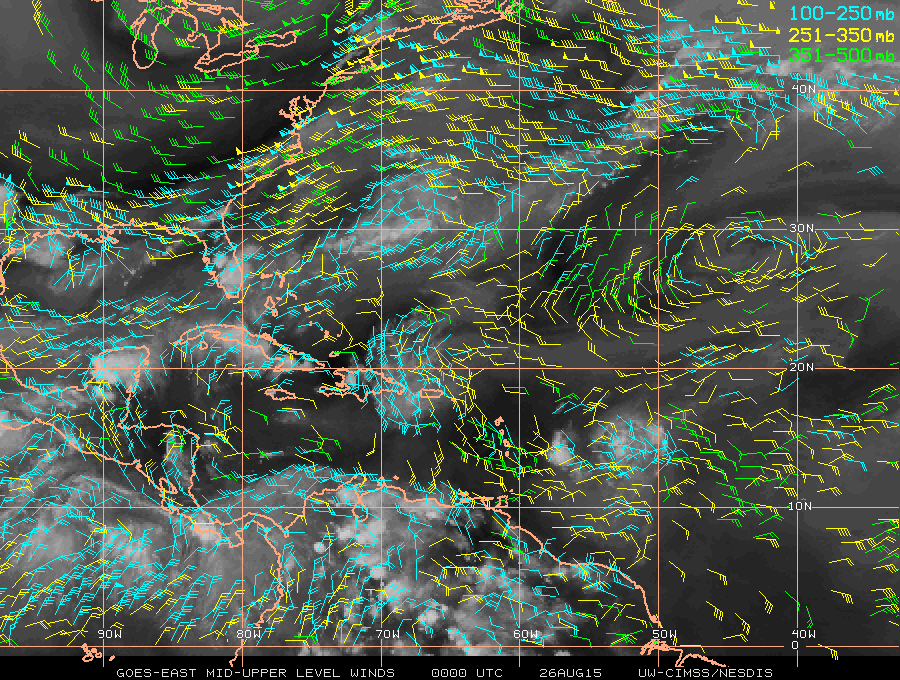
A water vapor loop of much of the Tropical Atlantic suggests that the environment ahead of Erika likely won’t improve particularly quickly; a large and persistent TUTT (Tropical Upper Troposphere Trough) is located to the north-northeast of Erika over the central Atlantic, with a clear axis of shear (note how moisture on the loop appears to be moving west-east from Danny’s remnants over PR/Hispaniola towards the TUTT) located north of Erika. The shear axis associated with the TUTT is still north of Erika and may even be thinning/weakening some, however, upper level winds derived from satellite data show very light upper level winds ahead of Erika due to a fairly robust upper level anti-cyclone:

Erika UL winds

This may suggest on first glance that Erika will move into an area of weaker shear soon; however, Erika is embedded within a fairly strong surge of easterly trade winds (and is hence moving at 20MPH to the west); if you have strong easterly surface winds and calm upper level winds, there is still effective westerly shear affecting the storm, and the vortex will still likely be tilted as it is:

Erika LL winds

In addition, although Danny did erode some of the very dry air previously present in the path of Erika, there is still a reasonable amount of dry air ahead of Erika. The amount of dry air on its own likely wouldn’t prohibit intensification, however wind shear resulting in a tilted vortex makes dry air entrainment more likely into Erika, meaning its convection will likely continue to pulse and be generally removed from its center for until it can possibly move into an area of weaker shear in a few days.

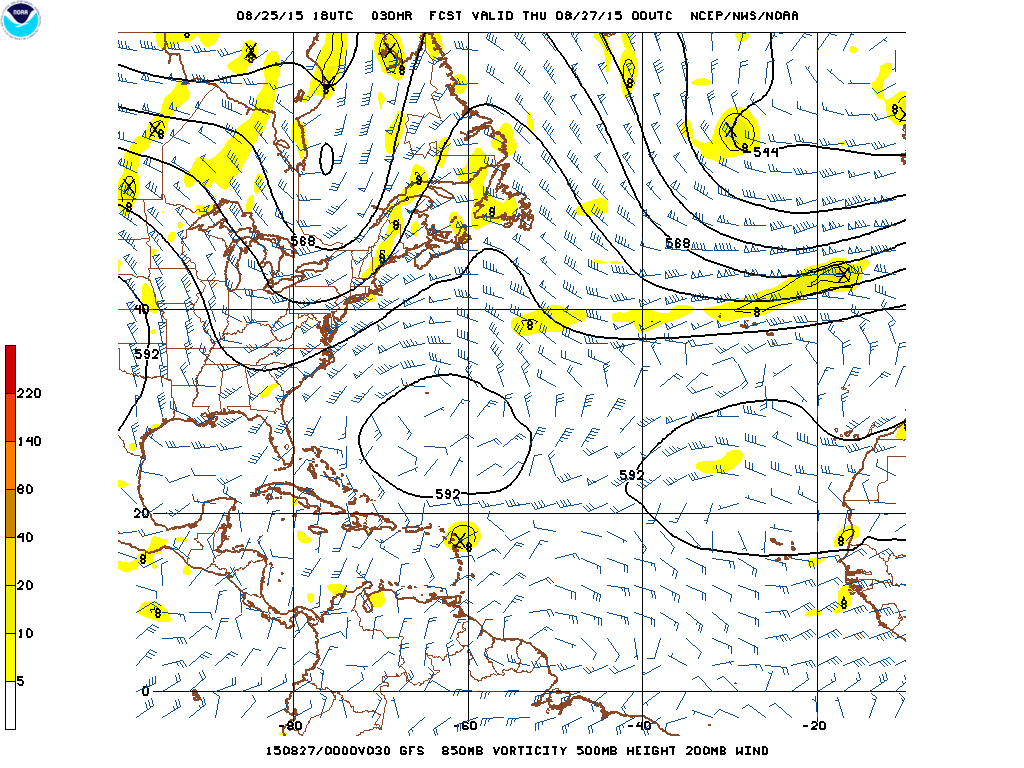
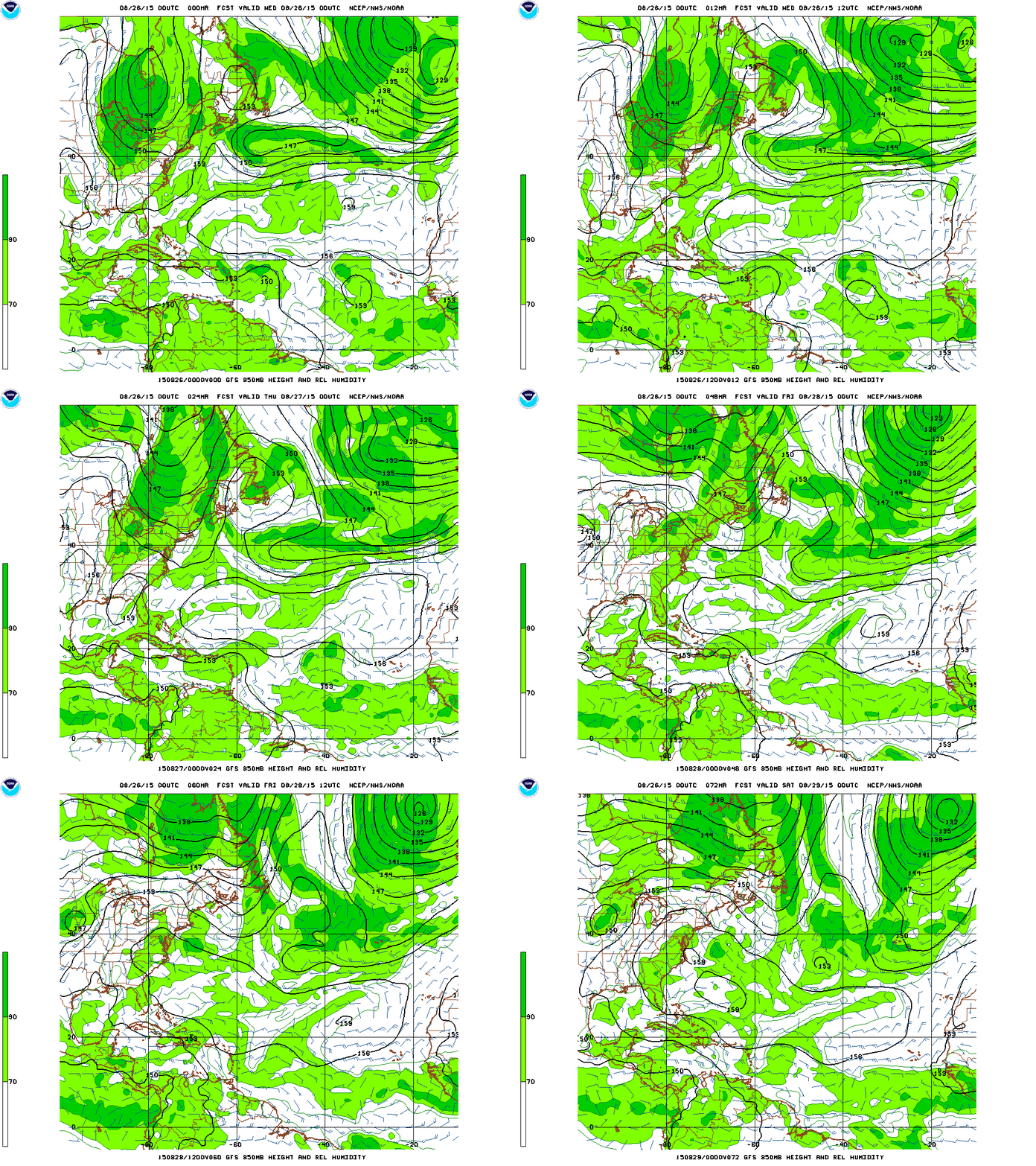
Erika GFS 30

As for when Erika may move into weaker shear, that’s a tough call. By Wednesday evening, the Monday 18z GFS run shows Erika (the ball of 850mb vorticity approaching the Leewards) still under the upper level anti-cyclone per the 250mb wind barbs; however, a look at the lower level winds still shows Erika embedded in a rather strong surge of easterly trades:

Erika GFS 30 850

This suggests that the lower portions of Erika will still be attempting to outrun the mid-upper level portions of the vortex, meaning the vortex will likely still be tilted and the storm won’t be much if any more organized that it is now.

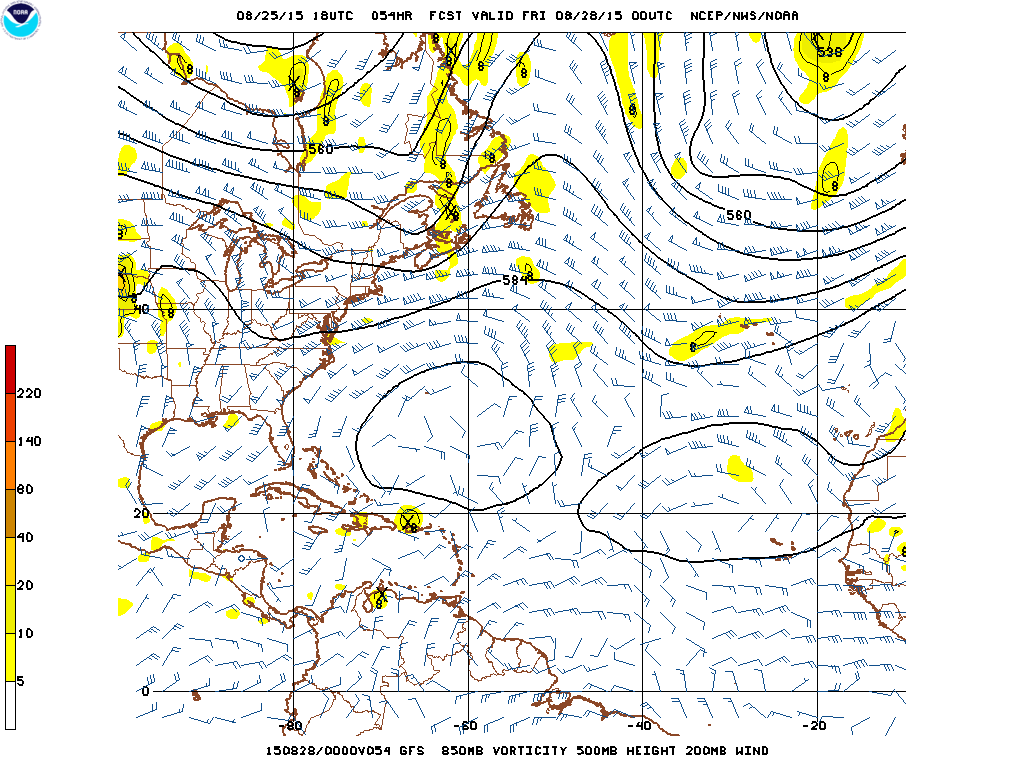
Erika GFS 54

Unfortunately for hurricane fanatics, a similar setup continues through the day Thursday, with weak upper level winds over Erika per the GFS (over or just north of PR on the model Thursday evening) thanks to the (shrinking) upper level anticyclone, but continued strong easterly low level winds, resulting in continued moderate to strong shear over the storm:

Erika GFS 54 shear

Monday’s 12z ECM run is in fair agreement with the GFS in terms of track of Erika through the next 2-3 days (across the northern Leewards towards PR and possibly Hispaniola) and environment; by Friday morning, the Euro has (what’s left of) Erika approaching eastern Hispaniola, with moderate shear over and in front of the storm:

Erika ECM 72

The GFS and Euro do however agree in an improving environment in the general vicinity of Erika in the day 4-5 timeframe as it moves through the general vicinity of Cuba or the Bahamas:

Erika ECM 96

By Saturday morning, the Euro has Erika moving over or just north of Cuba; the environment surrounding it isn’t particularly moist, however, the easterly low level winds will be weaker in this region by the time Erika gets there, and the storm (or what’s left of it) will be completely through the shear caused by the TUTT axis. The GFS has Erika in a very similar position by Saturday morning, and is beginning to weaken the shear as well:

Erika GFS 90

However, it is important to note the 18z GFS only has ONE loosely closed isobar (1014mb) and the 12z Euro has NO closed isobars with Erika as it passes near or over Cuba on the models on Saturday; both models open Erika up into an open wave by Friday at the latest, similar to what occurred with Danny between the Leewards and PR:

Erika GFS 90 surface

Before we start speculating further about future intensity and looking into the track of Erika more, let’s discuss what I think will or may happen with Erika’s intensity over the next 2-3 days as it tracks across the Leewards and towards PR/Hispaniola:

  • The environment ahead of Erika as it moves across the far NE Caribbean will be slightly less hostile than what was ahead of Danny, but not by much. The dry air in the atmosphere may have been worked out a little bit by Danny’s small moisture pouch as it moved by, the TUTT axis may slowly be weakening/shifting east, and the fairly robust upper level anti-cyclone over Erika may shield the storm some from the TUTT’s westerly shear.
  • However, there is good reason to believe that moderate shear (at least 20 knots) and fairly dry/stable air will plague Erika through Friday before potentially relaxing Saturday; that is another 72 hours of rather hostile conditions.

Erika TPW loop

-With that said, Erika has a larger circulation and a larger moisture pouch than Danny. This may make it less likely to open up into a trough of low pressure over the next few days of hostile conditions.

  • At their current longitude, per the TPW loop above, Erika has a more northerly component of motion than Danny did. This may make it less likely to get caught up in the Greater Antilles, but I will examine track more in a minute.
  • Erika is in my opinion a very marginal tropical cyclone at this time. Much more degeneration could result in the NHC declassifying it due to a lack of sustained convection near the center, or possibly cause the center to open up. Given the less than favorable environment, this could happen at any time over the next 72 hours.

Overall, Erika likely has a better chance of surviving the hostile next 3-4 days and emerging in a potentially better environment than Danny did due to a slightly less hostile environment and larger circulation. I’d put the odds of Erika surviving till Saturday as a tropical cyclone at 60% at this time. I’m going with a little better than 50/50 because the environment ahead of Erika doesn’t get much worse than it is now, and because the current environment while not fostering intensification has at least maintained Erika as a tropical cyclone today. One potentially valid concern is Erika getting caught up in the mountainous terrain of the Great Antilles this weekend, which I’ll discuss below.

More Specific Track Forecast and Longer Term Speculation:

Erika current steering

Currently Erika is being steering by sub-tropical ridging across the central and eastern Atlantic. There is a bit of a weakness in the ridging just north of Erika and a strong ridge centered east-northeast of the storm, allowing for some northerly component of motion despite a ridge being centered north-northwest of Erika. The ridge NNW of Erika appears to be slowly moving west, which will likely allow Erika’s current motion to continue in the near term. This motion continuing indefinitely would actually take Erika just north of Hispaniola around Friday:

Erika motion

Given I expect Erika to at best maintain status quo intensity for the next 72 hours, we can use the low level height/wind forecasts on the models to estimate its motion to see if it will change from the magical track above that would keep Erika just barely north of mountainous death:

Erika GFS GIF

When looking at the GFS, which opens Erika up into a trough of low pressure fairly quickly and does track it over the spine of Hispaniola and Cuba or close to it, the steering currents don’t appear to change too drastically over the next 3 days, and then appear to begin favoring a more northerly motion by the end of day 3. Although I can’t post images of it here, the Euro steering currents aren’t much different. Although Erika moves WNW towards a ridge, a cold front dropping south across the central and eastern Atlantic forces the ridging westward, meaning Erika won’t actually be running right into it…in addition, a trough slowly drifting east over the eastern US begins to impinge upon the ridge by Friday, allowing the ridge to take on a more NW-SE orientation, giving Erika more room to gain a more northerly component of motion.

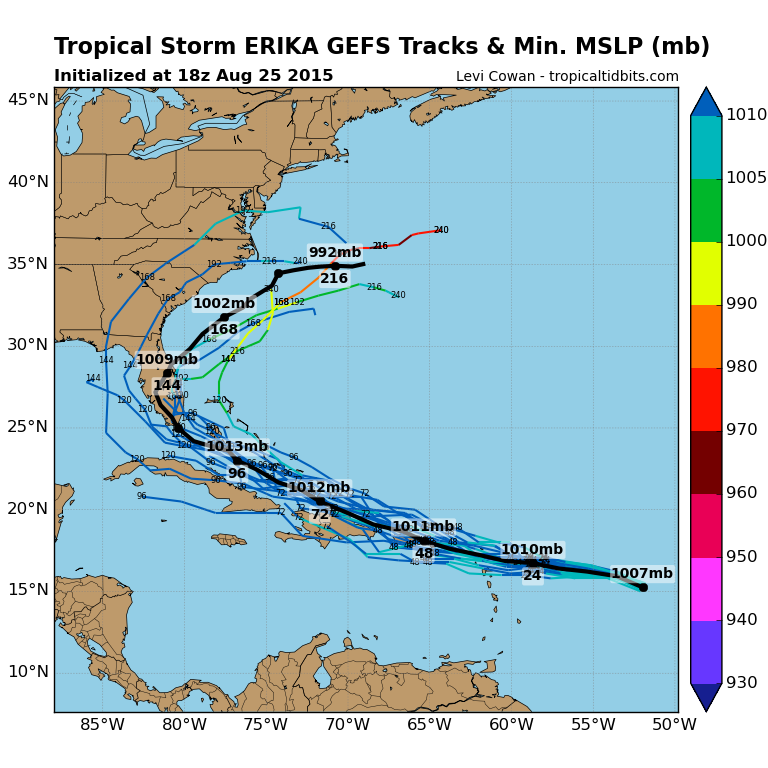
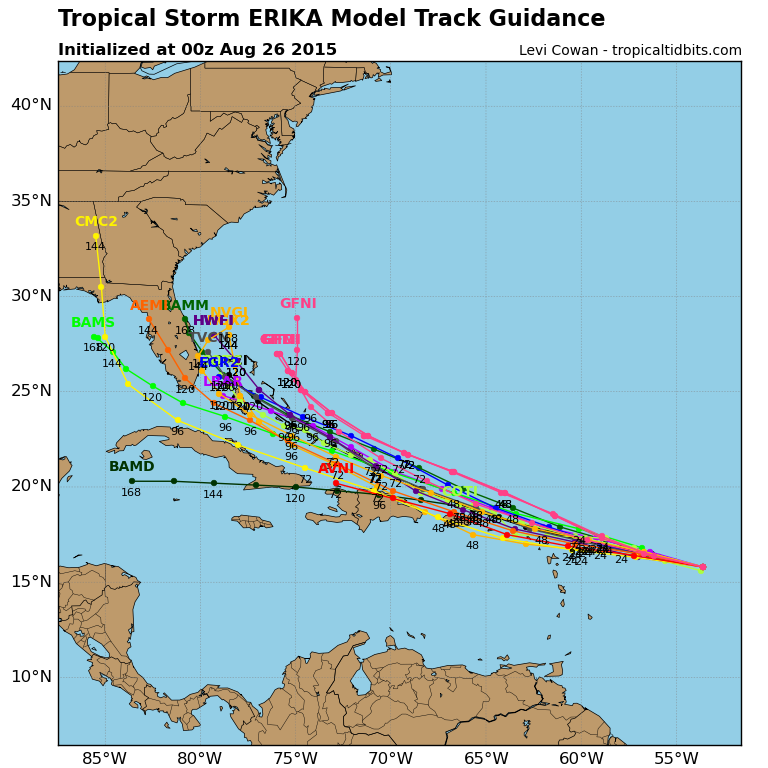
Most track models and GFS ensemble members agree with the motion remaining close to its present motion over the next 3 days:

Erika GEFS

Erika ATCF

Overall, I’m conservatively giving the nod to Erika staying just north of Hispaniola and Cuba. It could pass over PR, although PR isn’t large or mountainous enough to disrupt a tropical cyclone’s circulation. The ATCF track models (second image of tracks) have actually shifted Erika a little north over the course of today’s runs, however it is important to note that the GFS ensembles have trended a little south. The GFS does skim northern Hispaniola with Erika and has for a few runs. The 12z Euro appears to be slightly north of the recent GFS runs but not by much.

I believe that the GFS tracks Erika farther south because it opens it up into a wave quicker and allows it to get caught in the easterly trades and track farther south (like what happened with Danny). Given I think Erika can potentially try to at least maintain itself as a marginal tropical cyclone for the next few days, I feel it has a much better chance of missing Hispaniola and Cuba than Danny as if it maintains itself, the modelled steering currents suggest Erika staying on a similar heading, which would take it just north of Hispaniola’s and Cuba’s mountains.

If Erika opens up into a tropical wave and tracks farther south, a track over so many mountains while dealing with a marginal at best environment could well kill the system for good (see Danny); if something forces the ridging ahead of Erika to be a bit stronger, it could still hit the mountains even if it maintains itself as a tropical cyclone and then degenerate into an open wave. So, my 60% probability as laid out above is a conservative estimate based on these several sources of uncertainty, and if anything is more conservative than the NHC forecast due to the GFS and 12z Euro runs showing more substantial interaction with the higher terrain of Hispaniola and Cuba and degenerating Erika into an open wave. Although I don’t have access to the individual members, mean maps of the 12z Euro ensembles suggest that many members have an evolution very close to the 12z Euro with Erika degenerating into an open wave before getting to Hispaniola, skirting Hispaniola and barely missing Cuba before the north. It should be noted that the GFS and Euro and many ensemble members do still bring what’s left of Erika into the eastern Gulf of Mexico by Monday, however if Erika tracked over that much land it may be too disheveled to spin up into anything strong in the Gulf.

Erika TCHP

As for the potential intensification of Erika down the road if it can survive and find a lower shear environment, the waters off the Florida coast, over the Bahamas and into the eastern Gulf of Mexico are extremely warm and warm to a deep depth. Any tropical cyclone moving through this area would have no shortage of heat to work with from the ocean.

The GFS and Euro, as shown above, both show Erika emerging into a lower shear environment in the 72-96 hour timeframe (Saturday-ish) as it finally passes the TUTT axis and heads towards either the Florida Straits or Bahamas. Both models maintain the low shear look as they move Erika into the eastern Gulf by Monday:

Erika GFS 120

Erika Euro 144

The GFS is very sheepish in terms of re-intensifying Erika early next week near Florida or over the Gulf, but the 12z Euro did try to spin up a weak tropical cyclone over the eastern Gulf early next week. The HWRF and GFDL both maintain Erika as a marginal tropical cyclone through Saturday and then go bananas over the Bahamas Sunday into Monday and attempt to develop Erika into a major hurricane off the Florida coast. The SHIPS and LGEM intensity models are more middle of the road and show an intensifying tropical storm in five days.

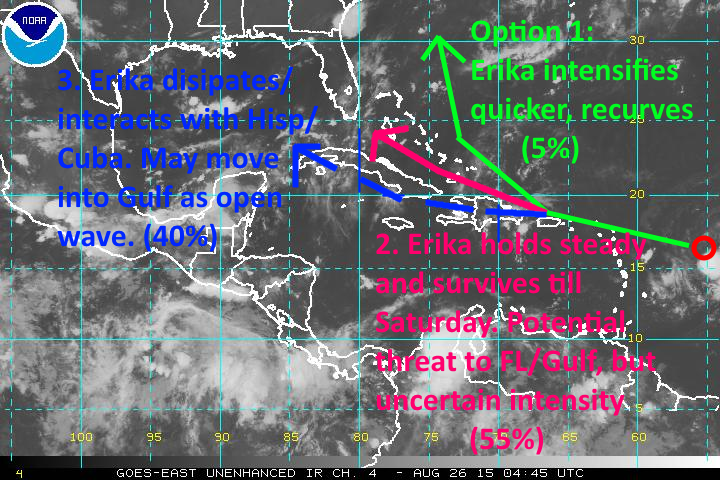
At this point, I see a few scenarios in terms of the intensity forecast, in no particular order:

  • Erika maintains as a tropical cyclone north of the Greater Antilles, but the environment doesn’t improve over the Bahamas as much as the GFS and Euro currently imply and we see a tropical storm possibly threatening Florida Sunday-Monday.
  • Erika maintains as a tropical cyclone and the GFS and Euro are correct in showing a low shear, good outflow environment over the Bahamas late this weekend along with very high heat content water, and Erika intensifies into a hurricane Sunday into early next week.
  • Erika degenerates into an open wave either due to the environment or due to ridging being stronger than anticipated at pushing it into Hispaniola/Cuba, and then either doesn’t redevelop over the Gulf or perhaps spins up into a weak tropical storm in the Gulf early to mid next week.

So, the intensity forecast is tied into the track forecast some, as I believe any chance for a stronger system comes off the table if Erika gets caught up in the Greater Antilles and completely loses its surface circulation.

I’m fairly sure that Erika won’t recurve completely east of the US at this point due to the pattern that will develop late this weekend into early next week:

Erika ECM ENS 120

The Euro ensembles (shown) and GFS ensembles from Monday afternoon are in reasonable agreement on a strongly –PNA and modestly negative NAO pattern late this weekend into early next week. The strong –PNA forces a ridge over the central US and essentially renders the polar jet useless east of the Rockies, meaning there won’t be a strong trough over the eastern US. The modest –NAO attempts to carve out a trough over the NE Atlantic, but the –PNA really dominates things and doesn’t allow the trough to dip far enough south to pick up a tropical cyclone over the Bahamas. This suggests that Erika will likely end up over Florida or the Gulf early next week, however at what intensity is in question.

Earlier models tried intensifying Erika quicker this weekend and recurving it east of the US before the –PNA really starting building ridging over the central and eastern US, however due to the hostile conditions Erika will face over the next few days I see that possibility as a remote outlier.

So, to summarize:

-Erika will struggle through Friday. If Erika misses the Greater Antilles and survives until Saturday or Sunday, the environment may favor intensification.

-The pattern supports a track towards Florida or into the Gulf, but given the first bullet and all the uncertainty discussed above, at what intensity this occurs at is in question. We could see anything from an open wave that doesn’t re-develop in the Gulf to potentially a hurricane that threatens Florida or the Gulf.

Interests in the Southeast US and along the Gulf Coast should monitor the evolution of Erika regardless!

Erika scenarios

Posted in Uncategorized | Leave a comment

6/27/15 OH Severe

For record keeping purposes, here is a discussion I created at 11:30PM on 6/26/15 for in-house Neoweather viewing regarding Saturday’s severe potential in eastern Ohio

With water vapor imagery showing the trough associated with our storm beginning to slow down and potentially start closing off over IL right now with heights gradually rising ahead of it per mesoanalyisis, am thinking that the continued trend among the short term/hi-res guidance to slow down the low further and strengthen it a bit more isn’t a mirage. This results in the dry slot working farther north into eastern Ohio where modest destabilization looks likely. Although mid-level lapse rates will be poor, rich low level moisture would combine with temperatures in the low to mid 70’s to produce over 1000 J/KG CAPE within the dry slot ahead of the cold front. Temperatures in the warm sector near/south of the Ohio River will struggle to drop below 70 tonight due to high dew points and cloud cover, so it won’t take much surface heating of the warm sector airmass to yield temperatures in the mid 70’s and a half decent amount of instability.

Within the warm sector, surface winds may be backed enough near the warm front on the edge of the dry slot to increase helicity enough for robust rotating updrafts across eastern OH by early to mid afternoon. In addition, 30-40 knots of bulk shear supports storm organization and potential updraft rotation. Although there is pretty good mid-level drying within the dry slot, very weak mid-level lapse rates and fairly high freezing levels will likely limit the hail potential.

Am thinking that if the slower models are right that a few storms or clusters could develop over eastern OH and potentially produce damaging winds given sufficient shear for storm organization and mid-level drying increasing the likelihood for microbursts with any robust cores that develop. Given storm motion will be almost perpendicular to the warm front that will enhance helicity some on the eastern edge of the dry slot/warm sector, I’m not sure that storm residence time will be great enough to capitalize on this increased shear and produce tornadoes along the warm front. However, with reasonably low LCLs and decent 0-3km CAPE per NAM soundings for CAK should temperatures reach the mid-70’s, the potential for a quick spin-up may rise if sufficient surface heating occurs (it won’t take much).

Although the 18z GFS still has a faster surface low and less instability in the dry slot, the slower low/more unstable dry slot is not only supported by the closing off of the upper level trough overhead and strong upper level divergence but also by a plethora of models including the 0z NAM, RAP, HRRR, SREF and 12z ECM. This gives me enough confidence in enough instability developing for a potential severe threat to play out.

Should there be any sun in the dry slot (or should temperatures reach 75+ without it), then NAM soundings suggest DCAPE increasing to 800-1000 J/KG along with moist low levels and nearly dry-adiabatic low level lapse rates, which would potentially support a more robust wind threat. However, there is still enough uncertainty regarding destabilization to go with anything more than a low risk with some bust potential either way.

severeforecast

Posted in Uncategorized | Leave a comment

June 22nd, 2015 Severe Weather Threat

A regional severe weather event/potentially outbreak is likely on Monday across parts of the Upper Mississippi Valley east into the Great Lakes. All modes of severe weather will be possible, however, uncertainty mainly regarding ongoing convection remains in this forecast.

water vapor

Current water vapor imagery shows two pertinent mid to upper-level speed maxes in the flow…one over the northern Rockies ejecting into the northern Plains, and another over southern Alberta/Manitoba moving southeast towards the northern Plains. These two speed maxes will partially phase and result in an impressively strong (by late June standards) speed max over the upper Midwest on Monday that will move east into the upper Great Lakes Monday night.

current sfc

Recent surface analysis depicts a seasonably strong lee cyclone across the central Plains, with a warm front extending east across the upper Mississippi Valley into the northern Ohio Valley. South of this warm front, rich low level moisture characterized by low to mid 70’s dew points exists.

current ML LR

In addition, strong mid-level lapse rates due to a stout Plains elevated mixed layer (EML) are present across the central Plains and they are advecting east due to strong W-SW mid-level winds. These lapse rates are evident on several 0z 6/22 observed soundings across the Plains including SGF, TOP and OAX.

The combination of steep mid-level lapse rates and rich low-level moisture would result in strong to extreme instability where convection isn’t ongoing in the morning to try to overturn this environment.

In addition, the strong mid to upper-level wind fields will cause the surface low over the Plains to strengthen to seasonably strong levels over the northern Great Lakes by Monday evening, resulting in strong speed shear and reasonable directional shear in the warm sector.

From a synoptic/ingredients point of view, the potential for a significant severe weather episode appears to be on the table from the upper Mississippi Valley east through a good portion of the western and central Great Lakes…however, an ongoing MCS will potentially throw at least some sort of a wrench into the overall threat.

current radar

Convection is gradually growing upscale across the High Plains as of 6z…with the line from north-central SD into south-central ND making the strongest strides. With already strong instability and shear in place across the region per 0z observed soundings and recent mesoanalysis, I’d have to think that this activity will continue through the night.

current MUCAPE

Although the nose of the low-level jet and mean winds suggest a more easterly motion to this MCS, the instability gradient and shear vectors strongly suggest a decent southerly component of motion with the ongoing MCS. This would likely take it into parts of southern WI/northern IL…IE the potential greatest risk area later in the day…by mid to late morning on Monday.

The convection allowing models have some differing ideas on how the MCS evolves…recent HRRR runs agree with the above assessment, and the 0z SPC and NSSL WRF models are generally close to this or perhaps a bit slower. The 0z NAM, HRW and NMM all have the MCS, but track it into MN by 12z and quickly weaken it thereafter as it moves generally easterly Monday morning.

Given the current propagation of the storms (a fair southward component of motion) but strong agreement on the MCS remaining strong through the night, I’d have to lean towards the southern/somewhat faster camp for the MCS track into Monday morning (which isn’t exactly uncommon), which takes the MCS into southern WI/northern IL before 18z. This has implications on the threat zone, as the MCS will overturn the atmosphere where it passes and also potentially limit moisture/instability advection north of where it tracks.

NAM 850 18

Assuming the MCS gets east of IL/WI by 18z, the strong low to mid-level wind fields combined with the rich low-level moisture and steep mid-level lapse rates in place will likely allow for fairly rapid recovery. However, if the MCS is slower moving or back builds, then recovery farther north ahead of the cold front into areas like WI and MI may be more questionable.

The NAM and HRRR have somewhat different MCS evolutions…the 12km NAM is a hair slower and farther north with the MCS, while the HRRR is a little faster and farther south. Compare the simulated radar products valid at 18z:

HRRR 18z radar

NAM 18z radar

Both models show an attempt at some back building convection across NE IA and N IL behind the main MCS, however, they show dramatically different instability outputs behind the MCS:

NAM 21z CAPE

HRRR CAPE

Both models agree on extreme amounts of CAPE in the clean warm sector…however, the NAM is much more optimistic about recovery behind the passage of the MCS across portion of MN/WI/N. IL. When parsing through other guidance, the 0z GFS isn’t as aggressive in recovering behind the MCS as the 0z NAM, but is more aggressive than the HRRR. The 0z SPC WRF is very bearish in post-MCS recovery. The 21z SREF is interesting…the mean appears to be close to the 0z NAM, however, there are at least a few members that don’t recover the airmass as aggressively across parts of northern IL/WI:

SREF 3000 CAPE

Considering that most of the SREF members appear to be farther north with the MCS than I expect (per 3-hourly precip fields), the fact that a few don’t recover the airmass as aggressively on the northern end of things suggests that the few that may have a realistic MCS depiction are also having trouble recovering the airmass behind it.

So, what we have at this point is a very complicated forecast…we have plenty of shear and instability in place for a high-end event, however a likely MCS may very well hinder the northern extent of that instability.

GFS 24

The reason the northern extent of the instability is of such concern is because the better upper level dynamics and shear will be located farther north…with warm mid-level temperatures and a stronger cap farther south.

Although the MCS may (in my opinion, probably will to an extent) limit the northward extent of extreme instability, it may leave outflow boundaries across parts of IA/northern IL that locally enhance wind shear later in the evening and also perhaps help serve as a focus for new convection by late afternoon/early evening. The MCS may still remain severe farther east across portions of southern lower MI, northern IN and northern OH.

SREF 21z

The MCS threat across parts of the southern Great Lakes Monday afternoon/early evening is conditional on the overnight/early morning Plains/upper Midwest MCS developing a cold pool and/or MCV, which would allow it to sustain itself in a respectable form through the morning and into the afternoon. Based on cells continue to grow in spatial coverage and intensity as of this writing with the MCS, I’m leaning towards that happening, but it’s not quite a slam dunk. Regardless, the instability gradient and shear vectors continue to point to an E or ESE propagation of an MCS if it maintains itself across southern lower MI and northern IN/OH Monday afternoon and early evening. In addition, the instability ahead of the MCS is expected to become moderate by late afternoon as the Plains EML plume begins advecting over rich low level moisture across the upper Ohio Valley, with increasing bulk shear and helicity values as well. This points the MCS, if it can in fact become robust enough by morning, maintaining itself with a damaging wind threat through the afternoon across the southern Great Lakes. The MCS would likely eventually outrun the better instability and shear to the point where it would weaken by the time it hit eastern OH or western PA if this scenario played out.

As for the threat farther back west with the cold front itself and new convection firing, I see a few possible scenarios:

1) The MCS clears early enough to allow strong recovery into northern IL and southern WI, but recovery is less aggressive farther northern into eastern MN, northern WI and MI. Storms re-develop by mid to late afternoon as the speed max moves across the upper Midwest and western Great Lakes along the cold front and along any outflow boundary left behind by the MCS. In this scenario, severe weather would probably be most likely across eastern IA, northern IL and southern WI. All modes of severe weather would be possible with a few strong tornadoes possible within the first few hours of initiation. Given strong instability, shear and large scale ascent upscale growth into another ESE-ward propagating MCS would be possible by mid to late evening with a potentially high-end wind damage risk. Farther north in this scenario, isolated to widely scattered convection would likely initiate along the cold front across eastern MN/northern WI/western upper MI, however, with more limited instability and questionable coverage the severe threat would be somewhat lower. Due to the strong shear, all modes of severe would still be possible, but the higher tornado threat would be mitigated farther north. The storms would likely move east into the rest of upper MI and also northern lower MI by mid to late evening and then gradually dissipate overnight without growing upscale.

2) The MCS tracks farther north, allowing greater instability to occur farther north. The threat area would likely expand some into much of WI and SE MN, with potential upscale growth farther north. This scenario would potentially put more of lower MI in line for a second round of storms, especially farther south in the state…however, the storms would probably be linear or quasi-linear by the time they reached lower MI, which would temper the tornado threat there at least some.

3) The MCS breaks up by afternoon, allowing for strong instability to build into much of WI and lower MI. This would potentially be the worst case scenario as coverage of impressive parameter space would be greater. This scenario would also possibly open the door for a large scale threat into lower MI…the main risk would still be damaging winds, however more robust rotating updrafts within a QLCS with a somewhat better tornado potential would be possible. In this scenario, warm frontal storm development would be possible mid to late afternoon across much of lower MI in a moderate CAPE high shear environment, with some tornadoes being possible here as well.

In general, I think possibility 1) is most likely for reasons discussed above.

Overall, I am thinking that an MCS with perhaps a marginal severe threat tracks into parts of WI/northern IL by late morning or early afternoon and moves east into lower MI/N IN/N OH by mid to late afternoon with perhaps an increase in damaging wind risk as instability and shear begin to improve ahead of it. Behind the MCS, recovery occurs into all of eastern IA/northern IL and southern WI, with this area being in the sweet spot of strong-extreme instability, strong shear and weaker capping for re-development along the cold front and remnant outflow boundaries mid to late afternoon. This is where the best severe threat would be and where a few strong tornadoes are most likely. A few severe storms occur farther north in WI and upper MI, however lesser instability limits the coverage and intensity of storms some. I’m leaning towards this activity eventually growing upscale into an MCS by mid to late evening across northern IL/SW MI/NW IN. With strong shear overnight and moderate to strong instability remaining across the lower Great Lakes and northern Ohio Valley, a decent overnight MCS across parts of northern IN, northern OH and southern lower MI could be possible. In northern lower MI and the eastern UP, lesser instability may cause the storms to weaken some before getting there, keeping the threat non-zero but not extreme.

Posted in Uncategorized | Leave a comment

Sunday-Monday Midwest/Great Lakes/Ohio Valley Severe Threat

For record keeping purposes, here is a post I made on an online weather forum regarding the upcoming severe threat.

Just from an ingredients based perspective, I’d have to think there’s pretty good potential in the sub-forum Monday-Monday night.

Fairly persistent low-mid level ridging over the south and especially southwest US through the weekend will allow for strong surface heating over the Rockies/High Plains during the day which will allow a good EML to form…and the strong mid-upper level ridge over the south suggests there won’t be much organized convection to overturn that as it moves east on the northern edge of the low-mid level ridging.

Closer to the surface, an already moisture rich airmass is in place across much of the south-central and southeastern US, and a persistent anti-cyclonic flow near the central Gulf Coast through the weekend and into early next week will allow more moisture to continue to advect into the Plains and then east towards the Mississippi Valley/OH Valley/Great Lakes.

The combination of an EML and moisture rich low levels definitely supports the strong-extreme instability numbers spit out by both the GFS/NAM at this stage outside of any ongoing convection on any given day.

In addition to the instability, the combination of the enhanced flow on the northern edge of the mid-upper level ridge over the southern US and shortwaves diving south into central Canada thanks to a fairly stout ridge over Alaska should be enough to cause seasonably strong bulk shear over the northern portion of the very unstable airmass. In addition, the seasonably strong shortwaves should provide enough large scale ascent for areas of surface low pressure to develop that help undulate the quasi-stationary front’s position as they go by and also enhance low level shear.

So, from just looking at the ingredients potentially in place, things seem lined up for a moderate-high end event somewhere in the subforum Monday-Monday night, although as we get closer mesoscale details/ongoing convection may ultimately throw some wrinkles into that.

As has been mentioned…the speed max/shortwave that will move across the upper Mississippi Valley/Great Lakes Monday afternoon-night will eject out into the northern Plains on Sunday, and I’d have to suspect that adequate instability and shear will be in place for an MCS to develop somewhere over maybe SD or NE Sunday evening that moves ESE Sunday night. Although the nose of the 850mb jet is progged to get into southern MN by Monday morning, the shear vectors and MUCAPE gradient Sunday night suggest the MCS will likely track towards IA/MO/IL by Monday morning if it develops. Rich low level moisture…a decent EML…and strong low level jet should allow for quick recovery behind this potential MCS…however, if the MCS dives too far south it may limit moisture return farther east (IE MI/OH). In addition to creating moisture return questions…if the MCS doesn’t “get out of the way” quickly enough, getting enough surface heating to break the cap associated with the EML may become harder to do and limit the threat farther south/east. In addition, recent model runs have trended somewhat stronger with the proceeding shortwave over the eastern lakes on Sunday, and are trying to show an interaction with Bill’s remnants over the NE Sunday night into Monday. If this shortwave and associated surface low trend stronger/slower, then the surface cold front may get driven farther south Sunday-Sunday night over the eastern portions of the sub forum, also casting some doubt into the magnitude of the threat later Monday farther east.

As things stand now, I’d feel decent about some sort of an overnight MCS with at least a marginal severe threat over SD/NE/IA and perhaps into northern MO/parts of IL Sunday evening into Monday morning. For Monday, there’s reasonable agreement in the ingredients coming together for a sizable event, with only modest differences in timing of the short wave and associated mid-level speed max. With strong airmass recovery likely behind any nocturnal MCS on Monday and decent shear likely being in place, I’d have to feel fairly decent from eastern IA into WI/ northern IL…shear vectors support some southward component of motion Monday night with whatever the convection grows upscale into which puts lower MI/IN possibly into play and perhaps OH…although farther east questions about timely moisture return do grow some. The one wild card is the cap not breaking if nocturnal stuff hangs around long enough to significantly limit surface heating.

So, I see a fairly high end potential and feel fairly good about a decent event occurring somewhere, however I won’t feel great until the mesoscale details become clearer.

Posted in Uncategorized | Leave a comment

6/7/15 Severe Threat in Ohio

Not at all a straight forward severe forecast as moisture return/instability issues and timing of better upper level dynamics are both marginal for Ohio.

Two upper level jet streaks evident on water vapor imagery…one over the Four Corners region ejecting into the Plains and another over the Canadian Rockies moving towards the upper Midwest will partially phase and allow for a modestly deepening low pressure across the upper Great Lakes on Sunday. A cold front extending to the south/southwest of this low will remain well west of Ohio, while a warm front moves across the state during the afternoon and evening.

Given the location of the fronts, the potential focuses for convection on Sunday afternoon/evening for Ohio will be the warm front and either outflow boundaries from upstream convection or new convection firing along the southern edge of ongoing convection Sunday morning to our west/northwest.

As for the potential warm front play…questions regarding moisture return reign supreme for this forecast. The NAM and GFS, along with most 9z SREF members return 65F+ dew points by 0z Monday to the western half of Ohio and 70F+ dew points to near the OH/IN boarder. I believe the 70+ dew points are a little overdone when examining 12z Saturday soundings from the AR/LA area and also current surface observations. Regardless, dew points in the mid 60’s seem reasonable in western OH along with modestly steep mid-level lapse rates as a weak EML evident on 12z Saturday soundings and also current mesoanalysis moves east with little convection overturning it could allow for over 1000 J/KG of MLCAPE to develop over the western half of OH by Sunday evening. The GFS and NAM both show some modest upper level divergence associated with the entrance region of the upper level jet streak to our north overspreading OH (especially northern) by 0z Monday and also show a shearing out mid-level vort max, along with associated low level theta-e advection along the warm front aligning over OH Sunday evening. I am torn because with little capping I’d expect this combination to typically fire off isolated to scattered storms along the warm front in the evening, however the models which I think are a little aggressive in returning moisture still struggle to develop anything along the warm front. The 9z SREF shows a 30-40% chance of measurable precip across NE OH in the vicinity of the warm front in the 21-0z window and the “meteorology” suggests that isolated storms should fire in that area during the late afternoon/early evening. Given backed low level winds during the evening, an increasing low level jet during the evening and also an increase in effective bulk shear to 30-40 knots by evening across northern OH, if there is enough instability to fire storms along the warm front in central/eastern OH during the late afternoon and early evening they could become supercells with an attendant large hail/locally damaging wind risks. I believe that the brisk south-southwesterly low level flow, increasing dew points and likely cloud cover will keep the boundary layer well mixed until mid to late evening so I think storms could remain surface based through much of the evening with a brief tornado threat as well. Although the threat is conditional on even getting storms to fire, the risk for supercells with large hail and perhaps a tornado or two in my opinion justifies a low risk all the way through northeastern OH for now with a re-evaluation Sunday morning.

As for the potential storms developing to our west and moving in during the evening…convective allowing models show the storms develop well to our northwest and struggling to even get to NW OH by mid to late evening. Forecast models are notorious for progressing MCSs slower than what actually occurs and also farther north. The 15z RAP suggests that the nose of a strong low to mid-level jet and associated tongue of high theta-e air will likely reach Lake MI/Chicago/perhaps NW IN by 12z Sunday, and I suspect that any MCS that develops over the upper Midwest later today will likely reach that vicinity by early Sunday before likely weakening and leaving either outflow boundaries or allowing differential heating boundaries to develop. In short, I expect new convective development to occur likely farther SE than what a lot of the CAMs indicate…potentially from northern or central IL through northern IN into southern lower MI during the mid to late afternoon.

Strong surface heating combined with modestly steep mid-level lapse rates and more certain moisture return across IL/IN ahead of any clouds leftover from the overnight/morning activity should allow for strong instability to develop across IL/IN that possibly tries leaking into western OH by evening. With little cap…strong instability…improving large scale ascent thanks to the thermally direct circulation in the entrance region of a jet streak passing to the north…and an intensifying low level jet during the afternoon and evening…storms that develop across IL/IN/southern lower MI could become quite widespread and intense. There may be a brief window of discrete development with an attendant hail/tornado risk before the activity inevitably grows upscale into a MCS by early to mid evening. How quickly the MCS propagates is the main question for OH. Although the surface winds may back slightly, the wind profiles look somewhat uni-directional once you get above low levels, which may suggest that the MCS begins training as opposed to propagating east-southeast. On the flip side, good mid-level drying evident across the northern OH Valley/southern Great Lakes may contribute to more robust cold pool development that allows the line to continue sagging southeast somewhat through the evening. Depending on the exact orientation of overnight/early Sunday morning activity, it is also possible that the boundaries that trigger this new convection across northern IN/southern lower MI are more N-S oriented which would allow for upper level flow that is more perpendicular to the triggering boundaries, perhaps allowing for better propagation into SE lower MI and NW OH before things start paralleling each other too much. The MUCAPE gradient and shear vectors does suggest any MCS propagating E to SE into OH during the evening, however, the rather unidirectional flow above 850mb from the WSW gives me some pause.

Given the fairly favorable setup for perhaps initial supercells with hail/a few tornadoes across IL/IN into perhaps southern lower MI followed by a transition to an MCS with a fairly favorable looking atmosphere for damaging winds, feel as though a medium risk is necessary across parts of IL/IN/far NW OH. Farther south and east, the potential for storms to begin training as opposed to propagating more and also the potential for the uni-directional flow to limit moist inflow into the MCS by mid evening onward if the surface flow doesn’t back enough makes the threat much more uncertain. If the boundaries are oriented perpendicular enough to the mid to upper level flow then an MCS that propagates quicker and has a more moist inflow is possible, however we won’t know if that will occur until Sunday morning at some point which precludes placing the medium risk any farther southeast than it currently is. However, if the MCS can in fact propagate farther east or southeast…then a strong low level jet that favors rotating structures within any MCS may allow for a more notable severe threat to occur farther east than the current medium risk.

So, this will need to be re-evaluated Sunday morning, however for now it’s my best stab.

(Map made for Neoweather.com)

severeforecast

Posted in Uncategorized | Leave a comment