May 27th, 2017: Stormy Sunday Followed By Tranquil Memorial Day

SPC day 2

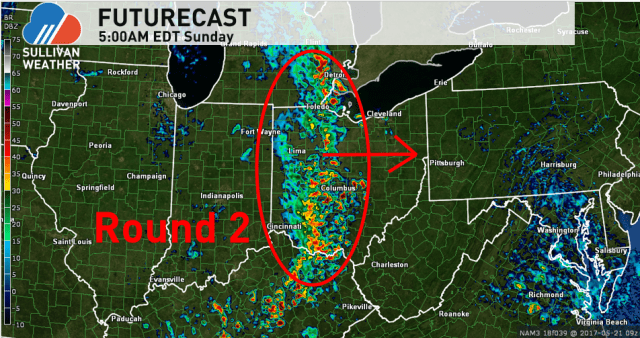
The Storm Prediction Center has placed essentially all of Ohio in at least a “marginal risk” (risk level 1/5) for severe thunderstorms Sunday afternoon and evening, with a “slight risk” (risk level 2/5) for southern Ohio.  There will be the potential for multiple rounds of rain and storms across Ohio between Sunday morning and late Sunday evening as a low pressure goes by and pushes a couple of fronts through.

Sunday Morning:

NAM3 19

The front that has stalled across southern Ohio today will lift back north Sunday morning and likely make it to Lake Erie by around noon.  This front may focus a few showers/perhaps a rumble Sunday morning as it lifts north.  I don’t expect widespread storms with the warm front, and temperatures and dew points will jump up south of the front.  After the front and chance for a few showers/storms lifts north, there’s a potential window of dry weather into the early afternoon.

Sunday Afternoon:

NAM3 30

A belt of stronger winds throughout the atmosphere will arrive mid to late Sunday afternoon, which will add a source of lift over Ohio and likely cause more storms to develop.  The best chance of storm development will likely be after 2:00PM (though something isolated could go a bit sooner), and with a cold front moving in from the west by early evening, warm front lingering over Lake Erie near the southern shoreline, and perhaps a “pre-frontal trough” ahead of the cold front (note the wind shift from southwest to south-southeast over eastern Ohio) there could be multiple areas of scattered to numerous thunderstorm develop by early Sunday evening.  The best shot for widespread storms will likely be near where the cold front and warm front are close together, which may be over northwestern Ohio or Lake Erie.  With that said, the entire state will be at risk for at least scattered storms developing or moving in at some point between mid Sunday afternoon and Sunday evening.

Sunday Night:

NAM3 35

The cold front will sweep through Ohio Sunday evening into the overnight.  Storm coverage and intensity should begin to diminish after 10:00PM Sunday evening as we lose instability thanks to the sun going down and also see the low and some of the better large scale “lift” in the atmosphere begin to pull away.  Regardless, a risk for storms will persist in eastern Ohio until the front moves through around midnight or so Sunday night.

Severe Threat:

Some ingredients will be in place for stronger storms on Sunday.  Here is a basic checklist of what we’re looking at from an ingredients perspective:

  • Instability: Moderate instability is expected, which is enough for severe storms if other factors are favorable
  • Directional shear (change in wind direction with height): Moderate near the warm front, marginal elsewhere.  This may allow for some rotation in storms, particularly near the warm front…but, the risk for rotating storms and tornadoes would be higher if there was more directional shear.
  • Speed shear (change in wind speed with height): Moderate, particularly late afternoon and early evening.   This may favor longer lasting storms that organize into small clusters or lines with an accompanying severe risk.
  • Lifting mechanisms: Present, with fronts in the area, perhaps a “pre-frontal trough” or wind shift, and some large scale lift due to a favorable jet stream orientation over our area.

Adding all of that together, here’s my assessment of the overall severe threat Sunday afternoon and evening for Ohio:

severe threat 5-28

The sufficient instability and speed shear suggest that storms organizing into small clusters or lines will be possible, which would drive a damaging wind gust risk with some storms.  Some directional shear suggests that a few storms may develop into supercells for a time, which would increase the hail risk and perhaps bring the risk for a tornado or two into the picture.  We are missing stronger directional shear though, so the tornado threat while higher than zero should not be out of control.  Some areas may see multiple rounds of storms which could result in local flash flooding.

All in all, Sunday will likely be a “run of the mill” type severe weather day with several severe storms across the state, but nothing that we’ll be talking about years later.  I do suspect that more of Ohio will be placed under the “slight risk” by the Storm Prediction Center.  Keep an eye to the sky during the afternoon, and have indoor backup plans in place in case storms rumble towards your area.

Memorial Day Looking Nice:

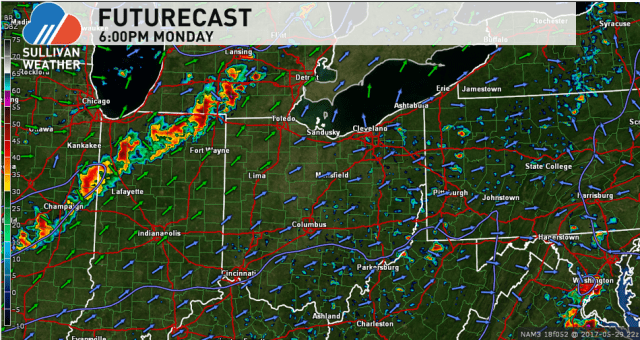
NAM3 52

Monday should be dry for much of Ohio with highs in the 70s.  A very isolated shower isn’t impossible in southern and eastern Ohio Monday afternoon, but I wouldn’t cancel any outdoor plans over it.  The better chance for rain comes later Monday evening as another cold front comes in from the northwest; storms with the front should be weakening as they move in later Monday evening, but a number of areas will likely see some rain Monday evening into Monday night with the next cold front.

Posted in Uncategorized | Leave a comment

May 19th, 2017: Unsettled Weather Continues This Weekend

current surface

An active stationary front draped across the Ohio Valley has been the focal point of occasional showers and thunderstorms across Ohio Thursday and Friday, with this expected to continue over the weekend as low pressure in the Plains intensifies and tracks northeast.  This will pull the front back north along with more moisture and instability, meaning ingredients will continue to potentially be in place for additional rounds of showers and storms across Ohio through Sunday evening.

Saturday pattern

The weather pattern this weekend will feature a deep trough in the jet stream moving east from the Rockies into the Plains and towards the Midwest, with a ridge in the jet stream over the eastern US.  Between the two, a belt of strong winds aloft known as the jet stream will be focused; within this jet stream will be smaller disturbances that will add lift to the atmosphere and take advantage of the pool of instability bubbling north into the Ohio Valley this weekend.  This combination of factors will likely cause multiple rounds of showers/storms this weekend over Ohio.

Saturday:

NAM3 24

Saturday is expected to start dry, however the first weak disturbance is expected to move in Saturday afternoon.  The current expectation is that the atmosphere over northern Ohio will be fairly dry and stable Saturday afternoon, meaning this initial batch of rain/storms will likely weaken as it pushes into northern Ohio.  It is trickier in central and southern Ohio as some better moisture and instability will likely be in place, meaning that the storms may persist or re-intensify south of route 30 Saturday afternoon.  These areas will need to keep an eye to the sky Saturday afternoon, while northern Ohio may just see a few passing and mainly light showers (if that) as it looks now.  Northern Ohio should be much warmer (70s) for highs on Saturday ahead of any rain.

Enough instability should exist in central and southern Ohio for a few strong to severe thunderstorms Saturday afternoon and evening with this first round.  The winds aloft won’t be very strong, so this currently just looks like a locally damaging wind/isolated large hail threat with the first round on Saturday.  Sometimes warm fronts can help cause some brief spin in storms, so I can’t completely rule out a brief tornado in central or southern Ohio Saturday afternoon…though that threat isn’t very high.

NAM3 39

The next round of weather is expected to come in late Saturday night.  Many of our forecast models keep us dry for several hours Saturday evening, but I’m a little bit skeptical of that as the warm front will begin lifting north across the state and may stay somewhat active in the evening.  I wouldn’t cancel outdoor plans Saturday evening but I would have a backup plan in place just in case.  There is better agreement on another round of rain/storms moving through between 11pm Saturday and 8am Sunday from west to east as another little disturbance in the jet stream goes by just to our northwest.  Better instability will be building north as this occurs, so some severe threat (mainly wind/hail) will exist with this next batch Saturday night or early Sunday morning, especially in western Ohio.  These storms will slowly weaken as they move east, but there will be a decent chance of at least rain and some embedded storms in eastern Ohio overnight Saturday night.

SPC day 2.png

The Storm Prediction Center has essentially all of Ohio in at least a MARGINAL RISK (risk level 1/5) for Saturday afternoon and night, with a SLIGHT RISK (risk level 2/5) for western and into central Ohio.  The bulk of this risk comes with the activity expected to spread in from the west late Saturday evening into early Sunday morning, but a couple of strong storms may occur in central and southern Ohio if any activity can make it that far east Saturday afternoon.

Sunday:

NAM3 58

We may see a brief period of dry weather Sunday morning after the Saturday night round of showers/storms.  This will not last long, as a cold front will move through from west to east between 12pm and 10pm Sunday.  Lift from the front and jet stream are expected to cause another round of showers and storms to develop Sunday afternoon.  We should dry out from west to east behind the front later Sunday afternoon and evening.  How fast the front moves through will determine how much of a severe threat exists with the front; a slower front, such as the model above shows, would mean a severe threat potentially as far west as Cleveland and Columbus Sunday afternoon/evening, while some of our models have a faster front and keep the severe threat confined to near the Pennsylvania border and points east.

The upper level trough responsible for all this weather will be what we call “closed off,” which tends to mean things slow down, so the potential for severe weather as far west as central Ohio is non-zero on Sunday.  I wouldn’t expect a big outbreak on Sunday, but winds aloft will be pretty strong so some storms may produce strong to locally damaging winds.

SPC day 3.png

The Storm Prediction Center currently has just far eastern Ohio in a MARGINAL RISK (risk level 1/5) for Sunday afternoon and evening for severe weather.  It is possible that this risk gets edged west a bit if our models come into agreement on the slower front, and an eventual upgrade to a slight risk (mainly for damaging winds) wouldn’t shock me.

Everyone should get into the low to mid 70s on Sunday…perhaps close to 80 in eastern Ohio if the front is on the slower side.

Heavy Rain:

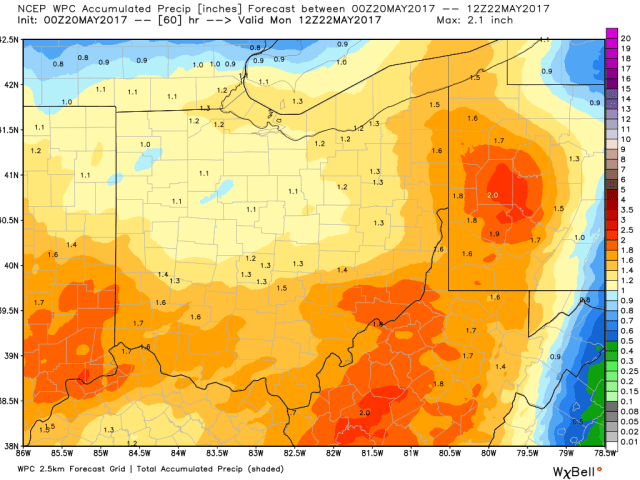
WPC rain

Widespread, area-wide average rain totals of around an inch to inch and a half are possible this weekend, on top of any rain that fell Thursday into Friday.  On average, this won’t cause a ton of flooding, but locally heavier amounts are certainly likely where thunderstorms repeatedly track.  This may result in local flash flooding concerns this weekend, and could cause a few creeks or rivers to come out of their banks where the heaviest rain amounts occurs.

We should get a dry period of weather Monday into Tuesday before wet and notably cooler weather moves in late Tuesday.

Posted in Uncategorized | Leave a comment

March 13-15 Ohio Snow Discussion

Here is my “abbreviated” write-up regarding the upcoming snow event to northern Ohio…

There was a definitely a reduction in QPF on the overnight/early morning models.  We’ll see if that trend continues and how it affects snow totals…

For the synoptic snow late this afternoon through early Tuesday the models are generally showing 0.25 to 0.40″ of QPF across the Cleveland/Akron areas with perhaps a tad more in far NE OH.  This will still be a long duration synoptic snow event as the 850mb and 700mb lows track right across northern OH between this evening and Tuesday morning keeping relatively modest large scale lift going from late this afternoon through early Tuesday.  We will see several hours of isentropic lift/mid-level warm air advection starting late this afternoon leading to what will likely be mainly light snow ahead of the mid-level low followed by getting into a relatively weak deformation zone late tonight through Tuesday morning, which should also keep light snow going.  With a shallow unstable layer over the lake and frictional convergence along the western shore with a ENE to NE flow after midnight tonight some lake enhancement could occur there overnight and allow for totals to be an inch or two higher than they would otherwise be.  Snow ratios could actually start out fairly high late this afternoon into early this evening as the best lift is focused in the mid-levels in the DGZ, though the flakes could get pretty small overnight as the best lift is focused below the DGZ.  Ratios should improve again early Tuesday as the low levels begin to cool, expanding the bottom of the DGZ quite a bit.  This improvement in ratios may align with the weak deformation zone along with some lake enhancement swinging through Cleveland/Akron and the snowbelt late tonight into early Tuesday.  Given all of this, average ratios of around 13-15:1 seem likely tonight which when combined with the model QPF suggests 3-6″ of widespread snow across the northern couple tiers of counties in north-central and NE OH.  NW OH will not see as proglonged of a period of modest lift tonight so they may see more like 2 to locally 4″.  Given the best large scale lift will be east of the western lakeshore, I think even with lake enhancement they should stay in the 3-6″ range through early Tuesday.  Because the deformation zone appears fairly weak and because lake induced instability won’t quite develop until later Tuesday morning, I don’t expect widespread 6″+ totals across the Cleveland area or snowbelt through early Tuesday, but some of the higher terrain could be pushing 6″ if everything goes well.

As the mid-level lows go by Tuesday morning the low-level flow will gradually come around to the NNW and a deepening layer of instability will develop in the low levels over the lake which should allow lake enhancement and orographic lift to really ramp up by later Tuesday morning.  Synoptic snow should be rather light by this point, though with some mid-level frontogenesis as a steep 700mb temp gradient moves overhead on the backside of the 700mb low along with vorticity advection and mid-level height falls ahead of the approaching closed 500mb low there will be some large scale lift present which should keep some light synoptic snow going Tuesday morning into the early afternoon.  This weak synoptic snow combined with improving lake induced instability and terrain enhancement should allow widespread light to moderate snow to continue downwind of the lake through Tuesday afternoon.  Ratios should remain OK as the DGZ lowers into the low levels where the best lift with the lake and terrain enhancement will be.  These factors should allow another 2-3″ of snow to fall during the day Tuesday, particularly in the higher terrain, with perhaps only an inch near the immediate shore and well inland.  Far NE OH could see 3-4″ during the day Tuesday as better snow will linger a bit longer there into Tuesday morning…pushing totals thus far to 5-9″ in the higher terrain through Tuesday afternoon and 4-7″ elsewhere.

As we head into Tuesday evening lake effect conditions improve more with equilibrium levels rising to 10k feet for much of the night with good moisture to over 10k feet as well.  One concern is a somewhat strong and sheered flow beneath the equilibrium level possibly hurting band organization.  With that said the thermodynamic profile will be quite favorable for good snow downwind of the lake and several vort maxes with the closed 500mb low will move overhead, adding some large scale lift and possibly enhancing the lake effect snow.  Snow ratios will be high with any lake effect snow that occurs.  I suspect either higher terrain or an upstream connection will be needed to get notable additional accumulations with the lake effect Tuesday night into Wednesday with the short fetch and somewhat stronger/sheered flow.  With some large scale lift I think even the shore sees at least another inch or two Tuesday night into Wednesday, but could struggle to see more.  The higher terrain should see at least a general 2-4″ Tuesday night through Wednesday morning given the prolonged favorable upslope flow, thermodynamic environment, and periods of better large scale lift with vort maxes rotating overhead.  The key to getting significant lake effect given the short fetch and stronger than perfect winds/sheer in the low levels will be upstream connections to Lake Huron.  The models initially have this connection going into the west side early Tuesday evening before gradually swinging to central Cuyahoga and Summit Counties and points east overnight.  With a NNW flow I’d expect this connection to be more persistent east of Cleveland and into western Lake/Geauga/Portage Counties.  Snow rates of 1-2″ per hour could occur with any band with an upstream connection that forms, so 3-7″ of additional snow seems possible wherever this connection sets up…likely a bit east of Cleveland proper.

The large scale lift ends Wednesday morning as the closed 500mb low moves away and mid-levels really dry out.  The low levels remain pretty unstable so LES snow showers with a little additional snow will continue through the day, but additional amounts after 8am Wednesday should largely be 2″ or less and confined to the higher terrain.  All of this adds up to totals near the shore of 5-9″…most likely in the lower half of that, but if some better lake enhancement occurs or if a Huron band affects certain areas the upper half is possible…and a general 8-13″ in the higher terrain just inland from southern Lorain County east through the secondary and primary snowbelt.  Locations that see the better lake effect likely with the potential Huron connection will see totals of 10-16″ in the higher terrain.  NW PA should see a more prolonged period of synoptic snow and better terrain enhancement, so should see 6-10″ near the lakeshore and a widespread 10-18″ inland.


Posted in Uncategorized | Leave a comment

January 26th-30th Northeast Ohio Snow Event

snow 1-26 no neo.png

Snow showers (possibly mixed with rain) will affect the area today with perhaps a light accumulation, especially in the hillier terrain south and east of Cleveland.  Some light lake effect may deposit a little bit more snow on the Cleveland metro and Snowbelt east of Cleveland tonight.  The snow Friday morning through Saturday afternoon will largely be confined to northwestern PA/western New York and perhaps graze the lakeshore in Lake and Ashtabula Counties at times.  Another couple of waves of snow are expected across northeast Ohio Saturday night through Monday morning.  Uncertainty in snowfall locations and amounts is higher that far in the future…but those waves of snow may be a bit more substantial and widespread, and those waves are responsible for the bulk of this forecast snow through Monday.

Technical Discussion:

A long duration snow shower event, featuring lake and terrain enhancement at times, will occur Thursday through Monday east and southeast of Lake Erie, bringing locally heavy amounts of snow by the time the event runs down.  It would have been nice if the lake were several degrees warmer or if temps aloft were several degrees colder, but I suppose we’ll have to make do with what we have after over two weeks of virtually no snow in the dead of winter.

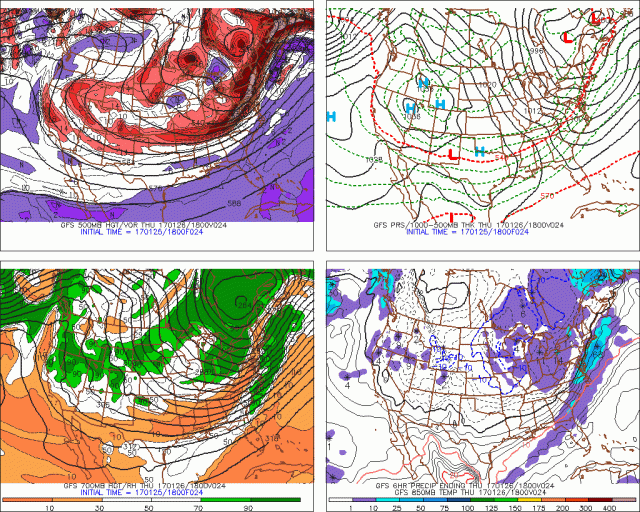
gfs-24

The action starts this afternoon (Thursday) as a shortwave trough aloft and surface trough/wind shift drop ESE across Lake Erie and NE Ohio.  850mb temperatures of around -5 to -6C and 925mb temps of around -1 to -2C, with surface temps in the 30s is marginal for supporting all snow during the day Thursday.  I’m sure any decent showers would fall as snow or grauple and locations higher than 1000 feet in elevation could remain all snow or grauple as well, but in the lower elevations it may not be all snow.

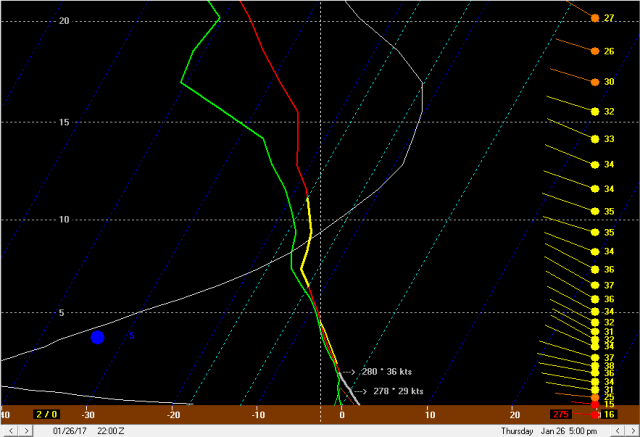
bufkit-1

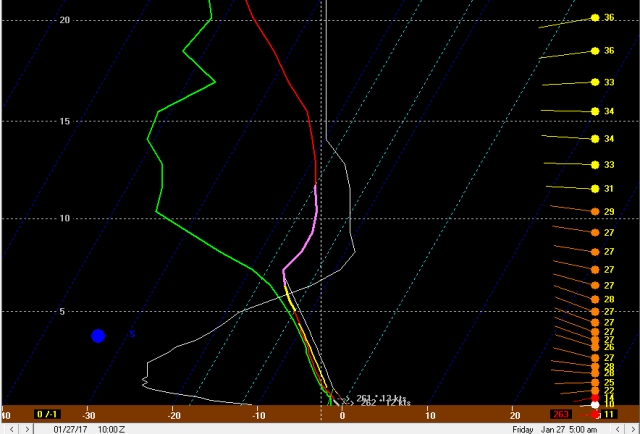
The shortwave will provide a shot of lift thanks to positive vorticity advection aloft along with good moisture to nearly 15k feet.  Low level lapse rates will be conditionally unstable, and the surface trough should provide enough convergence to focus some bursts of moderate precipitation across northern Ohio as it drops through during the late morning and afternoon.  Frictonal convergence could favor a more organized band of precipitation from the western lakeshore east through the Cleveland metro into the southern Snowbelt that moves more slowly.  Ororgraphic lift in parts of this corridor may also contribute to better precipitation.  Lake to 850mb temp differentials are only running around 7C during the day Thursday so I expect little lake contribution to the instability, but the layer of steep lapse rates and good moisture along with sources for lift could squeeze out a good tenth to quarter inch of precip in a corridor from Cuyahoga and northern Medina Counties points east-southeast towards Youngstown on Thursday.  Snow ratios will be 10:1 or less due to the strongest lift being focused beneath the DGZ (zone where temps are between -12C and -18C) and also due to mild surface temperatures, so most areas should see less than an inch of snow…but locations about 1000 feet that perhaps see this better “band” for a few hours could squeak out a couple of inches by Thursday evening.  NW PA will also see several hours of decent orographic lift on Thursday and may see slightly colder temps/better ratios thanks to higher terrain, so there could be some 2-3” amounts in the higher terrain in inland NW PA, with probably just about none near the lake.

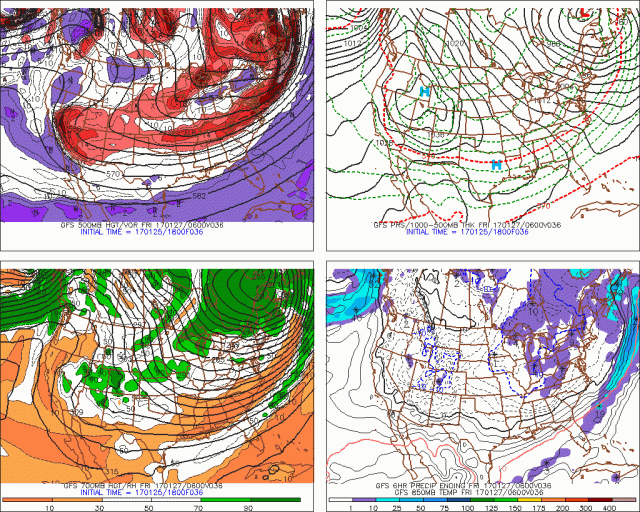
gfs-36

I’m not extremely impressed with the setup for Thursday night, as we will be in a region of large scale sinking motion between two shortwaves.  The mid levels will dry some and other than some upslope there won’t be any good sources for lift.  With a slightly north of due west mean low-level flow Friday night with little shear, moisture to 6-7k feet, inversion heights around 7k feet, and lake to 850mb temp differentials of 10-11C, there could be some minor lake effect snow Friday night.  The best shot will be in the higher terrain where orographic lift could help wring out the moisture picked up off the lake:

BUFKIT 2.png

My best guess right now for Thursday night is an inch or two of snow mainly along and north of route 6 in NE Ohio…especially in the higher terrain, probably an inch or less along the lake…and 2-3” in the higher terrain in inland Erie County Thursday night.  Not really heavy but some snow should continue off and on through the night, particularly in NW PA in the higher terrain.  Some Lake Michigan moisture could allow for a few snow showers with local minor accumulations south of route 6 in the rest of the NE OH Snowbelt Thursday night.  Snow ratios will improve a bit as the DGZ lowers and as surface temps cool below freezing.

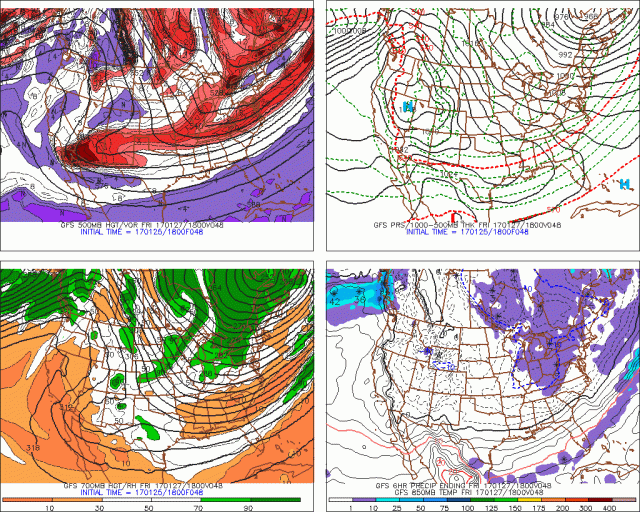
GFS 48.gif

The next shortwave will move through Friday afternoon, with an accompanying increase in mid level moisture and some large scale lift.  The winds will back to the WSW Friday morning and early afternoon ahead of this shortwave, which may focus a band along the shoreline from eastern Lake County east across Ashtabula County into Erie County for a few hours during this timeframe.

bufkit-3

Instability will still be less than stellar, with lake induced equilibrium levels only around 7k feet.  With that said, steep low level lapse rates and good moisture to about 9k feet along with some convergence along the shoreline could allow for some moderate snow Friday afternoon as this shortwave approaches.  The low level winds feature some shear on the models, so this combined with marginal instability may make it hard to sustain snow rates of more than an inch an hour.  The fairly strong and somewhat more WNWrly winds around 850mb may allow the snow to penetrate inland some in Erie County east into SW NY Friday afternoon.  This setup on Friday may again allow another inch, maybe two, of snow in extreme NE Ohio from parts of Lake County into northern Ashtabula County, with perhaps 2-4” across parts of NW PA.  With questions about band organization I have a hard time seeing anyone getting much over 4” in NW PA during the day Friday, but some light accumulating snow could occur over most of Erie County during the day.

Friday night again is a less than stellar setup for heavy snow…there will be a brief more WNW push of winds Friday evening behind the shortwave, which may push the snow a bit farther inland.  Mid-level moisture again decreases later Friday evening and inversion heights come down to less than 5k feet as we get some sinking motion behind the shortwave, so any snow may taper again for several hours Friday night.  I think some spots in far NE Ohio and mainly Erie County in NW PA could see 1-2” Friday night, but I struggle to see a ton more.

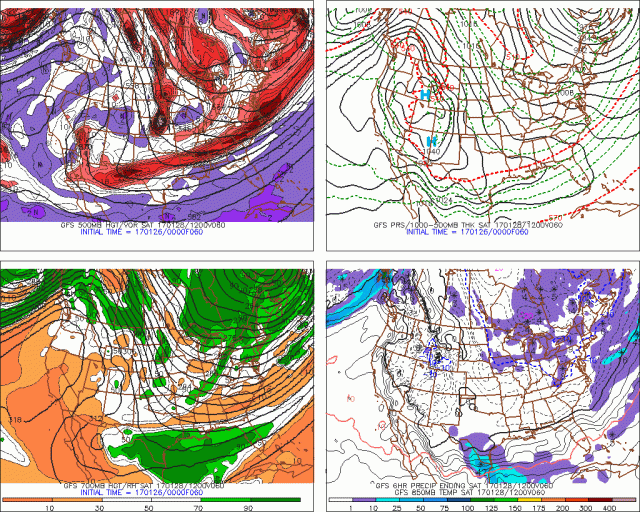
GFS 60.gif

Another shortwave glances the region Saturday morning, and this could lead to a brief increase in snow.  With WSW winds ahead of this shortwave and no real push of WNW winds behind it (due to the shortwave passing mainly to our north), this snow should mainly affect Erie County and perhaps graze the lakeshore in parts of Lake and Ashtabula Counties.  This shortwave just barely glances us so there won’t be as great a shot of large scale lift or mid-level moisture, and inversion heights may struggle to climb back too far above 5k feet…so there may be an inch or two of snow with this shortwave Saturday morning in the lakeshore in far NE Ohio into parts of Erie County, but I struggle to foresee much more at this time.  There should again be a break in the snow later Saturday morning into the afternoon in the sinking motion behind the morning shortwave, and also as winds begin backing to the southwest ahead of a series of more potent shortwaves.

A band of heavy snow will likely develop just south of a BUF on the SW flow Saturday afternoon with better antecedent moisture up there, a 13C lake to 850mb temp differential over eastern Lake Erie and full fetch of the lake.  This band could persist for several hours and produce over half a foot of snow.

NAM 72 500.png

The models agree on two potent shortwaves or really more like small upper lows dropping through the Great Lakes Saturday afternoon through Monday morning.  They do NOT agree on the exact tracks of these shortwaves and exact impacts on our lake effect/enhanced snow potential.

The Saturday night scenario is complex, as the models show two separate shortwaves tracking west to east across the region.  It is possible we get split by the two shortwaves completely, in which case the best lake effect may remain to our north with less of a push of winds to the WNW.  If the northern shortwave tracks overhead, we’d likely see a heavy snow band work its way down the lakeshore and into the Cleveland metro Saturday night into Sunday morning with winds shifting to the WNW by Sunday morning.  The models show 500mb temperatures dipping solidly below -35C with the shortwave Saturday night, so if that shortwave can track far enough south there’d be a deep layer of instability over the lake…to go along with deep moisture to around 10k feet and good convergence with the wind shift associated with the shortwave.  This is the first decent potential for advisory to locally warning criteria snow in NE Ohio, and there’d be a good chance for some warning snows in parts of NW PA and SW NY depending on how the band evolves as it shifts down the lakeshore.

bufkit-4

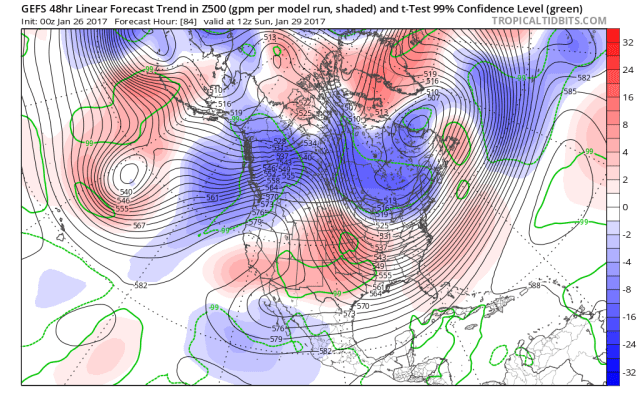
The 0z NAM was on the fence…it had the shortwave Saturday night/early Sunday far enough south to improve our lake effect conditions some and shift the winds to the WNW.  The 0z GFS was a little too far north…while the 0z Euro appears to be close to the NAM or perhaps even a bit better.  Subtle trends in this shortwave could mean the difference between another ho-hum 1-3” in the northern primary Snowbelt Saturday night and a more widespread 2-4” (perhaps locally more).  The GFS ensembles over the last several runs have trended deeper with the overall trough over southeastern Canada, which is a favorable trend.  We will see what happens:

GEFS trend.png

There will probably again be somewhat of a break in the snow later Sunday morning into the afternoon as we get into some sinking motion (briefly) behind the Saturday night/Sunday morning shortwave.  Another impressive shortwave will round the base of the trough Sunday night and this one will likely move overhead.

GFS 96.gif

This shortwave will actually try to swing around to neutrally tilted per the current model consensus Sunday evening, which may allow a low pressure to attempt to start forming nearby before the energy moves east of the Apps by Monday morning.  This shortwave could bring several hours of good large scale lift along with a deep layer of moisture and instability.  The wild card is the exact track of the shortwave and any low that tries developing.  If a low develops over the lake or over northern Ohio, there could be several hours of heavy lake enhanced snow.  If the low develops farther north, the snow could lift north into NW PA or perhaps SW NY and give us just a quick band with the wind shift as the whole trough shifts east/southeast later Sunday night.

Again, there’s considerable uncertainty with Sunday night’s situation.  The general trend on the models has been a little more robust with this shortwave, which if it occurs would be interesting.  There should, either way, be another burst of accumulating snow in the Snowbelt Sunday night into Monday morning, but the exact amounts and placement won’t be known for at least another couple of days…this is still about 4 days away which is quite far out.  Ridging should build in Monday and end the snow by early evening.

bufkit-5

Some of the forecast parameters for Sunday night into Monday morning are eye-popping…but we have a few days to watch the evolution of that potent shortwave so things may change.  A burst of heavy snow is certainly possible though depending on the wind direction Sunday night into Monday morning.

As for amounts…thinking an inch or two in the higher terrain in the primary and secondary NE OH Snowbelts on Thursday, little to no accums in the lower elevations.  Could see 2-3” in the higher terrain in NW PA with little near the lake.  For Thursday night thinking an inch to locally two in the higher terrain in the northern NE OH snowbelt, with maybe half an inch here and there a little farther south if we can see some Lake MI snow showers…up to 2-3” in inland NW PA, with around an inch near the lake.  For Friday thinking maybe an inch along the lake in Lake and Ashtabula, and 1-4” across Erie County, with the 3-4” amounts occurring where/if a better band can try to establish.  For Friday night thinking maybe a local 1-2” in extreme NE OH into Erie County PA.  Saturday again maybe a quick 1-2” in parts of Erie County, little to none elsewhere.

Saturday night will go for a widespread 3-5” for Erie County and 2-4” in the primary NE OH Snowbelt into Crawford County PA…and 1-3” back into the secondary Snowbelt (including the Cleveland metro) west into Lorain County…but this is less than certain and I could see more or less occurring in spots.  Will not expect more than a local inch or two during the day Sunday as we look to see a break.  For Sunday night I will go for 2-4” in the primary NE OH Snowbelt and 1-3” in the secondary…with an inch possible well west and south since there’s good synoptic support. I’ll go 1-3” for NW PA for now.  Sunday night into Monday is pretty uncertain, and this is a conservative, broad-brushed first guess for now.

This pushes totals to 10-18” in inland Erie County…possibly more near the NY boarder in the higher terrain where the higher ends are more likely to be met on a period to period basis…to 6-12” in Geauga County to 3-6” across the Cleveland metro.  A lot of this potential snow is occurring Saturday night through Monday and I broad brushed that for now…it could end up being more or less…but in the interest of rolling this all into one first guess forecast I gave it a shot.

Posted in Uncategorized | Leave a comment

January 5, 2017 Lake Effect Snow Quick Forecast

I don’t have time to put together a write up, but here are some quick thoughts for Thursday evening-Saturday morning.  This map only includes snow from 7pm Thursday on and does not include anything falling before then, including the LES or light clipper snow.

A established and heavy band of snow should push off the lake mid to late Thursday evening into the primary snowbelt in NE OH and NW PA as a surface trough/wind shift pushes south.  Thinking is we get a WNW flow Thursday night behind the clipper which initially sets a band up in northern/eastern Cuyahoga into central Geauga before the winds go W to WSW Friday morning and push things into Lake/maybe extreme northern Geauga. We get another little shortwave Friday evening that may push things back south a bit (after perhaps a break for most everyone briefly Friday afternoon) and re-intensify the band for a time, before things end by early Saturday. Snow showers may linger a few hours longer in NW PA on Saturday until the winds go due SW by noon.

Instability is moderate and moisture is OK but not great. There could be some Lake MI help. Winds look light, generally 15MPH or less, which favors better banding and keeps the heaviest closer to the lake. Ratios will be high so accumulations could be quick. Banding moves some but may lock in for several hours Friday morning into the afternoon on a flow that generally favors Lake County. With some accumulating snow lingering through Friday night this turns into a fairly long duration event, and I’d be shocked if favored areas didn’t see over 6″. Parameters don’t support super heavy 2-4″ per hour rates, but any band could easily produce an inch an hour through Friday afternoon before conditions diminish further Friday evening into Friday night.  Right now I favor NE OH for a little more snow than NW PA for this leg of the event because of the surface trough pushing south into extreme NE OH and trying to focus the heaviest snow there.  The W flow favors better shoreline convergence in NE OH as well.

Tough call for Cuyahoga.  Flow doesn’t really have any northerly component by 7AM Friday on the models and is light, so any snow by that point would affect Euclid at most and that’s about it.  With a light WNW flow Thursday night into very early Friday, convergence may sit over northern Cuyahoga and could drop accumulating snow even as far west as the western lakeshore before it shifts north Friday morning…amounts could be higher near the lake farther west, but I’m not extremely confident in that yet.

1-5 no neo.png

Posted in Uncategorized | Leave a comment

12/29/16: Lake Enhanced Snow on the Way

snow-12-29-no-neo

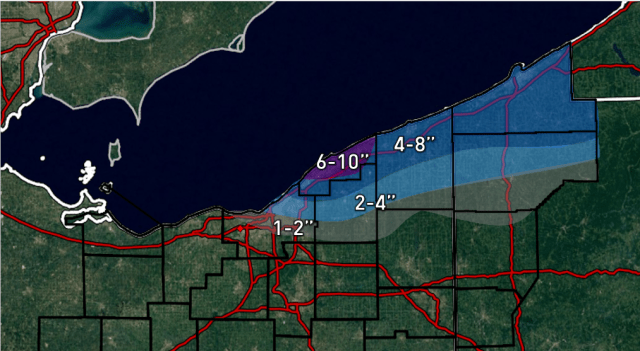
Lake enhanced snow will start firing up late  Thursday afternoon and intensify Thursday evening. The snow will be heaviest through early Friday morning before tapering down to scattered and mainly light snow showers by Friday afternoon. The snow will completely end Friday evening. The heaviest snow will be in the higher terrain in the “primary snowbelt” in northern Geauga, far southern Lake, and inland Ashtabula Counties. Because of the wind direction and abundant moisture, some decent snow is expected in the higher terrain farther south and west in the “secondary snowbelt” in southern Cuyahoga, northern Trumbull, northern Portage, northern Summit, and northeastern Medina Counties. Even away from the snowbelt, good moisture and help from Lake Michigan could contribute to some plowable snow in the higher terrain just northwest of I-71 down to near Mansfield. Locations near the lake will generally see less snow. It will be windy enough for some blowing and drifting snow issues.  This snow has the potential to affect the Friday morning commute across a large chunk of Northeastern Ohio, even outside of the normal “Snowbelt.”

Technical discussion:

gfs-36

A fairly deep upper level trough will take on a negative tilt over the eastern Great Lakes and New England Thursday night into Friday, allowing a low pressure to bomb out over eastern New England.  This whole process will allow cool air to move across the Great Lakes, and keep a rather deep and moist cyclonic flow going over the Great Lakes through Friday.  Although the airmass won’t be extremely cold and the lakes aren’t running as warm as previous lake effect events, the abundant moisture should allow some decent snowfall to occur downwind of the Great Lakes to end the week.

NAM 24 500.png

A little vort max may graze extreme NE OH mid Thursday afternoon…lake to 850mb temp differentials of only 11-12C and instability/moisture extending to only 4-5k feet will limit how much snow can get going Thursday afternoon.  I could see a few flurries in the primary Snowbelt Thursday afternoon, but not much more.

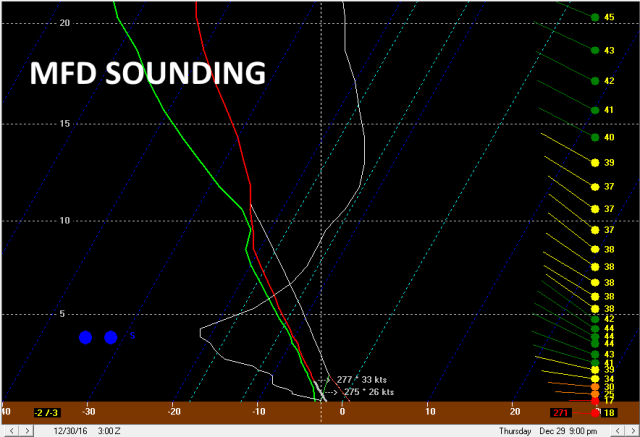
Pictured above is a first vort max starting to rotate into northern Ohio Thursday evening, adding better large scale ascent.  In addition, moisture depth will increase to over 10k feet quickly Thursday evening with the arrival of this vort max while instability also increases and deepens.  Forecast soundings show this improved thermodynamic environment quickly developing by mid Thursday evening over Lake Erie:

bufkit-1

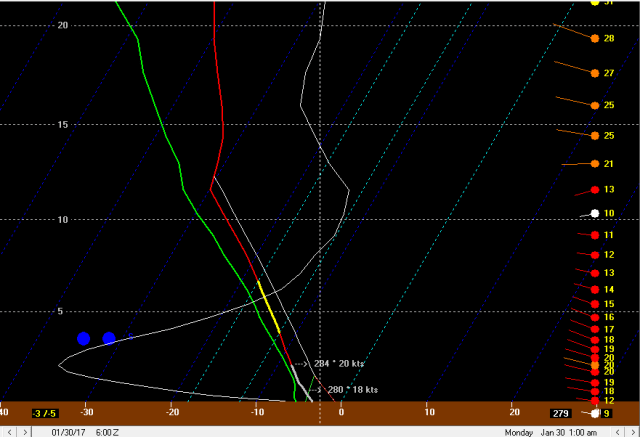
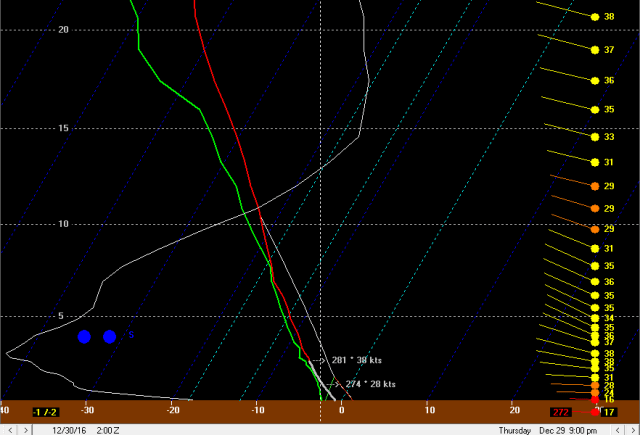
Note that the instability, while not extreme, extends to around 10k feet, with plenty of moisture past 10k feet as well.  There is upward motion (the white line) extending through all of the dendritic growth zone on the soundings Thursday evening, so once temperatures fall a couple of degrees below freezing snow to liquid ratios should improve.  The flow on this sounding is a bit strong in the lowest 10k feet, with a deep layer of 30-40 knot winds, and there is a bit of shear.  This will likely prohibit a strong single band from forming; however, large scale lift from the vort max, some moisture from southern Lake Michigan, a deep layer of moisture and instability and an OK flow for upslope to start developing should allow moderate to locally heavy snow to quickly develop Thursday evening as the first vort max moves in and allows conditions to become more favorable for snow.

nam-27-925

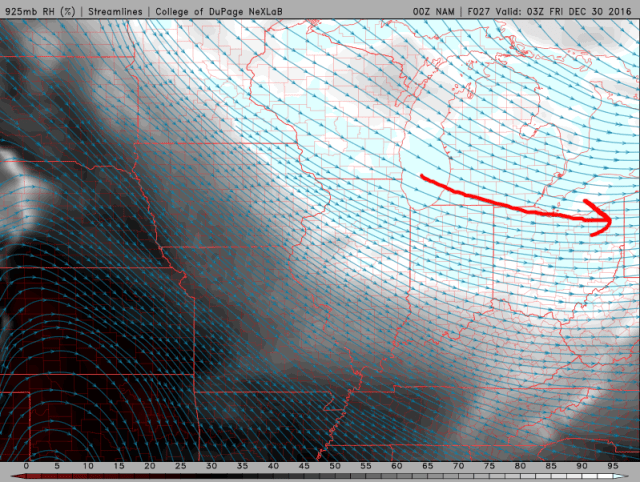
The low level flow will be in the 270-280 degree neighborhood Thursday evening, which does favor the bulk of the Lake Erie moisture affecting northern Geauga County east, and this is where the heaviest snow will likely take place Thursday evening…particularly in NW PA where there’s a longer fetch over warmer waters and more terrain to really enhance the orographic lift.  With that said, the low level flow will still carry Lake Michigan moisture into the west side and Cleveland metro Thursday evening, so this combined with the abundant synoptic moisture and some lift will likely allow snow showers to develop over the secondary Snowbelt Thursday evening as well…it may not be quite as heavy due to less help from Lake Erie, but this isn’t a pure lake effect situation where you’re often dry outside of the main bands.  The cold air advection regime allows a deep layer of conditionally unstable lapse rates to develop, which when combined with abundant moisture from the trough itself and Lake Michigan will allow half decent snow to develop south of the best Lake Erie enhancement…particularly in the higher terrain where upslope will occur.

bufkit-2

Although the flow doesn’t quite bring Lake Michigan moisture down into the central highlands Thursday evening, the ambient low level moisture combined with a deep layer of conditionally unstable lapse rates is still expected to develop…this, combined with modest upward motion with the vort max and upslope should allow light to moderate snow to develop over the central highlands Thursday evening as well.  The surface winds don’t quite hit the axis of the highest terrain at 90 degrees, but it should still be enough to get snow going.  The best upward motion here is located below the DGZ on this sounding, but the steep lapse rates and moisture do extend through the DGZ, so the weak convective processes could occur through the DGZ and allow for fairly high ratios in any upslope in the central highlands by mid to late Thursday evening.

NAM 33 500.png

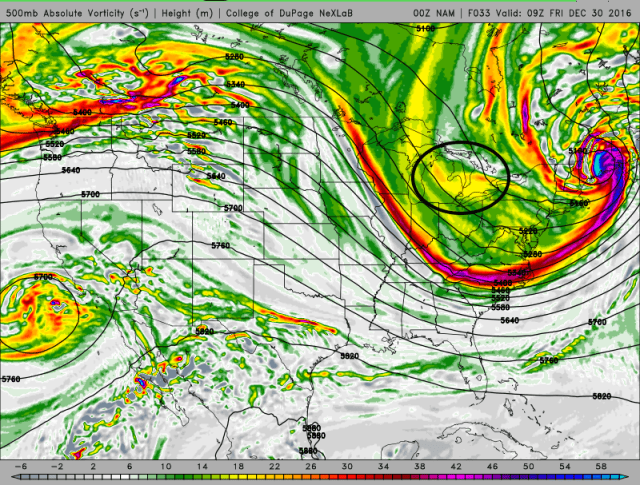
The snow may abate a little bit for a brief time between 1am and 4am Friday as we get a weak period of sinking air behind the first vort max.  Lake effect conditions continue to slowly improve so that may offset the weak larger scale descent…I doubt the snow stops but it may briefly lessen in intensity.  This potential lull will be short lived as a more potent vort max approaches and provides for another period of some large scale ascent between 4am and 10am Friday.

bufkit-3

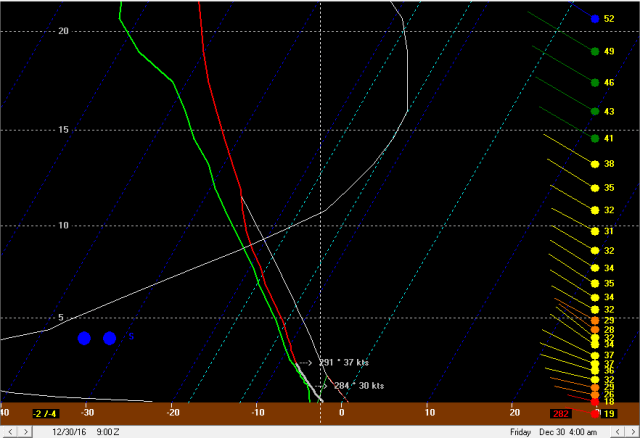
Lake effect parameters remain largely decent as this second vort max drops in, with instability and moisture still extending to over 10k feet.  The wind speed and shear are still a bit strong which will likely prohibit a very intense band from forming, however the synoptic moisture/lift and decent enhancement from the lake will still likely result in moderate to heavy snow, particularly in the higher terrain.  The winds do gain a more NWrly component early Friday morning as a surface trough pushes through, which will likely allow the “heaviest” snow to expand into Cuyahoga County and likely parts of the surrounding secondary Snowbelt as well, as the best Lake Erie enhancement shifts south.

NAM 36 theta.png

There may not be a sharp surface trough early Friday with the wind shift, and instead a more gradual shift.  There may be a brief increase in convergence as the winds shift, but I doubt a big band will develop and swing south.  Regardless, the favorable conditions for enhancement and upslope suggest good snows will continue into Friday morning, especially in the higher terrain of the primary and secondary Snowbelt.

NAM 33 925.png

With the winds gaining a more northerly component early Friday morning, the connection should shift south of the lakeshore and Cleveland metro and hit the central highlands.  Because this is occurring during a period of enhanced large scale ascent from the vort max, and because there’s not only a Lake Michigan connection but also the low level winds hitting the axis of the higher terrain at nearly a 90 degree angle, there’s definitely a risk for some pretty good snows for a few hours in the central highlands Friday morning.

bufkit-4

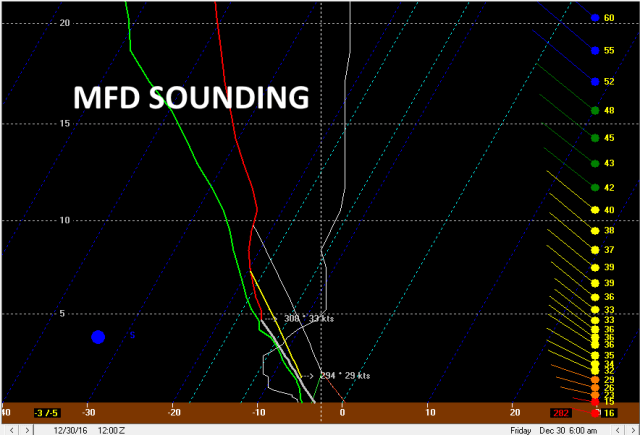
Forecast soundings from MFD for early Friday still show moisture and CAPE through the entire DGZ, with the flow hitting the terrain at nearly a right angle.  When factoring in the modest lift with the vort max and a likely Lake Michigan fetch, the conditions do appear ripe for another decent period of snows in the central highlands wherever the Michigan fetch sets up Friday morning.  Decent snow showers could continue well east across the rough terrain south of route 30 and produce up to an inch or two in spots, making for a rough Friday morning commute in locations well outside of the normal Snowbelt.

Synoptic lift goes away and moisture depth decreases Friday afternoon as the trough pushes east.  Lake effect conditions remain OK downwind of Lake Erie, so with a WNW wind some snow showers will likely continue across the Cleveland metro and primary Snowbelt…but nothing extreme.  Winds turn W and then SW Friday night, but with inversion heights crashing I highly doubt there’s much if any attempt at activity re-organizing on the west flow Friday evening.

NAM 3 33.png

modis

A note about the hi-res models…there is no ice cover over western Lake Erie except for near the Canadian shoreline, and even there it’s slushy.  The hi-res models show a little bit of clearing and radiational cooling over the ice Thursday night into Friday morning.  Satellite imagery showed that there isn’t ice here (and even so there is still some moisture and heat flux through ice), so these models likely are erroneously light on snow amounts from Cuyahoga County southwest into Lorain and Medina Counties due to incorrectly shaving like 60 miles off the fetch and then making that air colder than the air over the surrounding land.

As for amounts…the heaviest will likely be in the higher terrain.  Because of a longer fetch and longer duration of flow off of Lake Erie, the primary Snowbelt higher terrain should see more snow than the secondary Snowbelt.  NW PA should see more than the NE OH Snowbelt due to a longer fetch and even higher terrain yet.  Given the duration of heavier snow in NW PA (a good 18 hours), I still expect max amounts to exceed a foot there in the higher terrain.  In Geauga and Ashtabula Counties (particularly the higher elevations in northern Geauga County), I figure max potential amounts are probably in the 10-12” range…with widespread amounts of over half a foot given the duration of decent snows and what should be 15:1 ratios or so.  The fetch off of Lake Erie doesn’t quite go into the higher terrain in eastern Cuyahoga initially and takes a bit longer yet to hit the higher terrain in the secondary Snowbelt, and the fetch for these areas is over waters that are a few degrees colder, so rates may take longer to get moderate to heavy and probably won’t max out quite as heavy as farther east.  Even still, a good 12 hour or so period of decent snows could yield max amounts of 6 to 7” or so in the secondary Snowbelt, with widespread amounts of at least 4”.  Given some upslope starting Thursday evening and a likely Lake Michigan connection late Thursday night into Friday morning for at least a few hours, I do think the higher terrain all the way down to Mansfield and maybe even into northern Morrow County could see a few inches in spots.  I painted in 2-4” here for now, although there could be locally a bit more if the Lake Michigan connection sets up over a certain area and doesn’t move a ton.  With continually shifting winds, the latter scenario doesn’t seem particularly likely.

With a WNW flow for a while late Thursday night into Friday morning, we’ll have to watch for a shore parallel band developing and moving into the secondary Snowbelt in Lorain, Medina, and Summit Counties.  Winds are still a little on the strong side with a bit of shear during this timeframe, and as I mentioned I doubt a big band swings into these counties from the north as the winds shift, so I’m leaning against this scenario…but if it did occur, local amounts may exceed my 6-7” max in the higher terrain of these counties. The lakeshore is tough, especially from Lake County on west. I went 1-2” for these areas.  With the expected lack of big bands, I think you’ll need some terrain to get decent snows.  With that said, sometimes WNW flow lake enhanced events feature frictional convergence over Lorain and Cuyahoga Counties that can intensify snow in these areas, so I’m not entirely sold that some of the lower elevations in the northern portions of those counties can’t get 3” or so…but the highest amounts will certainly be confined to the higher terrain farther south and east.  With that last bit said, I did put most of Cuyahoga into at least 2-4” outside of the immediate lakeshore.

Posted in Uncategorized | Leave a comment

December 14th-15th Lake Effect Snow Event

snow 12-14 no neo.png

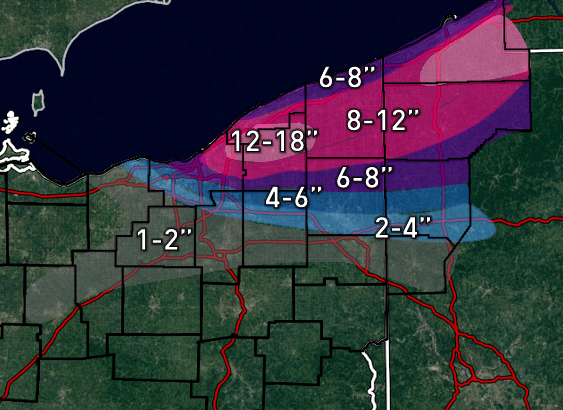
Heavy lake effect snow is on its way to the Cleveland area and east side once again starting this evening. The heavy snow will gradually spread in from north to south tonight into Thursday morning, before lifting northeast and ending Thursday night into Friday morning. Locations that see the most persistent snow bands may see over a foot of snow, however the snow is expected to move more than the previous lake effect event and keep totals from getting too out of control. Snow is expected to spread farther southwest than the previous event and affect much more of Cuyahoga County, with northeast Trumbull, northern Portage, more of Trumbull, and perhaps coastal Lorain County also getting affected at times. This snow could significantly affect the Thursday morning commute.

Technical Discussion:

GFS 18.gif

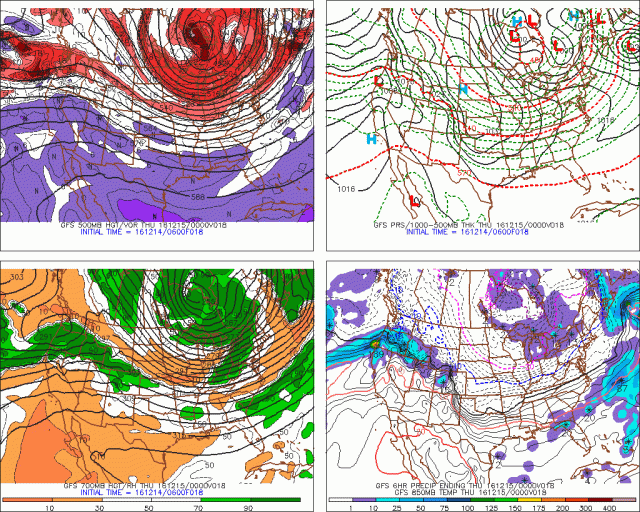
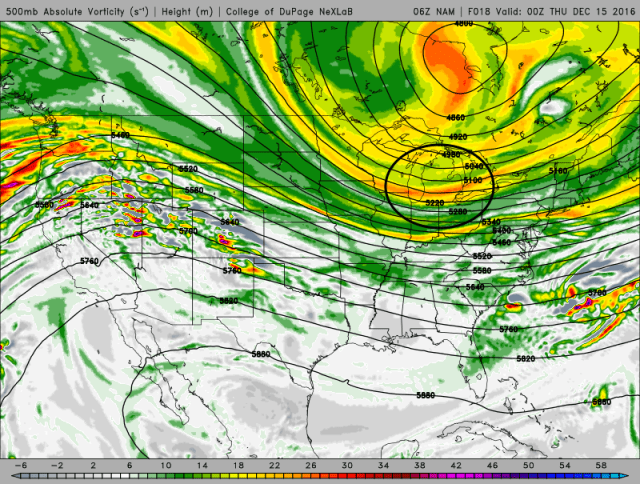
An unseasonably deep upper level trough will drop into Ontario and Quebec through Friday, ushering in the coldest air of the season thus far and aligning the winds out of the west-northwest across the Great Lakes, setting off another round of heavy lake effect snow.

Lake effect snow will intensify this afternoon as winds go southwesterly and allow a strong single band to form over the lake towards Buffalo. The flow is somewhat sheared, however an increase in moisture and lift ahead of a shortwave rotating around the upper level trough and moderate instability developing over the lake should allow snow rates of over 1” per hour to develop with the band as it moves off the eastern end of the lake this afternoon into locations near and just south of Buffalo.

NAM 500mb 18.png

The aforementioned shortwave will move over Lake Erie and NE Ohio/NW PA/SW NY between 0z-6z/7pm-1am Wednesday evening and push winds to a more WNW direction. As this shortwave approaches, even colder arctic air will move in allowing instability to increase, while at the same time inversion heights come up. A connection to Lake Michigan will likely develop and larger scale lift from this first shortwave and another one will help enhance lake effect processes Wednesday evening through Thursday morning.

bufkit-1

Instability will increase this evening, with lake to 850mb temp differentials increasing to 22C+, lake to 700mb temp differentials increasing to 32C+, and lake to 500mb temp differentials increasing to 40-42C. These values are all extreme and along with equilibrium levels on the models of over 10k feet suggest any snow band will be very intense and likely accompanied by some sporadic lighting. The combination of some moisture from the shortwave trough and a connection to southern Lake Michigan will increase moisture depth to around 8k feet. Snow ratios should be fantastic tonight with good RH and strong lift focused on the DGZ. Winds are a little bit on the strong side, but a very well aligned flow, upstream connections, and a favorable long fetch with a W to WNW flow and good convergence along the shoreline should mitigate the stronger winds.

NAM sfc 27.png

The first trough this evening doesn’t have appear to enough oomph to push inland, so the band may get locked in or move very little for several hours late this evening into early Thursday morning. With rising pressure over the Ohio Valley and very cold, dry air inland along with WSW winds, this band will likely setup near or along the lakeshore and into the primary Snowbelt. This wind profile is fairly similar to the one that locked in a band along route 6 with the last event, although with somewhat stronger WNW winds over water, which may allow the band to set up a couple of miles farther south tonight. This could bring downtown Cleveland, the immediate western lakeshore, more of eastern Cuyahoga County and more of southern Geauga County into play tonight. I don’t expect a huge difference in placement from the last event, but that couple of miles could make a big difference to some heavily populated areas that were on the edge of the last event. The winds wiggle a little bit between late this evening and Thursday morning, but not a ton, so the convergence near the lakeshore and fairly steady winds should cause the band to drift over similar areas for most of the night tonight.

NAM 700 30.png

The next shortwave and surface trough will push SE across the lake between 5am and 10am Thursday morning. There appears to be a somewhat stronger push of NW winds behind this trough, so it will likely push the snow band inland before perhaps breaking it up into multi-bands for a time later Thursday morning.

bufkit-2

The environment will be very favorable for heavy lake effect snow as this second trough passes; wind shear will be minimal, although wind speeds again are maybe 5-10 knots faster than is preferable. Lake to 850mb temp differentials are expected to exceed 25C by Thursday morning, with 700mb differentials exceeding 35C. These are both incredible differentials driven by the arctic airmass moving over a still somewhat warmer than average lake, with lift from the shortwave and an upstream connection to Lake Michigan offsetting the drier arctic airmass.

The trough will likely push through quickly enough that the band doesn’t sit on any one spot for more than a couple hours (although we’ll have to watch and make sure it doesn’t get hung up just inland), however the instability/moisture profile combined with the minimal wind shear, strong lift and good RH in the DGZ, and very strong convergence expected between 10kt WSW winds south of the trough and 30kt WNW to NW winds over the water north of the trough, suggests that very heavy snowfall is expected. Instantaneous snowfall rates to 2 to 4” per hours seem likely should this band come to fruition, however it’s questionable how long these rates sit over any one spot. The bad news is this band looks to move across a good portion of the Cleveland metro near rush hour, and even if those snow rates don’t last long they can create quite a mess.

BUFKIT 3.png

Behind the trough Thursday morning, winds are expected to go WNW to even NW, and this should push the primary band inland and break it up into multi-bands for at least a few hours. This will likely spread some lighter accumulations into the secondary Snowbelt and give a break to the northern primary Snowbelt. This flow could bring upper Great Lake connections (perhaps Superior/Michigan) into NW PA, and also hits the upslope areas well there, so moderate accumulations could continue in NW PA behind this trough in the higher terrain, with activity tapering considerable near and north of I-90. The Lake Michigan connection should shift south of Lake Erie for a few hours later Thursday morning and early afternoon in the more WNW to NW flow, although it’s possible upslope in the central highlands allows for a period of snow showers as the Lake Michigan connection aims towards that general area.

Some negatives will develop behind this second trough; the fetch will become shorter and the airmass will dry out, both due to the upstream airmass becoming even drier and the Lake Michigan connection shifting south. This drier airmass, shorter fetch, and somewhat colder temperatures will likely make it hard for intense bands to develop. Outside of any intense bands, it will be cold enough to limit snow growth and hence keep ratios in check. So, accumulations could really slow down for a time later Thursday morning into the afternoon. If a heavier multi-band can set up, then latent heat release within the band may push the DGZ into the clouds and allow for locally higher ratios within any band; due to the flow though it may be a struggle to see good bands develop for a time on Thursday.

NAM sfc 42.png

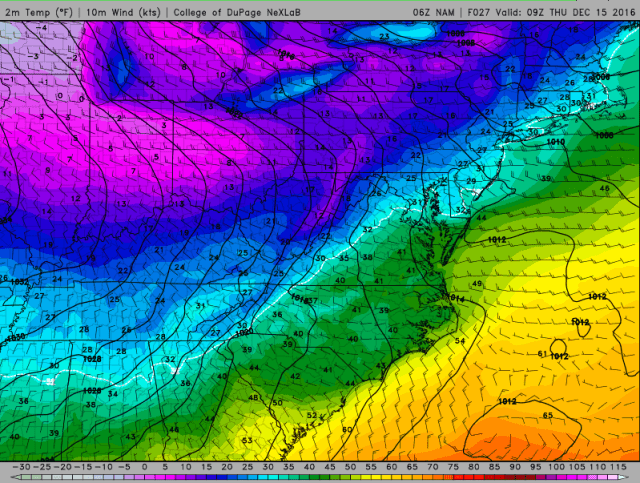
The surface high will really start pushing in Thursday evening, allowing temps to crater over land to near 0 and also causing SWrly winds to develop on land. This will tighten up convergence again near the lakeshore and in the Snowbelt, and may also re-develop a Lake Michigan connection for a time:

NAM 925 45.png

This combination of renewed convergence and some improved low level moisture could allow a band to re-develop from northern Cuyahoga County east into southern Lake and Geauga Counties Thursday evening. Winds will slowly continue to back as high pressure noses in, so this should cause the band to slowly shift northeast through the night. With that said, the winds on land may not get strong enough to push the band completely over the lake until Friday morning.

NAM 4 sounding.png

Forecast soundings from within the potential snow band on hi-res models show inversion heights remaining near 700mb through Thursday evening before really dropping off, with good moisture and lift (omega) in the DGZ. This could allow a decent band to still produce 1-2” per hour snow rates for a time Thursday evening closer to the lake. With that said, inversions do crash later Thursday night and high pressure will try pushing the band north, so amounts Thursday night will likely be held to less than 6” where the band is more persistent, and much of that could fall during the first half of the night.

So, as for amounts…it is quite possible that the lakeshore from eastern Lake County east through Erie County struggle to see a ton with this one. I expect a good burst in the primary Snowbelt from northern Cuyahoga County east/north as the single band pushes onshore with the first trough tonight. With convergence quite possibly hanging close to the lake and into the Snowbelt tonight behind the first trough, along with a Lake Michigan connection and very favorable conditions for heavy lake effect snow, it seems possible that a heavy band with 1-2” per hour snow rates persists for several hours tonight. With WNW winds over water, it is possible this band affects the lakeshore in Cuyahoga County before moving inland into the eastern suburbs, southern Lake County and a good portion of Geauga County. With a long fetch into the higher terrain of NW PA, those areas may do decently too. The band may wiggle some, which if it occurred may keep amounts through 5AM Thursday in the 4-8” neighborhood where the band affects most…however, if the strong convergence causes the band to be more impervious to small wind direction changes, the band locking in and producing up to a foot by 5AM Thursday isn’t impossible in a small area.

I expect the snow to intensify across the board between 5-9AM Thursday as the next trough passes through. Snow rates could increase to 2-4” per hour in the dominant band. This band will probably initially intensify in the northern Snowbelt before slipping south through 9AM Thursday and quite possibly breaking up into multi-bands late Thursday morning as the winds go WNW to NW. This band may move quickly enough that it only drops 1 to 4” of snow as it goes, but this could affect parts of Lorain, much of Cuyahoga, southern Lake, much of Geauga, southern Ashtabula, parts of NW PA (inland especially), and perhaps even northern Medina, Summit, Portage, and Trumbull with a burst of very heavy snow during rush hour. This could be a very high impact event. If the band gets hung up somewhere at all, even for just 2 or 3 hours, the very heavy snow rates could allow it to quickly drop over half a foot over a narrow corridor. This may happen from the western lakeshore into SE Cuyahoga County for a time, due to the winds paralleling the shoreline there for a time and perhaps causing the convergence to “stick” to the lakeshore for a couple of hours.

The snow should diminish across the board late Thursday morning and into the afternoon. The instability suggests heavy squalls may still occur, but the snow bands will likely break up by then, and the colder/drier arctic air may stunt snow growth outside of any good bands. Some areas, such as the higher terrain in the secondary Snowbelt, Geauga County, and particularly NW PA may pick up 1-2” late Thursday morning and afternoon, but unless we get a band to hang on from the west side into say Medina/Summit Counties…which does sometimes occur with this type of flow, but is hard to predict ahead of time…I doubt accumulations will be particularly impressive in this timeframe.

Signs do point towards a single band re-developing late Thursday afternoon and into the evening as winds inland turn SW and increase convergence along the lakeshore into the Snowbelt, while a potential Lake Michigan connection also tries to redevelop. Inversion heights will start to lower and moisture will be more limited than say tonight, however intensifying convergence along with weakening winds (increased residence time over the lake) could still allow a decent band to develop for a time. This band may initially develop from the western lakeshore out east towards Chagrin or Solon before gradually moving north. Snow rates of 1” per hour or more may still be supported Thursday late afternoon and evening if we get a good band to develop, but the band will likely be slowly moving, and conditions appear to degrade significantly for lake effect after midnight, so additional amounts from this band will likely be held to 2 to locally 6”.

Storm totals may exceed a foot where the band is most persistent tonight into early Thursday, and where the snow band tomorrow evening affects. I doubt amounts exceed 18” due to the bands likely moving around/breaking up at times through the event. I did include decent accumulations on the western lakeshore, as convergence could be strong in that area at times and allow for banding there. The southwest edge is as always not high confidence.

Posted in Uncategorized | Leave a comment

December 8th-9th Lake Effect Event for Northeast Ohio

An unseasonably deep trough will move across the Great Lakes Thursday through Saturday, bringing with it a deep cold air mass, sufficient moisture, and a broad cyclonic flow across the warmer than average Great Lakes. This will result in the second lake effect snow event downwind of Lake Erie of the season. This one will be of longer duration, favor lighter winds, a longer fetch, and colder temperatures, likely resulting in much more substantial totals than the first one (2-6” in NE OH).

Snow amounts of over a foot appear quite possible by Saturday in the higher terrain of southern Lake County and northern Geauga County, as well as inland northwest Pennsylvania. Eastern Cuyahoga County may also see heavy snow at times and decent storm totals. Amounts will drop off quickly outside of the Snowbelt, but a rouge snow band may drop accumulating snow in parts of northern Lorain County and western Cuyahoga County on Friday.

Map:

12-8-no-neo

Technical Discussion:

gfs-18

As the cyclonic flow begins developing over the region Thursday morning, a band of snow will likely develop over the lake and hug the lakeshore in Lake and Ashtabula Counties, before moving into Erie County PA and Chautauqua/Cattaraugus County NY. The band will likely hug the north half of those counties. We’ll actually be in a region of subsidence with mid-level drying through early Thursday afternoon behind a shortwave trough moving over the region early Thursday morning, however the long fetch and moderate instability will likely allow decent accums to being across parts of NW PA/SW NY on Thursday with this band.

NAM 500 24.png

By Thursday evening, a weaker shortwave or vort max is expected to drop across Lake Erie between 5-10PM. This will cause inversions to rise and mid-level moisture to increase, while also bringing a surface trough and wind shift with it. The winds will shift from WSW in the low levels to more of a W Thursday evening as this trough pushes through. This will likely push heavier snow into the NE OH lakeshore Thursday evening and push it a bit farther inland of NW PA and SW NY. With the passage of this first trough, inversion heights will increase to around 10k feet and moisture depth will increase to around 8k feet, allowing the intensity of the lake effect to increase:

bufkit-1

Although the shear looks bad, it’s much better aligned over the lake, and will result in strong convergence near the lakeshore as stronger, W to WNW winds over the lake run into weaker WSW winds over land. The stronger WNW winds over water will try to push the snow inland some Thursday evening, however the WSW winds over land suggest the better snow will hug extreme NE Cuyahoga County, Lake County, Geauga County along and north of US 6, the northern half of Ashtabula County and into Erie County through Thursday evening. The instability and moisture support snow rates of over 1” per hour assuming convergence can develop as it appears it should and focus better snow in the aforementioned area.

NAM sfc 30.png

The 12km NAM does show this zone of convergence, extending from as far west as Lorain County into inland Erie County PA, with the convergence stronger farther east. This favors moderate to heavy snow in the northern NE OH primary Snowbelt and into a good chunk of Erie County PA (and also the ski-country in SW NY) Thursday night. The convergence will not move much for several hours, so several inches could be picked up in these areas Thursday evening into the overnight, with locally over 8” in NW PA/SW NY through 4am Friday where a longer fetch, more terrain, and seemingly stronger convergence could contribute to heavier snow.

nam-sfc-36

Between 4am and 10am Friday, another shortwave will rotate around the larger trough to our northeast. Although the upper level shortwave stays to our northeast, the surface reflection will move southeast across Lake Erie as a well-defined trough. This will initially really increase convergence along the lakeshore early Friday as winds back a little bit on land ahead of the trough, and turn more WNW to even NW over the lake behind the trough. The upper level support for this surface trough will stay to our northeast, and the surface trough will be moving into high pressure nosing into the Ohio Valley, so it’s questionable how quickly this trough pushes through.

bufkit-2

Regardless of how quickly the trough pushes through Friday morning, conditions for lake effect will go from “pretty good” to “pretty outstanding” Friday morning, with moisture depth improving to 10k feet, inversions rising to 13-15k feet, and winds in the low levels weakening a little bit and increasing residence time over the lake. Lake to 850mb, 700mb, and 500mb differentials will push or exceed 20C, 30C, and 40C Friday morning as the trough pushes through…all of these values are “extreme” and support a few lightning strikes with any good snow bands Friday morning near the lake. Snow rates of 2” per hour are quite possible with the band along the surface trough Friday morning.

The question is, how quickly does the trough and band push south? I suspect the heart of the primary Snowbelt…far NE Cuyahoga, southern Lake, northern Geauga…will see a few hours of very good snow ahead of and along this trough given the W to slightly S of due W wind direction ahead of the trough. From there, winds only go WNW behind the trough, with the best upper support remaining well NE, and with surface ridging nosing into the Ohio Valley. This suggests that the trough will not push south super-fast, and may not push the snow band farther south than northern Lorain County/southern Cuyahoga County/the Geauga/Portage County border. This may drop a quick 1-4” on much of the Cleveland metro as well as southern Geauga County, inland Ashtabula County, and southern Erie/most of Crawford County PA given likely intense snow rates and gradual progression of the trough and accompanying snow band.

bufkit-3

Behind the trough for late Friday morning and afternoon, shear is weak, the flow is a favorable WNW and not too strong, instability remains extreme with high inversion heights, and moisture depth remains respectable. Decent lake effect snow should continue. The big questions for Friday behind the trough will be whether some sort of band can maintain itself across the southern Snowbelt and allow for a more focused area of moderate to heavy snow, and whether or not we can get any upstream connections. The environment is pretty freakin good for lake effect snow on Friday, so it’s just a matter of capitalizing on it:

NAM 925 42.png

The WNW low level flow does suggest a continued connection off of southern Lake Michigan through the day Friday, which would suggest some decent snow in the Cleveland metro and primary Snowbelt in NE OH. This flow would take the Lake Superior connection (which is actually rather common) into NW PA. The 850mb flow is a bit more NWrly and takes the southern Lake MI connection south of Lake Erie and takes the upper lakes connection into the Cleveland metro and Snowbelt. The well aligned low level flow off of lower Lake MI and some convergence along the way suggests that connection may contribute to snow in the Cleveland metro on Friday, with upstream lakes keeping things going in NW PA/far SW NY during the day behind the trough.

NAM sfc 42.png

Convergence will probably weaken some Friday with an absence of a trough to our NW, and also with temps on land warming up some and decreasing the temp differential over the lake a little bit. Regardless, remnant convergence from the morning band and some remaining lake to land temp and wind differentials should allow some loosely organized snow to persist on Friday across the Cleveland metro and southern Snowbelt. I don’t expect a firehose band, but with such a good thermodynamic profile and some pre-seeding from Lake Michigan there could be good bursts that add up to at least a couple to few inches during the day Friday behind the trough. This will be the best chance for parts of Lorain, Medina, Summit, Portage, southern Trumbull and Mahoning Counties (particularly northern portions of this corridor) to see some accumulation.

A good question is how much of a break will the northern primary Snowbelt see on Friday during the late morning and afternoon. In NW PA and SW NY, there doesn’t look to be strong convergence, but there may be decent connections to Lake Huron and Lakes Superior/Michigan (northern). This may cause snow to shut off along the shore (outside of any upstream connections) but decent snow could keep going in the higher terrain, particularly in any upstream connections. In NE OH, I expect northern Ashtabula and Lake Counties to see snow really slow down and possibly shut off Friday late morning and afternoon…however, convergence and orographic lift just inland may allow at least snow showers to continue in far southern Lake County, Geauga County, and southern Ashtabula County in the higher terrain…though they may become less organized. This may support a few inches behind the trough in the higher terrain of Erie and northern Crawford County in NW PA and a couple inches in far southern Lake County/northern Geauga County in NE OH through Friday afternoon…with perhaps a few inches a little farther south in NE OH where convergence tries to persist.

NAM 925 54.png

There may be an interesting setup Friday night into Saturday morning as ridging builds closer and slowly backs winds. There is pretty good agreement on a good southern Lake Michigan connection developing Friday evening, with the potential for strong convergence developing near the central lakeshore as temps cool on land and as winds on and go light and southwesterly:

Nam 54 sfc.png

This could favor a more organized convergence band re-developing Friday evening and persisting into Saturday morning. With a W or WNW wind initially, this band could initially develop over northern Cuyahoga and central Geauga County before slowly shifting north later Friday night into Saturday morning. Conditions will remain favorable for decent LES through Friday night before degrading Saturday morning:

BUFKIT 4.png

Upper level temps warm a little bit, but the low and mid levels remain plenty unstable and moisture Friday night for heavy snow rates should a band form. Any upstream connection would only increase the likelihood of heavy snow Friday night, and the somewhat weaker low level flow may also favor heavyier snow. Winds suggest this band will shift to northeastern Lake, northern Ashtabula, and Erie PA counties by sunrise Saturday. Snow rates of 1-2” per hour may be possible under this band, with the potential for the band to persist long enough to drop a few or locally several inches Friday night. Winds should shift enough to finally push the band out of Erie County PA by mid to late Saturday afternoon, bringing this event to a close.

As for accumulations…I expect 2-6” through mid Thursday afternoon in northern Erie County PA and into northern Chautauqua/Cattaraugus County NY with a WSW flow band that should start developing by morning and become fairly intense by afternoon. Coastal Lake and Ashtabula Counties may see a light accumulation from this.

By Thursday evening I expect the snow to intensify and push a bit farther south, and this could produce another few inches (3-6”?) through Thursday evening in Chautauqua/Cattaraugus County NY, Erie County PA and Lake and northern Ashtabula County in OH as the first trough pushes through and winds go more westerly. Far NE Cuyahoga and northern Geauga may also see light accumulations through Thursday evening. These accumulations in NW PA and SW NY should be focused a bit south of where the initial band will dump through mid-afternoon.

Thursday evening into the overnight will likely see the band hold steady or shift ever so slightly farther south with a WSW surface flow on land and WNW flow over the lake. Lake effect conditions gradually improve, and this could produce another few inches (2-6”) through 4AM Friday in far NE Cuyahoga, northern Geauga, Lake, northern Ashtabula, and Erie PA (into inland SW NY). The band will intensify ahead of the next trough and then gradually push south into the Cleveland metro and southern Snowbelt. This whole process could produce a few inches in the northern Snowbelt initially while the band intensifies early Friday, and then 1-4” in the southern Snowbelt and Cleveland metro through mid Friday morning as the band swings south.

Friday late morning through afternoon may feature the snow becoming less organized…however upstream connections, longer fetch and upslope into NW PA may produce a few more inches in this timeframe, with perhaps a few inches where the remnant convergence band and southern Lake MI connection set up into parts of the Cleveland metro (possibly western and southern suburbs) and southern Snowbelt.

The band Friday night may produce a couple inches in eastern Cuyahoga/southern Geauga and up to several inches in northern Geauga and Lake/Ashtabula and into NW PA as it re-flares and then very slowly shifts NE. NW PA may see some more Saturday morning before it finally ends.

All together…given the potential for multiple instances of banding with moderate to heavy snow, and perhaps even continued accumulating snow showers between periods of banding, think there will be over a foot in the typical hot spots in southern Lake/northern Geauga and inland NW PA. Inland NW PA may see locally up to 2 feet where any upstream lake connections develop on Friday. Drew the sharp southern cut off from northwestern Cuyahoga County southeast through far northern Summit, northern Portage, and Trumbull Counties. Winds get WNW for a time, but lake aggregate troughing tends to be stronger when the lake is warmer, and ridging building in on land suggests the trough/convergence band Friday may not make it extremely far inland. For the Cleveland metro this is tough…may be a couple of windows for banding near the shoreline late Thursday night through Friday evening which could produce a few inches, even down to the shore. Farther east, there may be a good shot of banding through very early Friday another shot Friday night into early Saturday, so amounts along the shore could be decent. There could be graupel near the lake given how warm the water still is which may hurt ratios near the shore and keep higher amounts inland a bit. Inland could see 15-18:1 ratios with temps below freezing for the event.

High res models are iffy on amounts…BUF WRFs look good through early Friday but don’t run out any farther. NMM is similar to this idea but struggles to develop an organized band at times and is lighter on amounts…ARW seems lost. 4km NAM isn’t far off from this idea but also struggles to organize bands and shows lighter precip than you’d expect given the setup, and hence shows much lighter amounts. The 12km NAM and SREF consistently show snow, perhaps in a band, in the Snowbelt, and these low-res models combined with the setup do argued for a prolonged heavy event with good totals in the heart of the Snowbelt. We’ll see.

Posted in Uncategorized | Leave a comment

11/19/16: First Snow and it Feels so Good

Lake enhanced snow will accompany the first true cold air mass of the season this weekend, bringing locally up to several inches of snow in the higher terrain of the Snowbelt east of Cleveland. Map:

snow 11-19 no neo.png

Meteorological Discussion:

nam-30

It’s a beautiful site! After being transplanted to a Virginia-like climate for the last 12 or 13 months, the models have a closed low just to our northeast Saturday night, with plenty of cold air and synoptic moisture moving over the unseasonably warm waters of Lake Erie. Finally, the wait is over and our first true taste of winter is here!

NAM 925 15.jpg

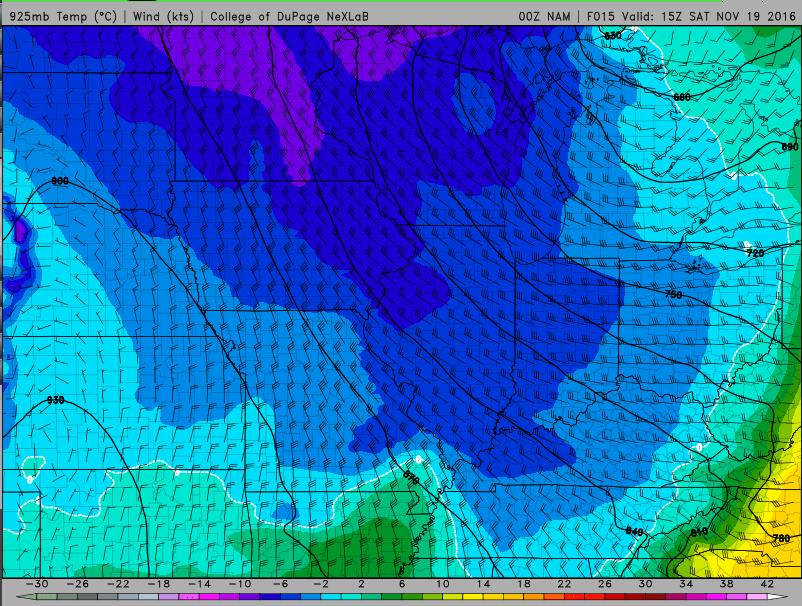
A band of ana-frontal/post-frontal rain will not clear eastern OH until late Saturday morning/around noon near the PA boarder. 925mb temps will crash to 0 to -2C by 13-14z/8-9AM, with surface temps in the upper 30s to near 40. These low level temp profile will be marginally supportive for some flakes mixing in on the back edge of the ana-frontal rain band. So, this basically means that we’ll start our Saturday on a positive note, assuming you like mangled snowflakes mixing in for 20 minutes with gusty winds and falling temperatures as much as I do. It doesn’t mean much more, because the precip will briefly pull out of the area before anything more interesting happens.

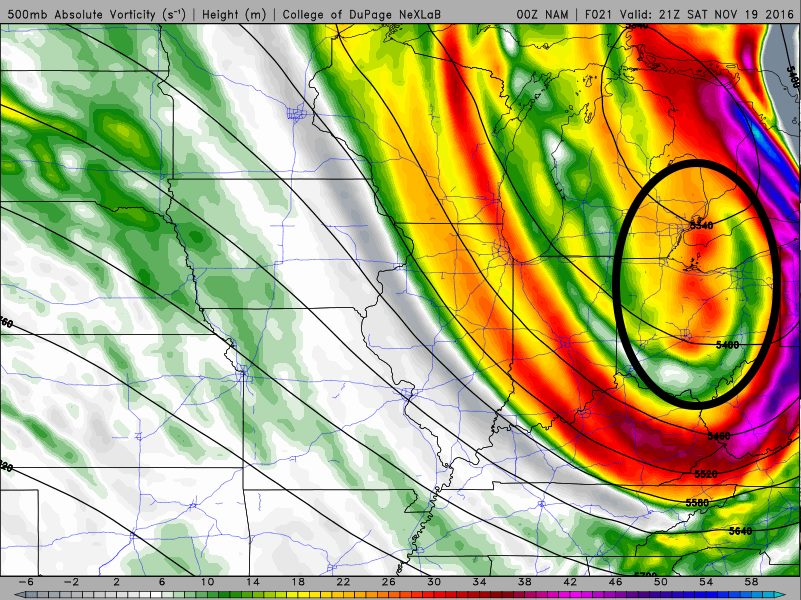
NAM 500 21.jpg

Interesting weather returns late Saturday afternoon/early evening as a vort max rotates across northern Ohio and Lake Erie. This vort max will move in on the leading edge of wrap around moisture, and also be accompanied by a surface trough/wind shift that will drop southeast across the lake. Oh, this is exciting already!

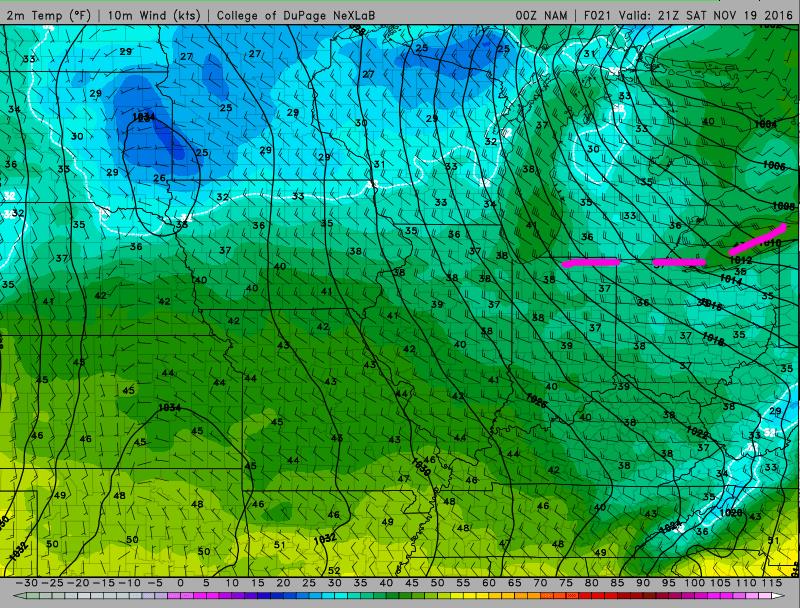
NAM sfc 21.jpg

Here is the surface map, showing a noticeable kink in the isobars and shift in the winds. The winds ahead of the trough over NE OH/NW PA are WSW, with winds behind the trough out of the WNW. These are fun wind directions, because it gives a long fetch for the trough to work with over Lake Erie, and also brings pre-seeding from southern Lake Michigan. The thermodynamic environment as this trough pushes across the lake will become extremely favorable:

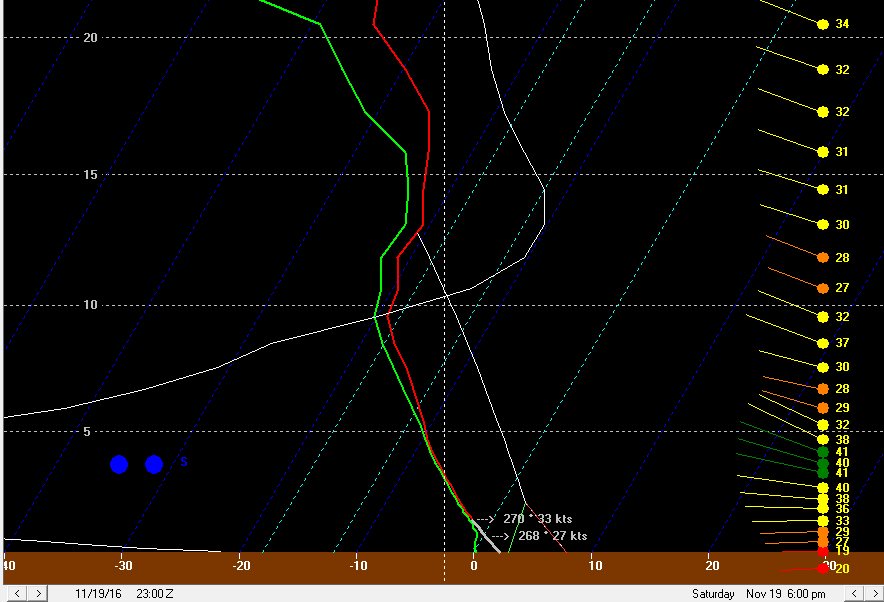
BUFKIT 1.jpg

Deep moisture to nearly 20k feet, over 700 J/KG of lake induced CAPE, with equilibrium levels near 13K feet, along with the convergence with the trough and likely pre-seeding from Lake Michigan will combine to generate intense precipitation along the wind shift as it pushes off of Lake Erie. A band may briefly form over the lake parallel to the shore in the WSW flow ahead of the trough and swing inland. 925mb temperatures of -2 to -3C and 850mb temperatures of around -8C as the trough pushes inland will easily support all snow (or perhaps graupel) with any decent bursts of precipitation. Inland it probably won’t take much of a burst to fall as graupel or snow, as these temperatures are a couple of degrees C colder than what it normally takes to get early-season accumulating lake effect snow.

The trough pushes south fairly quickly, however many areas will likely see a quick burst of snow. Given the likelihood of intense precipitation along this trough, some areas could see a quick half inch or inch of snow as the trough pushes inland…even the lakeshore may see accumulations if a good burst moves overhead. The layer of instability may be just deep enough for a few lightning strikes as the trough pushes on shore.

NAM sfc 30.jpg

Behind this first trough, the isobars will become oriented just north of true NW to SE, with WNW surface winds. The isobar pattern is very close to historic isobar patterns for heavy single banded snow in Cuyahoga County, but is perhaps oriented slightly more N to S than the average of those events. The winds are also stronger. With that said, some convergence should still set up due to friction and the colder air inland butting up against the lake modified air, and based on the strong flow possibly pushing the convergence a bit inland, and isobar pattern, the potential for a more focused area of snow showers will extend from Lorain County east through the southern half of Cuyahoga County into Geauga, inland Ashtabula, northern Trumbull and southern Erie PA Counties. The strong winds will likely prohibit a true primary band from forming, but enhanced convergence in this area should result in better snow.

BUFKIT 2.jpg

The instability and moisture remain very favorable through the overnight, with equilibrium heights hanging near 12k feet and deep moisture lingering to 10k feet or higher into early Sunday morning. With strong wind hitting the terrain at a fairly good angle, I expect the combination of some convergence as discussed above and orographic lift to wring out decent snow across the higher terrain in NW PA, inland Ashtabula, Geauga County, eastern Cuyahoga County, and likely into the hills in northern Summit County, southern Cuyahoga County, and northern Medina County through the night.

NAM 925 33.jpg

In addition to the relatively favorable looking wind direction and convergence, but upstream moisture from Lakes Superior/Michigan will likely swing from NW PA Saturday evening into the primary NE Ohio Snowbelt overnight Saturday night, and perhaps onto the west side Sunday morning as the winds gradually veer to a more northwesterly direction. Any upstream connections may result in locally heavier bands of snow, despite the relatively strong winds and some wind shear otherwise preventing strong banding. A Lake Huron connection will also edge west into NW PA early Sunday morning. The deep synoptic moisture, convergence south of the shore, orographic lift, and strong instability support a general snow downwind of the lake focused on the higher terrain, but any of these upstream connections will support narrow heavier bands of snow within that.

NAM 700v 33.jpg

The NAM and GFS both bring one last vort max across Lake Erie and into north central and northeast Ohio very early Sunday morning; this could bring another intensification in the snow for a few hours very early Sunday, both due to the added lift from the vort max and the subtle surface trough/wind shift with the vort max adding to the low level convergence near the lakeshore.

NAM 700 36.jpg

My general rule of thumb is that moderate to heavy lake enhanced snow will continue until at least when the 70% RH line at 700mb moves east of the area; the general consensus is for this to occur around 7-8AM in Cleveland on Sunday, by 10AM in Geauga County, and around noon in Ashtabula County. As the low cuts off and slows over New England this drying will really slow as it reaches NW PA, and they may remain in the moisture cyclonic flow into Sunday night, before gradually drying into Monday.

This suggests the large blob of decent snow will end in NE Ohio Sunday morning from west to east, but perhaps linger over NW PA through Sunday and into Sunday night.

SREF 700.gif

The SREF mean matches the recent GFS/NAM/Euro runs fairly well with how quickly it moves the 70% 700mb RH line east Sunday morning. Several members are slower and would keep heavier snow going longer in NE OH Sunday morning, and it’s worth noting that just small changes in the models WRT their handling of this cut off low may have impacts on how much snow falls in NE OH. The models have been relatively consistent their last couple of runs, so we’ll see if the current consensus holds up.

BUFKIT 3.jpg

Even after the best moisture strips away, the instability/moisture profile aren’t “horrible” for pure lake effect that may be leftover. Equilibrium levels take until Sunday evening to fall below 10K feet, and moisture is solid at and below 5k feet, and into the DGZ all of Sunday. The flow is WNW which isn’t the longest fetch but also isn’t the shortest, and winds in the low levels, which still a little stronger than preferable, do weaken some compared to Saturday night. This leads me to believe that disorganized light to moderate snow showers will continue on Sunday. With 850mb temps of colder than -10C, clouds/snow showers around all day, and probably some snow on the ground in most of the Snowbelt away from the shoreline, highs on Sunday will struggle to hit freezing in many spots and any additional snow showers may produce an additional inch or so in spots Sunday afternoon.

hi res 44.gif

With a WNW to NW wind, I’d expect any connection to the upper Great Lakes to move into the Cleveland metro and/or primary Snowbelt Sunday afternoon. Although the atmosphere will be drying some, sufficient instability and improving low level winds (weakening speed and directional shear) may allow for a disorganized band or two to possibly form downwind of these upstream connections through Sunday afternoon, especially where the bands hit higher terrain. This may be where spots pick up the additional inch or so I discussed above Sunday afternoon.

At this same time, a healthier Huron connection (and better synoptic moisture) will affect NW PA; with a WNW to NW flow, the band may not edge as far west as the ARW has it (near Meadville), and may stay in central or eastern Erie and Crawford Counties. The NMM traditionally does not have as bad of a bias for placing bands too far southwest, and is a little farther east with that band. With strong winds that are gradually shifting, the ARW’s solution of stalling a single and extremely intense Huron band on Sunday may not be realistic. A more diffuse moderate to briefly heavy band that moves a little bit across NW PA seems more reasonable given the strong winds.

BUFKIT 4.jpg

As we head into Sunday night, the inversion slowly lowers and moisture starts stripping away above about 4k feet. This sounding has just enough juice for maybe some light accumulations Sunday night, mainly driven by the extreme temp differential between the lake and 850mb still allowing for about 500 J/KG of lake induced CAPE under the inversion. With the winds in the low levels finally weakening below 30 knots and gaining a bit more of a westerly direction, this may try to favor lose organization of snow showers from the Cleveland metro east. A negative here is that high pressure building in from the west will likely shut off upstream connections into NE Ohio Sunday night. Overall, if a band does try to develop Sunday night, some spots may see another inch or two of snow, but nothing very substantial.

In NW PA the deep synoptic moisture will finally pull east Sunday evening, allowing for the steady orographic enhanced lake enhanced snow to taper. With that said, instability and moisture depth remain a little bit deeper, along with a possible Huron fetch that may not shift east into SW NY until Monday morning. This could allow some spots to squeak out another 2-4” in the higher terrain of NW PA Sunday night. I don’t expect another to see more than nominal addition accums in NE OH or more than an inch in NW PA on Monday.

So, all in all, this is a tough forecast. Many signs point towards a lot of lake enhanced/effect precipitation, including the favorable fetch, upstream connections (especially NW PA), very good moisture/instability, and orographic lift. The one negative is strong winds/wind shear limiting band organization until perhaps Sunday afternoon and Sunday night…by then the other good factors will start diminishing for NE OH and by Sunday night in NW PA. Another negative is warm ground and air temperatures. I suspect that once inland locales get a little snow down that with air temps falling to near freezing that ratios can increase to near 10:1 inland by later Saturday night and Sunday…especially in the higher terrain of NW PA. Near the lake temperatures may not get to freezing until Sunday night, keeping ratios much lower and constantly melting any snow that does stick. So, although some bursts may occur at times near the lake and accumulate a little, big accumulations are highly unlikely near the lake.

For NE Ohio, I figure the flow and terrain favor eastern Cuyahoga and most of Geauga County Saturday night. It appears that a good 12 hours or so of moderate snow is possible here. Again, with the lower ratios, especially at first, and likely lack of an organized, dominant band that drops a ton of snow at once, amounts will probably stay somewhat under control. With that said, such a long window of decent snows into Sunday morning leads me to believe that a few inches…IE 3-6”…are quite likely to fall in most of Geauga County through Sunday morning, especially in the higher terrain in central and northern portions of the county. Another inch or two of snow from snow showers Sunday afternoon and Sunday night could push totals over 6” and up to near 8” in the higher terrain of northern Geauga. How far south and west to extend the snow is tough, as the hi-res models really want to get a good portion of Medina, Summit, and Portage in on the act. With a strong WNW flow I do expect northern portions of these counties to get in the act Saturday night into early Sunday, but the isobar orientation along with typical hi-res model bias to place bands too far SW suggests that only the northern portions of these counties will get in the act. Normally, a prolonged WNW flow band into these areas can produce decent totals, but with a little bit less terrain here than farther east, moisture moving out faster in these areas, and a likely lack of a big band, I will keep amounts in these areas to 2-4”. I don’t expect much if any additional snow here after Sunday morning. If a better band does form, the secondary Snowbelt could see a locally higher amount under that band…but at this time that doesn’t look very likely. Due to a prolonged WNW flow off of Lake MI and strong winds carrying bands well inland, parts of the central highlands may see light accumulations as well. Only allowed an inch or two at the lakeshore and in spots that will be generous.

For NW PA, stronger orographic lift through the event and an additional 6-12 hours of favorable synoptic moisture along with Lake Huron moisture will allow for considerably higher totals. I’m looking at a 30 hour period of pretty good snow in the higher terrain of NW PA, with light to moderate snow showers lingering for several hours after that into early Monday before finally ending. Snow ratios in the higher terrain of NW PA should be a bit higher due to slightly colder temps and also better odds at quickly establishing a snow pack to build on. With the Huron band likely meandering and not being extremely intense, and still lower than optimal ratios, I struggle to see more than 18” or so as the jackpot in NW PA…but I do foresee a rather large area seeing at least a foot. If the Huron band can stall for a few hours, which again seems less than likely, then a local spots may see easily 2 feet of snow.

Posted in Uncategorized | Leave a comment

Jim Sullivan’s 2016-2017 Winter Forecast for the US

Seasonal forecasts are difficult, as you are predicting the average weather pattern months in advance, as opposed to the normal hours or days. Many factors go into making a seasonal forecast, such as water temperatures around the world, snow cover, and the stratosphere, to name a few of the bigger ones. Often times some factors dominate over others, or not one thing dominates, making for a harder forecast. Last winter was a very strong “El Nino,” which favored warmer conditions across much of the United States. This winter will be a weak La Nina, which does favor colder conditions, particularly across the Northern US, however the weak nature of the La Nina makes the confidence in this forecast lower. Here are the forecast maps:

December (temperature and precipitation compared to normal):

december-16-forecast

January:

January 17 forecast.png

February:

february-17-forecast

It is important to note that these are AVERAGES for the months; it can rain or snow on one day but still be drier than normal; conversely, it can be warm one day but still be colder than normal for the month. These are the predominant conditions that I expect each month to average out to.

I expect this winter to be much colder than last winter across much of the country, especially the north, with January being the coldest month. An active storm track from parts of the Ohio and Tennessee Valleys east towards the northern Mid Atlantic and New England could mean normal to above normal snowfall in this corridor, especially if the temperatures behave as I expect them to. The Great Lakes may also see more snow than normal, with an active lake effect snow season. The northern Rockies may also see more snow than normal. Conversely, the Southwest and Deep South are expected to be predominantly warm and dry this winter. Can it snow in these areas; sure…but in general these areas will see a dearth of snow and cold chances.

Seasonal forecasts can go wrong, but this is my best guess.

Here is the meteorological reasoning and research behind those maps:

First, a link to last year’s forecast. An extremely strong stratospheric polar vortex caused my February forecast to bust hard.

Jim Sullivan’s 2015-2016 Winter Outlook for the United States

This year’s forecast is a little less clear-cut than last year’s, and considering I had so much trouble with February last winter perhaps that’s a bad thing. Last winter featured a near record-breaking El Nino driving the weather pattern, this winter does not look to have such an obvious forecast signal.

Global Sea Surface Temperatures:

ssta

A weak La Nina has been attempting to develop in the Pacific all summer with limited success. With that said, the warm pool has shifted west to near Australia and Indonesia, with cooler waters in the Indian Ocean. This suggests early on that tropical forcing may be focused west of the Dateline, which is considerably farther west than last winter and is more typical of a La Nina. The north Pacific as a whole is very warm, however the northwest Pacific has warmed to similar levels as the northeast Pacific, suggesting that the recent positive PDO from the last few winters may be weakening/trying to flip back to negative. The Atlantic as a whole is very warm, with a notable cold pool south of Greenland and Iceland.

I will look deeper into the pattern in the sea surface temperature anomalies, especially in the tropics, and developments in the stratosphere and troposphere, and how these developments may impact where/if high latitude blocking occurs through the winter.

El Nino Southern Oscillation (ENSO):
winter forecast 16-17 nino regions.gif

After a record or near record basin-wide El Nino dominated the winter of 2015-16, the waters in all of the Nino regions have cooled substantially through the Spring and Summer. The decline has been somewhat slower than after past strong El Nino events, however a recent surge of cooling in Nino region 3.4 has increased confidence in a weak La Nina for the upcoming winter (sea surface temperature anomalies in 3.4 of -0.5C to -0.9C for 5 consecutive 3 month periods).
winter forecast 16-17 850mb time-long.png

One reason for why this La Nina has been slow-developing may be due to a lack of persistently stronger than normal trade winds in the equatorial Pacific through the Spring and Summer (denoted by cool colors). There has been a somewhat stronger burst of trade winds since early September, but still nothing very strong, with normal or slightly weaker than normal trades at the same time east of 160W. The sub-surface cold pool, due to a lack of stronger trade-winds to upwell colder waters, is not extremely impressive and doesn’t appear to be getting more impressive at this time:

winter-forecast-16-17-t-depth

The Southern Oscillation Index, which measures the sea level pressure difference between Tahiti and Darwin, and is a good indicator of how strong the trade winds may be across the Pacific, has been running weakly positive all summer. This indicates somewhat stronger trades than normal. September saw a stronger positive number, coincident with stronger negative zonal wind anomalies on the 850mb time-longitude plot above, and also a bit of a dip in sea surface temperature across the central and western ENSO regions on the graphs above. The 30-day mean as of October 23rd is however not as strongly positive, with the most recent daily index being negative, which suggests the sea surface temperature anomalies probably won’t cool a ton more as we head into the winter:

soi

Given the combination of trade winds struggling to stay strong, the only gradual cooling of waters in the ENSO regions, and the sub-surface cold pool being rather run of the mill and not getting larger/stronger, I think the La Nina will remain weak this winter. It’s still not impossible that the waters warm later in winter and make it difficult to maintain an anomaly of colder than -0.5C in ENSO region 3.4 for 5 consecutive 3 month periods, which would make the winter a “cool but neutral” ENSO if that occurred, officially. Regardless, the warm waters near Indonesia suggest tropical convection and hence forcing will probably be focused west of the Dateline this winter, which is a key feature in La Ninas. Given this, we’ll probably see the weather pattern across North America resemble one more common with La Nina events this winter. La Nina events often feature a weaker than normal sub-tropical jet stream, meaning warmer and drier conditions compared to normal across the southern tier, and ridging over the northern Pacific, which often provides cooler conditions to the northern tier, particularly in the west. There are often variations to these patterns, but per the CPC, here is what the “typical” La Nina weather pattern looks like:

Winter forecast 16-17 La Nina typical.PNG

My forecast won’t necessarily match that, due to the weak nature of this La Nina and other factors that may contribute to the weather pattern…however, ENSO is still the best predictor of the upcoming winter’s weather pattern (as last winter illustrated), and it is important to understand what La Nina events and El Nino events typically entail…and go from there.

The Indian Ocean:

The ENSO alone does not determine where tropical convection, which is a key driver of the global weather pattern, occurs. Convection occurs in the Indian Ocean, and if the Indian Ocean water temperatures aren’t “in sync” with ENSO then the ENSO correlation with the weather pattern may weaken some.
winter forecast 16-17 Indian Ocean.png

Currently, water temperatures are warmer than normal from Indonesia east towards Australia and Malaysia, and are near or cooler than normal in the bulk of the Indian Ocean, with the most substantial cool anomalies west of Indian. This is a classic “negative” Indian Ocean dipole, per this graphic courtesy of the Australian Bureau of Meteorology:

Winter forecast 16-17 IOD.png

A negative IOD is typically associated with La Nina conditions. With this said, sometimes a cool neutral or weak to moderate La Nina winter don’t occur in a negative IOD. Although there’s a small subset of cool neutral ENSO or La Nina winters that occurred with a +IOD since 1960, the difference between those winters and cool neutral winters with a –IOD shows more precipitation near Indonesia, Malaysia, and northern Australia, and less precipitation over the Indian Ocean and east of the Dateline over the Pacific:

winter-forecast-16-17-iod-plus-vs-minus-sst

This suggests that La Nina winters that occur with a –IOD are more “typical” La Nina winters, with tropical convection focused west of the Dateline BUT ALSO east of the Indian Ocean. Due to the small sample side of +IOD/cool ENSO years, I’m not going to post a bunch of these comparison maps here. The gist here is that La Nina “stuff” should work well this year with a –IOD, suggesting subsidence and a weaker Indian Ocean Hadley Cell, common with La Nina conditions in the Pacific.
winter forecast 16-17 850 v potential.png

Although the signal wasn’t strong over the summer, vertical velocity potential (where lift and subsidence are occurring) shows a more coherent La Nina signal since early September…with uplift west of the Dateline but east of the Indian Ocean, and subsidence over the Indian Ocean and east of the Dateline. Not an extremely strong signal, but definitely coherent.

winter-forecast-16-17-200mb-mean-wind-last-30

This is having an effect on the pattern over the last 30 days; the uplift is resulting in a stronger Hadley Cell between 100E and 160E, causing a stronger jet stream north of this Hadley Cell due to a stronger temperature gradient, with a weaker jet stream north of the subsidence and weaker Hadley Cells. Note the signs of a north Pacific anti-cyclone over Alaska, caused by the exit quadrant of the jet streak supporting storminess over the Bearing Sea, promoting higher heights to the east. This general pattern continuing into winter would support north Pacific ridging and some form of troughing over North America as wavelengths get longer.

The Atlantic Ocean:

winter forecast 16-17 Atlantic SST.png

As mentioned earlier, waters in the Tropical Atlantic are warmer than normal. This represents a positive/warm Atlantic Multidecadal Oscillation, which we’ve generally been in since the late 1990s. The Atlantic is smaller than the Pacific/Indian Ocean by a fair margin, however tropical convection does still occur over the Atlantic, and warmer or cooler waters compared to normal here can have some influence on the large scale weather pattern.

To determine how the AMO may affect tropical forcing, I took all weak to moderate La Nina winters (along with a few cool neutrals that were close) since 1950 and sorted them by AMO phase. Subtracting the –AMO years from the +AMO years shows that tropical forcing appears to be more “typical” of a La Nina in the Pacific in +AMO years, with stronger subsidence/denoted by less precip over the tropical Pacific east of the Dateline and stronger uplift/denoted by more precip farther west:
winter forecast 16-17 AMO precip diff.png

There also appears to be stronger uplift over South America and stronger subsidence over the Indian Ocean in +AMO years. This alters the strength of the Hadley Cells and hence the jet stream to the north of the tropical convection, and this can be seen when running the same comparison, this time looking at the 250mb zonal (west to east) winds:

winter forecast 16-17 AMO 250mb diff.png

Note how +AMO La Nina years tend to have a stronger sub-tropical jet across southern North America, a stronger polar jet over the North Pacific south of the Aleutian Islands, and a somewhat stronger polar jet over the North Atlantic. This look on its own suggests increased storminess off the Northeast and Mid Atlantic coasts in +AMO La Nina years compared to in –AMO La Nina years. There is one notable difference in 500mb heights between +AMO La Nina winters compared to –AMO La Nina winters:

winter-forecast-16-17-amo-500mb-diff

Heights are on the mean higher in +AMO La Nina years over western Canada than in –AMO La Nina years. This may be due to increased uplift over the Maritimes in the western Pacific causing a stronger jet over the north-central Pacific. Elsewhere, heights tend to run higher in +AMO La Nina winters by a little bit, although this may just be due to have several warmer years in that set of years (post 1998 is warmer than the 60s and 70s globally). It’s worth noting that there is no difference over the eastern US, despite higher heights almost everywhere else; this may suggest that against the running normal of any given time period that +AMO La Nina winters tend to be a little colder than –AMO La Nina winters.

The North Pacific:

winter forecast 16-17 Pac SST.png

Much has been made of the very warm north Pacific the last few winters, with the idea being that warmer than normal waters south of Alaska have fueled strong ridging over western Canada and Alaska that have put a deep trough over the eastern US. This was not the case last winter with a super El Nino in place. The positive Pacific Decadal Oscillation has been decreasing over the last few months; it was in a prolonged negative phase until a few years ago, and has been largely positive since early 2014. I’ve seen speculation/comments that the PDO index is all of a sudden “bunk” because the waters are warm all over the North Pacific; when looking at straight anomalies this is true, however when looking at anomaly difference compared to the global mean sea surface temp anomaly, which the above image does, you see a different picture. Given the globe is warmer right now than the 1981-2010 mean, this is the correct way to diagnose different patterns in water temperatures.

A few things stand out when looking at the SSTs this way; the IOD is definitely negative, perhaps strongly so, and the AMO is still at least somewhat positive. The La Nina, compared to the global mean SSTA, is actually more robust than a borderline at best weak La Nina. Also, the PDO is still positive, with a little more warm water in NE Pacific than NW Pacific, but it isn’t a strong positive. Here is a graphic from the University of Washington showing what a +PDO and –PDO look like on the sea surface temperature anomaly maps:

winter forecast 16-17 PDO phases.jpg

The warm phase is on the left, the cold phase is on the right. Are we looking like the cold phase yet? No. But it isn’t a strong positive, with some more relatively warm water in the western Pacific and some more relatively cool water in the eastern Pacific when compared to the last few winters, when the PDO was more solidly positive. Water temperatures in the mid-latitudes are driven by the weather pattern more so than the other way around; it’s possible ridging over the NE Pacific this winter causes the +PDO to strengthen, but this ridge would likely be caused by the positioning of the strongest tropical forcing, and not the waters that are 50 degrees instead of 45 degrees. With that said, there may still be some weak feedback between the SSTs and the weather pattern, and the SST pattern going into winter may be indicative of a large scale weather pattern that is a precursor to certain winter weather patterns.

Does a +PDO La Nina winter typically result in a different weather pattern than a –PDO La Nina winter?
winter forecast 16-17 PDO precip diff.png

(A brief note about how I sorted certain years: 2001 was counted as a –PDO, because the PDO was strongly negative in the fall and quickly went negative again after the winter; 2005-06 was counted as a –PDO because the PDO went strongly negative in October/November, and was essentially neutral again by March; 2013-14 was counted as a +PDO because the PDO was strongly rising in the fall and then remained positive for an extended period of time after winter).

Although the sample size for +PDO La Nina winters is bordering on small, it appears that in general those winters feature less convection just east of the Dateline; with more convection over the Indian Ocean, and a mixed signal (perhaps somewhat more convection) near the Maritimes in the western Pacific. Convection also appears to be more active in South America and into the Atlantic in these winters.
winter-forecast-16-17-pdo-250mb-diff

At 250mb, there are some similarities to the +AMO La Nina winters and +PDO La Nina winters; it is worth noting that two years (95-96 and 13-14) appear in both data sets. +PDO La Nina winters feature a (slightly) stronger sub-tropical jet over the southern US, and stronger polar jet over the North Atlantic; there’s also a stronger jet over the central Pacific. The Asian-Pacific jet appears stronger and more extended in +PDO winters; the stronger jet breaking over the central Pacific does favor more ridging in the NE Pacific. It is worth noting that these strongest jets are displaced a bit farther south in +PDO La Nina winters than +AMO La Nina winters.
winter-forecast-16-17-pdo-500mb-diff

The 500mb mean height difference between +PDO La Nina winters and –PDO La Nina winters shows a coherent signal for stronger ridging over western North America and Alaska, and also over the AO region; there’s a signal for a more +NAO in +PDO La Nina years as well. 2013-14 was known for having very anomalous ridging over western Canada and into Alaska; in the interest of showing that one winter isn’t skewing the relatively small sample in that area, the trend for +PDO La Nina winters to have higher heights in that area than –PDO La Nina winters remains when removing 13-14 from the mean:
winter forecast 16-17 PDO diff no 14.png

Is the difference as strong? No, not quite; but it’s still there in western North America and the Arctic. It’s interesting to note that the signal for an Aleutian low and SE US trough are features more typically seen with El Nino winters; +PDO and El Nino years tend to go together more often than +PDO and La Nina winters. This is just an anomaly difference map between +PDO La Nina winters and –PDO La Nina winters, here is what the actual anomaly map for +PDO La Nina winters (cool neutral to moderate La Nina) looks like:

winter forecast 16-17 plus PDO 500mb anom.png

This shows that the +PDO cool neutral to moderate La Nina winters don’t have an El Nino like pattern, with an Aleutian/N. Pac ridge, but the difference map shows that ridging extends farther east into western North America in +PDO cool neutral to moderate La Nina winters than in –PDO ones. Although again I doubt the warm waters in the NE Pac in +PDO winters do much to force the large scale pattern, there may be some positive feedback with the ridge that La Nina forcing typically puts in the northern Pac anyways. The north Pacific is still very warm right now, so although the +PDO has weakened some, this modest positive feedback with the La Nina ridge needs to be kept in mind this winter.

La Nina Winters Following Big El Nino Events

Strong to “Super” El Nino events add a lot of heat to the atmosphere, which can conceivably have an impact on the following winter, even if there’s a flip to La Nina. Although I have more than 20 years in this sample, which means I can’t run the difference maps, I’m going to compare La Ninas (of any strength) following strong or super El Nino events to all other La Nina events (of any strength).

La Nina events following Big El Ninos:
winter-forecast-16-17-post-nino-500

Other La Nina Events:

winter forecast 16-17 post non nino.png

It is worth noting the small sample of La Nina events following big El Nino events, and also worth noting that La Ninas of all intensity were included in these composites. The most significant difference seems to be more variability in the north Pacific/Aleutian high, but again this may be due to the smaller sample of post strong El Nino La Nina winters. In the post Nino winters there’s a more coherent signal for a +WPO and either weaker north Pacific ridge or at least a lack of a consistent signal in that area. There’s more poleward positive 500mb anomalies in the post Nino years, which would argue perhaps for more arctic air spilling into North America, but negative anomalies also extend off the west coast of Canada, which normally isn’t a cold look for the central/especially eastern US.

Again, I’m not sure if this altered north Pacific signal is due to the varying intensities of the La Ninas included or perhaps the small sample size for post strong El Nino event La Nina winters, but it’s something small that I’ll consider when I draw my final maps.

High Latitudes

Large upper level ridges in the high latitudes that cause the jet stream to buckle, called high latitude blocks, can have a significant impact on temperature and precipitation patterns in the mid-latitudes during winter. Where/if these blocks occur is largely driven by the state of the stratosphere, tropical forcing, and terrain in the mid to high latitudes.

The QBO

winter-forecast-16-17-cpc-qbo

The QBO…or Quasi-biennial Oscillation…is a stratospheric phenomenon over the tropics, with a “positive” or westerly QBO featuring westerly wind anomalies in the stratosphere over the tropics…while a “negative” or easterly QBO features the opposite. Normally the QBO has a period of 26 to 30 months, which would’ve put the winter of 16-17 in line to be a vaunted negative QBO winter. However, as you can see on the 30mb and 50mb winds above, after easterly winds began descending in early 2016, they just stopped, with westerly winds resuming in the 30-50mb level where the QBO is typically measured. This appears to be nearly unprecedented, although a very recent paper suggests that the very strong El Nino may have forced the QBO to go back to westerly/positive when it appeared to be trending towards easterly/negative as expected.

The possible impacts on this winter are less than clear cut; normally, westerly QBOs feature a stronger stratospheric polar vortex, making it harder for stratospheric warming events to occur. Because the stratosphere and troposphere often couple during the winter months over the Northern Hemisphere, a stronger strat PV that is harder to weaken can lead to a more positive winter AO; on the other hand, sudden stratospheric warming events that weaken the stratospheric polar vortex and often lead to a period of strong –AO in the winter occur more frequently in an easterly QBO. Stratospheric warming events have occurred in westerly QBO winters, but are more frequent when the sun is active. Sunspot numbers have been decreasing as we head towards the next solar min, but geomagnetic activity has remained somewhat higher. With all of this said, a –QBO/quiet sun combo is the best bet for a period of significant high latitude blocking in winter, but tropospheric influences are still very important, as the QBO’s correlation to DFJ temperatures in the CONUS is fairly weak:
winter forecast 16-17 QBO corel.jpg

With that said, due to the influence of the QBO on possible high latitude blocking, it is still important to try to guess how it may influence this winter. Last winter featured strong and frequent attacks on the stratospheric PV, however the strong +QBO and ++ENSO ultimately allowed the PV to remain intact until it was too late; this essentially ruined my February forecast. Although reliable QBO data only goes back until 1979, I’m going to see if La Nina winters with a +QBO have any noticeable difference with La Nina winters with a –QBO. To increase the sample size, winters that had a tri-monthly ENSO value of -0.5C but weren’t officially a La Nina due to duration issues were included. Winters that featured a QBO flip during one of the winter months were not included:
winter forecast 16-17 QBO precip diff.png

The +QBO La Nina years tended to feature more active convection near the Pacific Maritimes, and also over South America, with no coherent signal over the ENSO regions. There is a notable signal for less convection over the Indian Ocean. At a glance, this would perhaps focus a stronger jet over eastern Asia and perhaps over the northern Atlantic. The strength of the Ninas in the +QBO set was: 2 strong and 2 weak. The strength of the Ninas in the –QBO set was: 1 strong, 2 moderate, and 4 weak; the sample for +QBO is small, but there is a variance in intensity here.

winter-forecast-16-17-qbo-250mb-diff

The 250mb zonal wind difference doesn’t show the stronger Asian-Pacific jet that I expected; it in fact shows a weakened one, with a slightly stronger sub-tropical jet over the Atlantic. The 500mb difference is certainly interesting:
winter-forecast-16-17-qbo-500mb-diff

The +QBO La Nina winters actually feature a much stronger and farther higher latitude north Pacific ridge, with the AO averaging somewhat more negative, along with lower heights from central Canada to the northern Mid-Atlantic states. I’m not sure what exactly causes a much more amplified north Pacific ridge in +QBO La Ninas compared to –QBO La Ninas; it may be small sample size noise (although I doubt it with anomalies of that magnitude), it may be the stronger strat polar vortex coupling with the troposphere and combining with the La Nina forcing to just put a ridge there. I still personally feel I struggle the most with how the stratosphere couples with the troposphere and influences the winter weather pattern so I can only speculate so much, but that’s still a significant signal.

Weak Fall Polar Vortex:
winter-forecast-16-17-current-strat

Unlike last year, when the stratospheric PV was compact, strong, and rearing to go during the fall, the current strat PV is splitting…in October. That’s right, after refusing to split last winter, it’s splitting in October, in a +QBO when the vortex is supposed to be stronger. This split appears to be caused by a prolonged and very deep Aleutian low, which favors strong upward momentum transfer into the stratosphere. A complete vortex split this early appears essentially unprecedented since 1980; however, since then, there have been a few other October/November periods that have featured much weaker strat PVs than normal, per 50mb zonal winds in October and November. Here is how the following winters played out, with double weighting to the falls that had the weakest PVs:

winter-forecast-16-17-weak-fall-pv-50

It is worth noting, that in this sample, there were…El Ninos: 3 La Ninas: 5 Neutral: 2…and westerly QBO: 4 and Easterly QBO: 6. So, all sorts of different things, many of them not like this winter (La Nina and westerly QBO). However, in the winters that featured weak fall PVs, on the mean, the winter PV was also weak, which tends to favor a –AO in the winter. The ONLY year here that sort of matches this winter since 1980 was 2008-09; the PV stayed weak that winter, but the winter AO averaged very close to neutral. To broaden the sample a bit, here are the +QBO winters following weak PV October/Novembers:
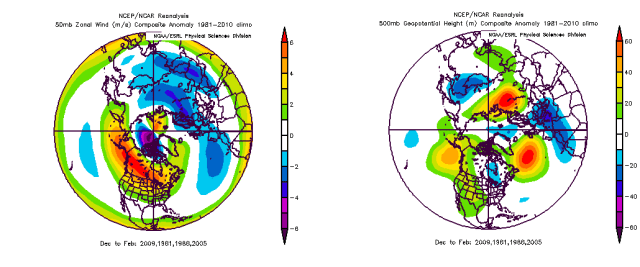
winter-forecast-16-17-weak-fall-pv-plus-qbo

On the mean, these winters actually featured a resurgent strat PV, although perhaps it was displaced a bit from the pole towards North America. The 500mb pattern featured some blockiness and probably a slightly negative AO overall, and hints of a –NAO (although not in the preferred position for the eastern US). Given the small sample size of +QBO winters that started with a weak fall PV, and only one such La Nina winter, it is tough to determine what, if anything, the weak fall PV means. On average, when including the –QBO years, it tends to lead to a weak winter PV…but the +QBO years tell a different story, and given the current +QBO years I’m worried the PV may try to re-strengthen into winter and not help the prospects at significant blocking. On the flip size, the October-November pattern over the high latitudes in those four years was considerably different than the pattern we are seeing this year; this year’s pattern will feature will above average temperatures and also heights over the Arctic (lots of blocking on the mean in October and most likely November this year), the four +QBO years that had a weak fall strat PV on the mean did NOT have above average temperatures and heights over the Arctic:
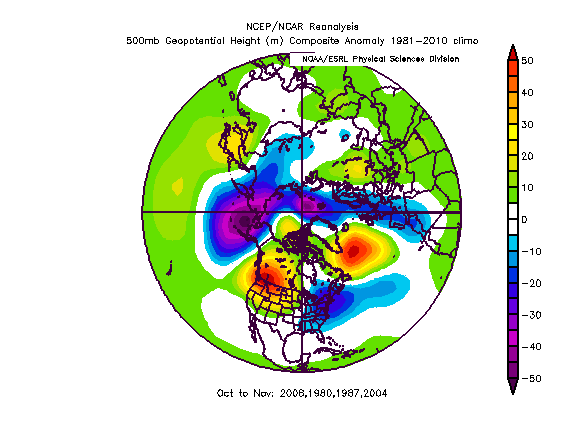
123

These years did feature a strong Aleutian low, much like this Fall, but had many differences in the high latitude pattern…meaning that the small sample size of other very weak fall stratospheric PVs, in either +QBO or La Nina years, makes it hard to get a read on the situation and hard to find good analogs.

Eurasian Snow Advance:

winter-forecast-16-17-snow-cover

Dr. Judah Cohen has become very well known for his theory that fast October snowcover advance in Eurasia, particularly south of 60N, leads to a winter weather pattern more conducive for upward momentum transfer and warming into the stratosphere and for a weak stratospheric vortex, and eventually a –AO in the winter months. The correlation for this index have taken a hit the last few winters, particularly last winter, however it should still be a high enough correlation that it’s worth examining when also examined with other factors that may influence high latitude blocking in the winter months.

winter forecast 16-17 SAI theory.png

The theory states that the more expansive snowcover allows for a stronger Siberian high, which amplifies the jet in a way that favors upward wave propagation into the stratosphere and keeps the strat PV weaker. The snow advance this October in Eurasia has been extensive, and will be one of the top snow advance Octobers since reliable records of snow cover began. In a vacuum, this does suggest a heightened potential for a weaker strat PV and a more negative AO in the troposphere this winter; there are other mixed signals as discussed above, however.

October Pattern Precursor:
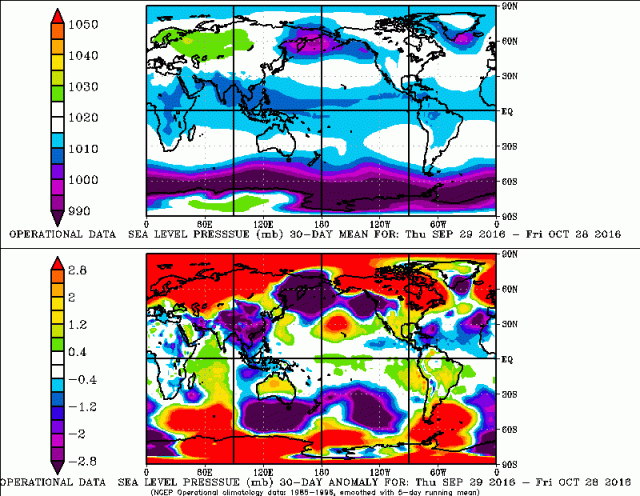
winter-forecast-16-17-oct-precursor

A relatively recent paper (http://onlinelibrary.wiley.com/doi/10.1002/joc.3968/abstract) has found that a certain October weather pattern tends to proceed –AO DJF periods; the most notable aspects were anomalously high surface pressure over Siberia/particularly near the Taymyr Peninsula, along with anomalously low SLPs south of Greenland and also south of Alaska. Right now, this October appears to be a match, especially over Russia. The paper specifically discusses a correlation between 700mb height anomalies and the inverted DJF AO between 70-80N and 90E-120E; higher heights in this box in October tend to correlate to a –DJF AO; here are those anomalies this year, through October 26:

winter-forecast-16-17-tca

The paper claims a correlation of 58% from 1958-2012, meaning that the October pattern allegedly explains 58% of the variability in the DJF AO; meaning it’s useful, but not perfect. The TCA (this) and SAI (snow cover) theories took their lumps last winter, especially the SAI, but both have a half decent correlation over time, and both appear to be strongly pointing towards a –AO this DJF; if they fail again, it would be a big hit for them.

Pattern This Fall:

winter-forecast-16-17-gefs

A very deep Aleutian low is developing currently and is expected to remain quite strong through at least mid-November. There may be some relaxation late in the month, if you believe the European weeklies (both the current version and the parallel/soon to be upgrade version), however it appears that the strong negative anomalies built up in this area through the first half of the month will not be wiped out by any weakening of the Aleutian low in late November…in addition, this implies a very warm first 15-20 days of November in much of North America, with perhaps some transient shots of colder air becoming more possible after the 20th. Regardless…an Aleutian low is more of an El Nino thing, so its presence is a bit surprising. This, combined with the ongoing rain in California (!!) suggests that La Nina forcing may not be overwhelming the pattern at this present time.

winter-forecast-16-17-oct-pattern

In addition, October featured a strong –AO, mainly due to ridging north of Russia, and November is expected to feature a decent –AO as well for much of the month. I looked through previous cold neutral ENSO or La Nina falls to find other falls that featured an anomalous Aleutian Low and/or –AO in a cold ENSO state…I removed the strong La Nina year that made it in:

winter-forecast-16-17-fall-pattern-analog

Not many cold ENSO winters had a similar pattern to what is playing out this fall…years that were closest were double weighted. The Aleutian Low on the mean does go away these winters, but the AO isn’t very negative on the mean and the cold tends to dump into the western US. Note that only a few of these years had a October-November –AO, and none of them appeared to be as negative as this year’s. Many of these years also don’t match trends noted in +QBO La Nina, +AMO La Nina, and +PDO La Nina; it will be interesting to see if the Aleutian low is replaced by an Aleutian high late those trends try to suggest.

Analogs:

Due to this winter appearing to be a fairly unique set of variables at play, I’m not sure how useful the analog method will be…however, I do use analogs to help time the possible pattern and also determine the possible magnitude of anomalies up against the research I just laid out above. I don’t think any one analog is particularly great. They are:

54-55, 83-84, 95-96, 13-14

Putting it all Together:

The tropical SSTA profile suggests tropical forcing will be most active near the Pacific Maritimes and perhaps over South America into the Atlantic, and least active over the Indian Ocean and Pacific east of the Dateline; this will support a stronger than normal jet over eastern Asia breaking over the NW Pacific, favoring ridging over the Aleutians. La Nina winters in a +QBO, although few, tend to support a more robust ridge over the Aleutians. The PDO should remain positive this winter, although not as positive as the last couple; +PDO La Ninas tend to be associated with a more extended Asian-Pacific jet (contrary to the +QBO years), with the ridging being located farther east, closer to the Gulf of Alaska, with more pronounced troughing in the Midwest and Northeast (centered in the Midwest). The AMO should remain positive, which in a La Nina tends to re-enforce the influences of the +PDO.

The Fall pattern appears to be one conducive for further blocking in the winter due to a weakened stratospheric polar vortex, however the +QBO typically leads to the opposite occurring more frequently. With that said, the current potentially record weak stratospheric PV and potential for that vortex to remain under attack, due to a strong Aleutian low in November which tends to promote upward momentum transfer into the stratosphere, does cast some doubt as to the future of the strat PV and winter AO. Another La Nina/+QBO Fall that featured a weak strat PV (08-09) saw the PV remain weak during winter, but the AO that winter was weakly positive on average. Lots of mixed signals here, although I tend to lean towards the winter AO being negative on average.

The analog years I selected suggest December being the warmest month overall, the coldest month being January, followed by a slight relaxation in February (but not as warm as December). With that said, only one analog (83-84) was reasonably close to the October pattern and expected November pattern, and had the coldest month as December. An assortment of La Nina years that I played with and ran through tended to also have January as their coldest month, but had December as the second coldest month and February as the “warmest.” With the current lack of cold across North America I’m not sure how frigid December may or may not be, and it may depend on how much improvement the Pacific sees in late December, but I will differ from my 4 “analogs” in that area.

There is a lot of uncertainty this year due to some conflicting signals, but some signals did resonate with each other, such as a signal for more robust northern Pacific ridging and perhaps a –AO winter overall; the fall pattern is unusual and the combination of factors is still unusual, so this forecast represents what I think the evidence points towards being most likely, but is not high confidence.
 

Posted in Uncategorized | Leave a comment